The Short Answer: The biggest mistakes are buying based on room size claims alone, choosing ‘HEPA-type’ over True HEPA, and forgetting that filter replacement costs matter more than purchase price. Avoid ionizers that produce ozone.
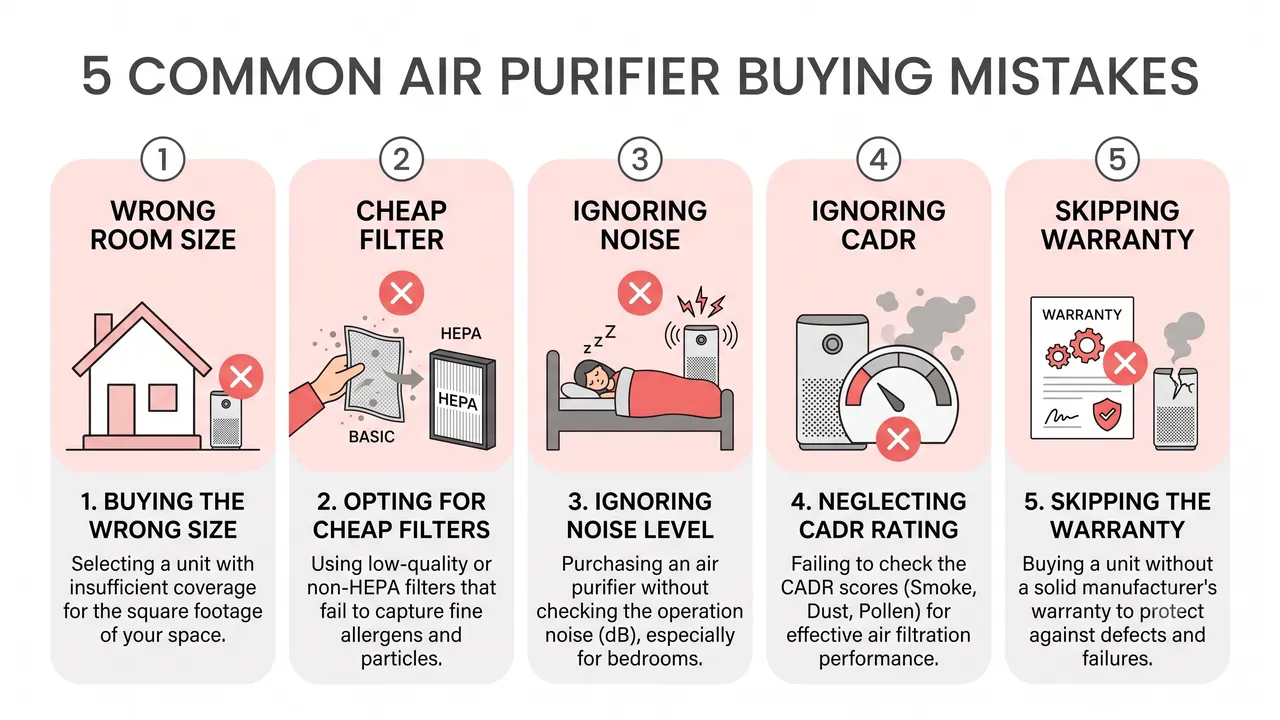
Learn From Others’ Expensive Errors
We analyzed thousands of air purifier reviews, return reasons, and buyer complaints to identify the most common and costly mistakes. The air purifier market is flooded with misleading claims, confusing specifications, and cleverly designed marketing that pushes buyers toward products that underperform. Avoiding these errors will save you money and, more importantly, ensure your purifier actually delivers cleaner air.
If you’re new to air purifiers, start with our complete guide on how to choose an air purifier to understand the fundamentals before diving into what not to do.
15 Air Purifier Buying Mistakes
Mistake #1: Buying Based on Room Size Claims
The “covers up to 1,500 square feet” claim on the box is measured at 2 ACH (air changes per hour), the bare minimum for general air quality maintenance. For allergy or asthma relief, you need 4.8 ACH. That means you should divide the manufacturer’s claimed coverage by 2.5. A purifier advertised for 1,500 sq ft actually only provides effective allergen-level coverage for about 600 sq ft.
Ignore the big number on the box. Instead, calculate from CADR (Clean Air Delivery Rate). A CADR of 200 CFM in a room with 8-foot ceilings covers roughly 270 sq ft at 5 ACH. For a deeper breakdown, see our CADR and ACH explainer.
Mistake #2: Ignoring Filter Replacement Costs
A $99 purifier with $80/year filter costs becomes a $339 purifier after three years. A $300 purifier with $50/year filter costs becomes a $450 purifier in the same period. The filter math often makes the “expensive” purifier cheaper in the long run.
Always calculate the 3-year total cost of ownership before buying. Add the purchase price to three years of filter replacements (HEPA + carbon). This is the number that actually matters, not the sticker price. We cover filter replacement strategies and third-party filter options in a dedicated guide.
Mistake #3: Buying Ionizers Thinking They’re Just As Good
Ionizers produce ozone as a byproduct, even the ones marketed as “safe” or “ozone-free.” They don’t actually remove particles from your environment; they merely charge particles so they stick to walls, furniture, and your lungs. They provide zero gas-phase filtration for odors or VOCs.
If a purifier advertises “ionizer” or “ionic” as its primary feature, skip it. True HEPA filtration captures and traps 99.97% of particles down to 0.3 microns without releasing anything harmful. For a full breakdown of air cleaning technologies and their risks, read our air purifier technology comparison.
Mistake #4: Expecting One Purifier to Cover the Whole House
Portable purifiers clean one room at a time, and only effectively when the door is closed. A purifier running in your living room does absolutely nothing for the air quality in your bedroom. Air doesn’t flow efficiently between rooms in most homes, especially with doors closed.
For whole-house coverage, you need either multiple room-sized units or a whole-house HVAC-integrated system. Don’t try to save money by buying one large unit and hoping it will cover 2,000 sq ft of open-concept living. It won’t. Check our room-by-room purifier guide for specific placement strategies.
Mistake #5: Turning It Off When You Leave the Room
Air purifiers are designed for continuous operation. Turning them off for 10 hours and then blasting them on high when you return is far less effective than running continuously on auto mode. When a purifier sits off, particles accumulate freely. When you restart it, the motor works harder to catch up, putting more wear on the unit than steady low-speed operation.
The energy cost of running a purifier continuously on low is roughly $7–20 per year. That’s less than the cost of a single replacement filter. Our guide on how long to run your air purifier covers optimal schedules in detail.
Mistake #6: Hiding It Behind Furniture
A purifier tucked behind a sofa or bookshelf recirculates the same small pocket of trapped air. The clean air output can’t mix into the rest of the room, and intake is restricted. Even purifiers with 360-degree intake need clearance on all sides, at least 12–18 inches from walls and furniture.
Placement is one of the most underrated factors in purifier performance. An ideal spot is near the center of the room or at least in an open area with good airflow. Read our room-by-room placement guide for specific recommendations.
Mistake #7: Never Replacing the Carbon Filter
HEPA filters get replaced because you can see them getting dirty. Carbon filters look identical whether they’re fresh or fully saturated, so people leave them in for years. After 3–6 months of use, a saturated carbon filter stops adsorbing odors and gases entirely, and can even release previously captured VOCs back into the air under certain temperature and humidity conditions.
If you have chemical sensitivities, cook frequently, or live near a pollution source, replace carbon filters on schedule. Our VOC and formaldehyde guide explains why gas-phase filtration matters.
Mistake #8: Buying Too Small for Your Room
This is the single most common mistake. People buy a purifier rated for 200 sq ft and place it in a 350 sq ft living room, then wonder why their allergies haven’t improved. Manufacturers rate coverage at 2 ACH, you need 4.8 ACH for meaningful allergen removal. Size up or face disappointment.
When in doubt, buy one size larger than you think you need. A slightly oversized purifier running on medium is quieter and more effective than an undersized unit screaming on high. See our best air purifiers for allergies and asthma for properly sized options.
Mistake #9: Expecting It to Replace Cleaning
Air purifiers capture airborne particles during the brief window between when they’re disturbed and when they settle back onto surfaces. They don’t clean your floors, carpets, upholstery, or furniture. Dust, pet dander, and allergens settle on surfaces within minutes. The purifier catches only what stays airborne.
You still need a HEPA vacuum, regular dusting, and washed bedding. Think of an air purifier as one layer of a multi-layered defense system, not a standalone solution. Our DIY indoor air quality guide covers the full range of strategies.
Mistake #10: Not Researching the Brand’s Filter Availability
Some manufacturers discontinue filter production for older models, leaving you with an expensive paperweight. This is especially common with white-label Amazon brands that appear, sell for 12–18 months, then vanish entirely.
Stick to brands with established filter supply chains: Coway, Levoit, Winix, Blueair, IQAir, and Austin Air have all demonstrated long-term filter support. Before buying any model, verify that replacement filters are currently in stock and check how long the model has been on the market. Our brand rankings evaluate filter ecosystem reliability.
Mistake #11: Buying Based on Amazon Star Ratings Alone
Amazon reviews are the primary research tool for most buyers, and they’re systematically misleading for air purifiers. The first 30 days of ownership are the honeymoon period, the unit looks new, sounds quiet, and the air “feels cleaner.” Five-star reviews flood in during week one. The real problems, filter loading, fan bearing noise, sensor drift, surface at months 6–18, long after the review window feels relevant.
Read the 3-star and 2-star reviews specifically. These often contain the most honest and detailed assessments. You’ll find patterns that genuine long-term owners discover: “filter light came on after 3 months instead of 6,” “developed a rattle at medium speed,” “replacement filters are always out of stock.” Also check review dates. A product with mostly reviews from 2023 and few recent ones might indicate a quality decline in newer production batches.
Mistake #12: Falling for “HEPA-Like” and “HEPA-Type” Language
Not all HEPA claims are equal. True HEPA means the filter captures 99.97% of particles at 0.3 microns, this is an industry standard, not a marketing term. But products labeled “HEPA-like,” “HEPA-type,” “HEPA-style,” or “99% HEPA” have no regulated meaning. They can capture far fewer particles and still use the word “HEPA” in their marketing.
Always look for “True HEPA” or “medical-grade HEPA” on the spec sheet. If the product page uses vague language, assume the filter doesn’t meet the standard. Our HEPA filter deep dive explains every filter grade and what each one actually captures.
Mistake #13: Ignoring Noise Levels for Bedroom Use
A purifier that runs at 55 dB on its effective speed setting will wreck your sleep. Many buyers test noise in a showroom or daytime living room and don’t realize how much louder it feels at 2 AM in a quiet bedroom. Anything above 40 dB in a sleeping environment starts to disrupt sleep quality for light sleepers.
Check the noise rating at the fan speed you’ll actually use at night, not the whisper-quiet “sleep mode” that barely moves air. The effective cleaning speed and the tolerable noise level need to overlap. Our quietest air purifiers for bedrooms guide ranks models by real-world noise at effective cleaning speeds.
Mistake #14: Skipping Air Quality Monitoring
Buying an air purifier without any way to measure air quality is like buying a diet plan without a scale. You have no baseline, no way to track improvement, and no way to know if the purifier is actually doing its job. Many mid-range and premium purifiers now include built-in air quality sensors, but standalone monitors are more accurate and give you independent verification.
An air quality monitor helps you optimize placement, determine when to run on high, and confirm that your investment is paying off. See our best air quality monitors recommendations and our guide on how to test if your air purifier is working.
Mistake #15: Overlooking the Warranty and Build Quality
A cheap purifier with a 1-year warranty is a red flag. Quality air purifiers are built to run 24/7 for years, manufacturers who offer only 12 months of coverage know their product won’t last. Look for at least a 2-year warranty, with 5 years being the gold standard for premium units.
Fan motor bearings, electronic controls, and sensor components degrade over time. Brands like Austin Air offer 5-year warranties on the motor and IQAir backs their units for up to 10 years. Budget brands that disappear after 18 months won’t honor any warranty claim. Read our air purifier warranty and longevity guide for a deep dive on what to look for.
Mistake-to-Solution Quick Reference
| # | Mistake | Key Solution | Learn More |
|---|---|---|---|
| 1 | Trusting room size claims | Calculate from CADR at 4.8 ACH | CADR Guide |
| 2 | Ignoring filter costs | Calculate 3-year total cost of ownership | Filter Guide |
| 3 | Buying ionizers | Choose True HEPA only | Technology Comparison |
| 4 | One purifier for whole house | Buy per-room units or HVAC integration | Whole-House Systems |
| 5 | Turning it off when leaving | Run continuously on auto mode | Run Time Guide |
| 6 | Hiding behind furniture | Place with 12–18” clearance on all sides | Placement Guide |
| 7 | Never replacing carbon filter | Replace every 3–6 months | VOC Guide |
| 8 | Buying too small | Size up for 4.8 ACH coverage | Allergy Picks |
| 9 | Replacing cleaning with purification | Use HEPA vacuum + purifier together | DIY Air Quality |
| 10 | Ignoring filter availability | Stick to established brands | Brand Rankings |
| 11 | Trusting Amazon star ratings | Read 2–3 star reviews for honesty | , |
| 12 | Falling for “HEPA-like” labels | Look for “True HEPA” certification | HEPA Deep Dive |
| 13 | Ignoring noise levels | Test noise at effective speed, not sleep mode | Quiet Picks |
| 14 | No air quality monitoring | Buy a standalone AQ monitor | Monitor Picks |
| 15 | Overlooking warranty | Minimum 2-year, prefer 5+ year coverage | Warranty Guide |
Red Flags in Air Purifier Marketing
The air purifier industry is notorious for misleading marketing. Watch out for these common red flags:
“Medical-grade” without certification. Any brand can slap “medical-grade” on their product. True medical-grade HEPA (H13/H14) is independently tested and verified. If the product page doesn’t mention specific filter grade testing (EN 1822 or similar), the claim is likely hollow.
“Removes 99.9% of all pollutants.” This is technically true for some particle sizes but wildly misleading for gases, VOCs, and ultrafine particles. A HEPA filter does almost nothing for gaseous pollutants, you need activated carbon for that. Ask: 99.9% of what, at what particle size, in what conditions?
Celebrity endorsements and influencer promotions. A fitness influencer or TV personality is not an air quality expert. Paid promotions almost never include performance data. If the marketing focuses on lifestyle imagery rather than CADR numbers, walk away.
“No filter replacement needed!” Every air purifier that actually works requires filter maintenance. Washable pre-filters are fine, but if the primary filtration is a washable “HEPA-type” filter, it loses effectiveness with every wash. Permanent filters are a marketing term for filters that degrade invisibly.
Proprietary filter lock-in. Some brands design filters that only they sell, at premium prices, with no third-party alternatives. Before buying, check whether compatible replacement filters exist from other manufacturers. Our third-party filter guide covers this topic in depth.
Vague CADR numbers. Some brands list a single CADR number without specifying particle type (smoke, dust, or pollen each have different CADR ratings). Others list CADR in cubic meters per hour, a larger-sounding number, instead of the standard cubic feet per minute (CFM). Always compare in the same units.
“NASA technology” or “space-grade filtration.” NASA uses HEPA filters, which have existed since the 1940s. Calling it “NASA technology” is like calling a tire “NASCAR technology.” It’s the same basic filter with a marketing spin.
How to Avoid Each Mistake
Here is a practical pre-purchase checklist that addresses every mistake on this list:
-
Calculate your actual room size and multiply by your ceiling height to get volume. Divide by your target ACH (4.8 for allergies) to get the required CFM. Compare this to the purifier’s CADR rating, not its marketing room-size claim.
-
Build a spreadsheet with purchase price + 3 years of filter costs (HEPA + carbon). Sort by total cost, not sticker price. The cheapest purifier to buy is rarely the cheapest to own.
-
Verify HEPA claims. Look for “True HEPA” or a specific grade (H13, H14). Avoid anything with “like,” “type,” or “style” after “HEPA.”
-
Check third-party reviews from sources that do independent testing, not just Amazon star ratings. Look for reviews that are 6+ months old with follow-up updates.
-
Read the 2-star and 3-star reviews on Amazon. These reveal patterns of real-world problems: noise development, filter longevity issues, sensor failures, and build quality concerns.
-
Verify replacement filter availability before you buy. Search for replacement filters on Amazon and the manufacturer’s website. Check that they’re currently in stock and have recent reviews.
-
Check noise levels at the fan speed you’ll use for sleeping or working, not just the lowest “whisper” setting. Compare dB ratings across models at similar CADR output.
-
Measure your air quality before and after purchase with a standalone monitor. This is the only way to confirm your purifier is delivering real results.
-
Read the warranty terms carefully. Look for motor coverage length, what’s excluded, and whether the manufacturer has a track record of honoring claims.
-
Avoid white-label brands that sell exclusively on Amazon with generic names. These brands frequently discontinue products and filters within 1–2 years.
FAQ
How much should I expect to spend on a good air purifier?
For a single room up to 300 sq ft, expect to spend $100–$200 for a quality unit from a reputable brand. Add $40–$80 per year for replacement filters. Premium brands like Blueair and IQAir cost more upfront but often have lower per-year filter costs and longer warranties. The sweet spot for most buyers is $150–$250 with $50–$70/year in filter costs. See our best air purifiers under $150 and budget picks under $100 for specific recommendations.
Do air purifiers actually help with allergies and asthma?
Yes, but only properly sized units with True HEPA filters running continuously. Clinical studies consistently show that HEPA air purifiers reduce airborne allergen concentrations (dust mites, pet dander, pollen, mold spores) by 50–80% in enclosed rooms. The key is running the purifier at a speed that achieves at least 4.8 air changes per hour. A purifier that’s too small, runs intermittently, or uses a “HEPA-type” filter won’t deliver meaningful results. Our allergy and asthma purifier guide has detailed recommendations.
Is it safe to run an air purifier 24/7?
Yes, air purifiers are engineered for continuous operation. In fact, turning them on and off repeatedly puts more strain on the motor than running steadily. The energy cost of continuous operation is typically $7–20 per year. Auto mode, which adjusts fan speed based on detected air quality, is the most efficient setting for round-the-clock use. The only exception is ionizer-based units, which should not run continuously due to ozone output. Read our guide on how long to run your air purifier for more detail.
Can an air purifier remove viruses and bacteria?
True HEPA filters (H13/H14) capture particles as small as 0.3 microns with 99.97% efficiency, and they’re even more effective at capturing particles both smaller and larger than that threshold. Most viruses travel on respiratory droplets (1–5 microns) or aerosols (sub-micron), both of which HEPA filters capture effectively. However, an air purifier is not a substitute for vaccination, ventilation, or hygiene practices. It’s an additional layer of protection, particularly valuable in poorly ventilated indoor spaces. Check our wildfire smoke guide, the same principles apply to airborne pathogen filtration.
Should I buy a smart air purifier with app control?
Smart has are convenient but not essential. The most important specs are CADR, noise level, and filter type, none of which require Wi-Fi. App-controlled purifiers let you monitor air quality remotely, adjust settings from another room, and track filter life automatically. However, they also add cost, introduce potential connectivity issues, and create a dependency on the manufacturer’s app staying updated. If a smart purifier and a basic model have identical CADR and filter specs, the basic model is usually the better value.
Related Articles
- How to Choose an Air Purifier: CADR and ACH Explained
- Air Purifier Myths Debunked
- Best Air Purifiers 2026: Complete Guide
- HEPA Filter Deep Dive
- Air Purifier Technology Comparison
- Best Air Purifier Brands Ranked
Disclosure: This article contains affiliate links. We may earn a commission from qualifying purchases at no additional cost to you. Our recommendations are based on independent research, testing, and analysis, not affiliate partnerships. We only recommend products we would use ourselves.
Support This Guide
Helpful? Add The Air Purifier Guide as a preferred source on Google so our guides show up in your search results.
Related Articles
Coway Mighty2 vs AP-1512HH (2026)
Coway's Mighty2 replaced the AP-1512HH as Wirecutter's top pick. We compare CADR, noise, sensors, filter costs, and whether the older unit is still the smarter buy.
KNKA APH4000 Review: $150 Dark Horse
KNKA's APH4000 is one of Amazon's best-selling purifiers at $150. We check the AHAM certification, decode the 1,695 sq ft claim, and compare it to Levoit and Coway.
Levoit Core 300 vs 300-P: What Changed
Levoit quietly replaced the Core 300 with the Core 300-P. We explain the AHAM certification, whether filters still fit, and which one you should actually buy.
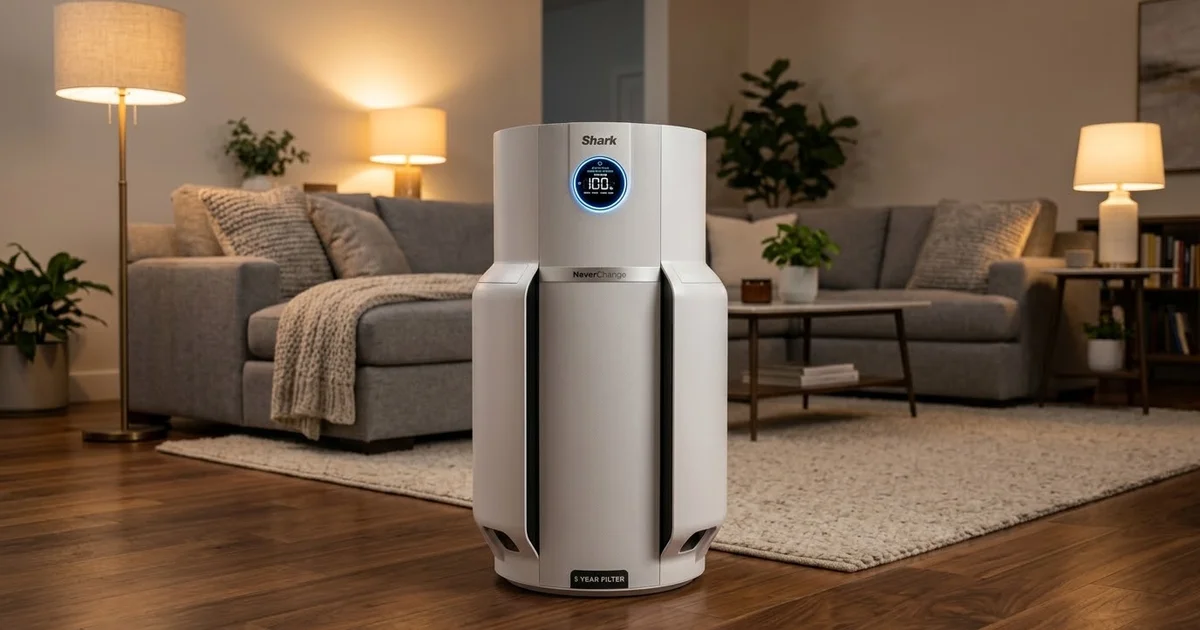
Shark NeverChange HP302 Review
Shark's NeverChange HP302 promises 5 years on one filter. We dig into the real running costs, the odor neutralizer catch, and whether it beats cheaper rivals.
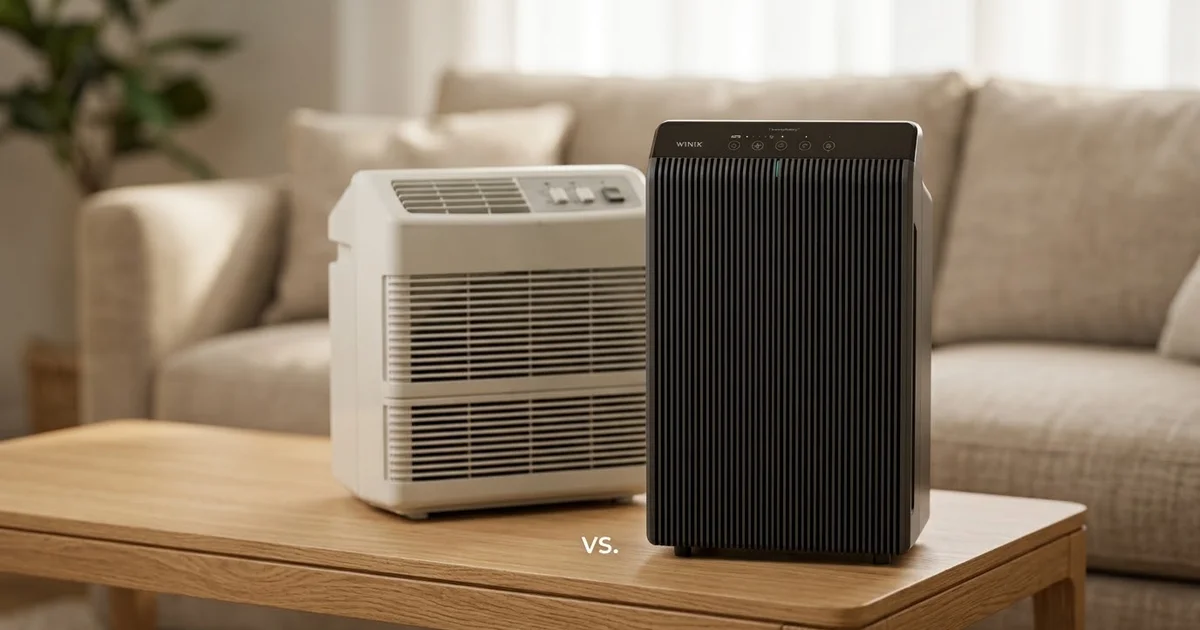
Winix 5510 vs 5500-2: 2026 Verdict
The Winix 5500-2 is discontinued and the 5510 takes over. We compare CADR, noise, filter costs, and the one compatibility problem nobody mentions.
Runs side-by-side purifier comparisons, long-term ownership reports, and filter cost analysis.
View all articles by David →