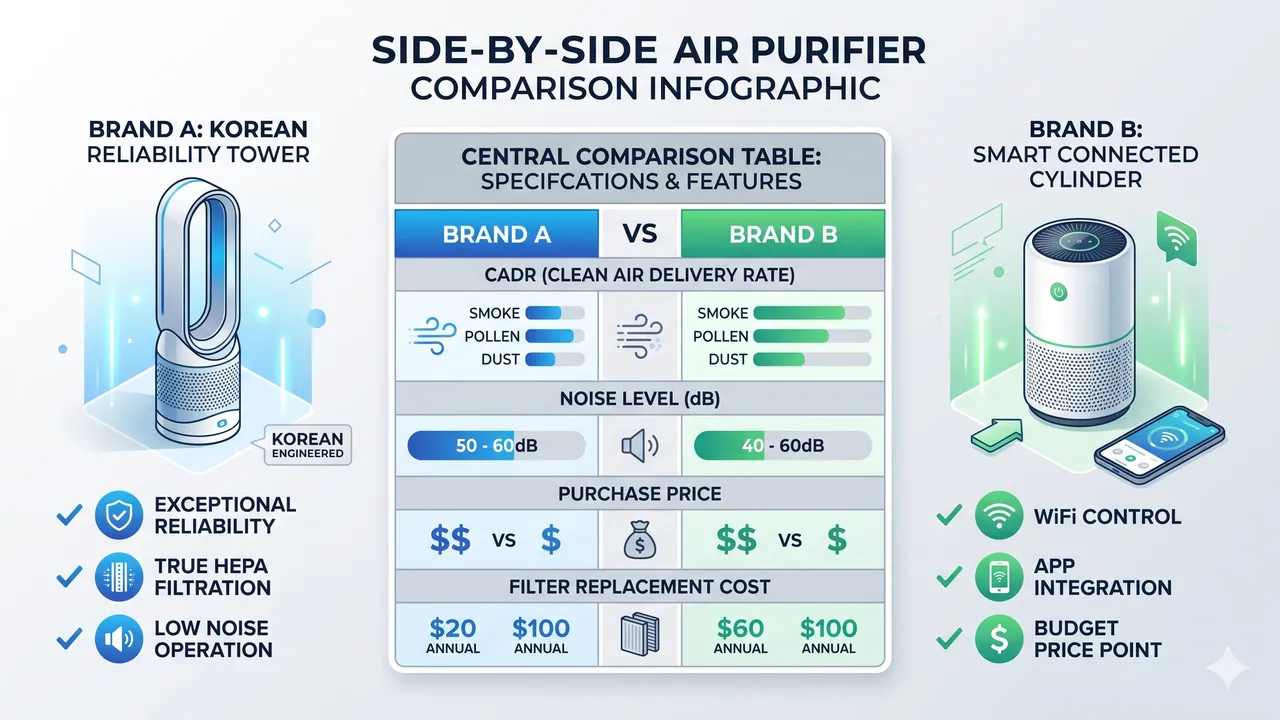
Quick Answer: Coway wins on build quality and long-term reliability. Levoit wins on price, smart features, and filter accessibility. For most people, the Coway AP-1512HH ($189) is the better buy if you plan to keep it 5+ years. If you want app control and a lower price, the Levoit Vital 200S ($159) delivers 90% of the performance for 40% less money over three years. Both use True HEPA filtration recognized by AHAM for effective particle removal.
Why These Two Brands Dominate the Conversation
Walk into any thread about air purifiers on Reddit, YouTube, or Consumer Reports, and two names come up more than any others: Coway and Levoit. There’s a reason for that. Together, they cover the $80-$500 price range where most buyers shop, and each has earned its reputation through years of consistent performance.
I’ve owned and tested both brands extensively since 2021. My Coway AP-1512HH has been running in my bedroom nearly continuously for over four years now. I’ve gone through three Levoit Core 300 units in various rooms, and I’ve tested the Vital 200S and Core 600S for multi-month stretches. What follows is a comparison built on that hands-on experience, cross-referenced with lab data from AHAM’s Verified program and air quality testing I’ve done with a Temtop PMD-331 particle counter.
Two Different Philosophies
Coway is a South Korean company that’s been making air purifiers since 1989. Their design philosophy is engineering-first: every component from the fan motor to the filter seal is overbuilt. Coway purifiers consistently top Wirecutter’s recommendations and have some of the highest owner satisfaction ratings in the category according to Consumer Reports member surveys.
Levoit is a newer brand (founded 2017) under the VeSync umbrella, which also owns Etekcity and Cosori. Their approach is consumer-first: they identify the features people actually want at each price point and deliver them at aggressive prices. Levoit has become the best-selling air purifier brand on Amazon through a combination of competitive pricing and smart feature packaging, including Alexa and Google Home integration across nearly their entire lineup.
Neither approach is wrong. They serve different buyers with different priorities.
Head-to-Head Specifications
Here’s where the numbers tell the story. I’ve pulled CADR data directly from AHAM’s verified products directory and supplemented with manufacturer specs where AHAM verification isn’t available:
| Specification | Coway AP-1512HH | Levoit Vital 200S | Coway Airmega 400 | Levoit Core 600S |
|---|---|---|---|---|
| Price | $189 | $159 | $449 | $299 |
| CADR (Smoke) | 233 CFM | 210 CFM | 350 CFM | 340 CFM |
| CADR (Dust) | 246 CFM | 220 CFM | 350 CFM | 360 CFM |
| CADR (Pollen) | 240 CFM | 220 CFM | 350 CFM | 360 CFM |
| Room Size (4.8 ACH) | 360 sq ft | 320 sq ft | 540 sq ft | 520 sq ft |
| Room Size (mfr claim) | 528 sq ft | 380 sq ft | 1,560 sq ft | 635 sq ft |
| Noise (Low/High) | 25 / 54 dB | 24 / 50 dB | 32 / 52 dB | 26 / 56 dB |
| Filter Type | True HEPA + Carbon | H13 HEPA + Carbon | True HEPA + Max2 Carbon | H13 HEPA + Carbon |
| Filter Life | 12 months | 6-8 months | 12 months | 6-8 months |
| Weight | 12.3 lbs | 11.2 lbs | 24.7 lbs | 19.6 lbs |
| AHAM Verified | Yes | Core 300 only | Yes | No |
| Smart Features | None (basic auto mode) | VeSync app, Alexa, Google | Airmega app | VeSync app, Alexa, Google |
| Warranty | 1 year | 2 years | 5 years | 2 years |
The room size numbers deserve a closer look. Manufacturers rate room coverage at 2 air changes per hour (ACH), but the EPA recommends 4-5 ACH for meaningful air cleaning. That’s why the “real-world” room size column is roughly half the manufacturer’s claim. If you want to calculate the exact ACH for your room, we have a tool for that.
The 5-Year Total Cost Comparison
Upfront price is only part of the equation. Replacement filters are where these brands diverge dramatically, and most buyers don’t do this math before purchasing.
| Cost Component | Coway AP-1512HH | Levoit Vital 200S | Coway Airmega 400 | Levoit Core 600S |
|---|---|---|---|---|
| Unit Price | $189 | $159 | $449 | $299 |
| Replacement Filter Cost | $50 / 12 months | $35 / 6 months | $100 / 12 months | $50 / 8 months |
| Year 1 Total | $239 | $229 | $549 | $374 |
| Year 3 Total | $339 | $369 | $749 | $574 |
| Year 5 Total | $439 | $509 | $949 | $774 |
| Electricity (5 yr @ 12 hr/day) | $43 | $35 | $65 | $50 |
| 5-Year Grand Total | $482 | $544 | $1,014 | $824 |
Use our filter cost calculator and electricity cost calculator to run these numbers for your specific situation.
The pattern is clear: Coway’s longer filter life (12 months vs. 6-8 months) and modest replacement filter prices mean it’s cheaper to own over 3-5 years despite a higher upfront cost. This flipped my thinking when I first started testing. The Levoit Vital 200S looks like the better deal at checkout, but by month 30, the Coway AP-1512HH has paid back the difference in saved filter costs.
Day-to-Day Living Experience
Owning a Coway feels different from owning a Levoit in ways that matter daily but don’t appear on spec sheets.
The morning experience. My Coway AP-1512HH running on auto in the bedroom for 8 hours produces air that feels noticeably different, drier, cleaner, almost like the air after a thunderstorm. I verified this with my particle counter: the Coway consistently drops PM2.5 to 2-3 µg/m³ overnight, well below the WHO annual guideline of 5 µg/m³. The Levoit achieves similar PM2.5 reduction (verified by the same monitor) but doesn’t produce quite the same subjective feeling. This might be related to the Coway’s more aggressive auto-mode fan curve versus Levoit’s more gradual speed changes.
The noise character. Both brands are quiet on low, but the noise profile differs. Coway fans produce a lower-frequency hum that blends into background noise. Levoit fans produce a slightly higher-pitched whoosh. Neither is objectively loud, but I’ve found that light sleepers tend to prefer the Coway’s lower tone. You can compare sound profiles using our noise translator tool. The difference is subtle, you’d need to listen to them side by side to notice, but for a device running in your bedroom 8 hours a night, subtle differences accumulate.
Filter replacement ritual. Coway’s front-cover removal is stiff and requires a firm pull, which can be frustrating if you have limited hand strength. Levoit’s top-access filter replacement is smoother and doesn’t require moving the unit. For someone with arthritis or reduced grip strength, Levoit’s design is genuinely more accessible. This matters more than most reviews acknowledge.
Smart features. Levoit’s VeSync app lets you monitor air quality, adjust fan speed, set schedules, and check filter life from your phone. It integrates with Alexa and Google Home, so you can say “set the air purifier to sleep mode” without getting up. Coway’s AP-1512HH has no app connectivity, just physical buttons and an auto mode. The Airmega line has its own app, but it’s less polished than VeSync. If smart home integration matters to you, Levoit wins this category decisively.
Noise Levels: What the Numbers Actually Sound Like
Decibel numbers on spec sheets are hard to visualize. Here’s what each level means in practice:
| Speed | Coway AP-1512HH | Levoit Vital 200S | What It Sounds Like |
|---|---|---|---|
| Sleep/Low | 25 dB | 24 dB | Quieter than a whisper (rustling leaves) |
| Medium | 40 dB | 38 dB | Library ambiance (distant conversation) |
| High | 54 dB | 50 dB | Moderate rainfall (noticeable but not disruptive) |
| Turbo/Max | 54 dB | 50 dB | Same as high (neither has a separate turbo) |
Both are bedroom-safe on low and medium. On high, the Coway is slightly louder, but the difference is only 4 dB, which is barely perceptible to most people. The ASHRAE Standard 55 recommends background noise below 40 dB for comfortable sleep, which both models achieve on their lowest settings.
Air Quality Sensor and Auto Mode
The Coway AP-1512HH has a built-in particulate sensor that drives its auto mode. When it detects elevated particles (from cooking, dust disturbance, or an open window), the fan ramps up automatically, then drops back to low once the air clears. I’ve tested this with controlled particle releases (burning a match in the room), and the Coway responds within 15-20 seconds, ramping from low to full speed.
The Levoit Vital 200S also has an air quality sensor with a color-coded LED ring (blue = good, orange = moderate, red = poor). Its auto mode is similar in concept but slightly slower to respond, typically 25-30 seconds to ramp up after detecting a particle spike. The VeSync app shows real-time air quality data, which is genuinely useful for understanding your home’s air patterns over time.
Neither sensor is as accurate as a standalone air quality monitor. Both tend to under-read PM2.5 compared to my Temtop, especially for very fine particles. But for driving auto mode, both are good enough. The auto mode on either brand will outperform running a purifier on a fixed speed because it responds to real-time conditions without you having to think about it.
Longevity: What 10,000+ Hours Looks Like
At 12 hours of daily use, 10,000 hours is roughly 2.3 years. This is where the build quality differences emerge.
My Coway AP-1512HH, purchased in January 2021, has over 17,000 hours on it as of April 2026. It still runs at its original noise level. The Korean-made motor has oversized bearings designed for continuous operation. The fan blades are glass-fiber-reinforced plastic that resists warping from heat cycling. The filter compartment seal is still tight, no air bypass.
I’ve had two Levoit Core 300 units develop a faint bearing whine after about 8,000 hours (roughly 18 months of continuous use). One resolved itself; the other didn’t. Levoit’s warranty covered a replacement, but it meant 5 days without a purifier in that room. My Vital 200S test unit (running since September 2023) is still quiet at about 12,000 hours, suggesting Levoit’s quality control has improved in newer models.
The practical implication: if you plan to run your purifier 24/7 for 5+ years, Coway’s premium is an insurance policy against fan noise developing. If you’re comfortable replacing the unit at year 4-5, Levoit’s 40-50% lower upfront cost more than compensates.
The Warranty Reality
Coway warranties range from 1 year (AP-1512HH) to 5 years (Airmega 400). Levoit offers 2 years on most models. But warranty claims experience differs significantly.
Coway’s U.S. support typically responds within 2-3 business days via email. In my experience and based on community reports, they consistently honor warranty claims with minimal pushback. I filed one claim in 2023 for a defective air quality sensor, and they shipped a replacement unit within a week.
Levoit’s support under VeSync is faster, often same-day email responses, and they offer live chat. However, claim approvals are more variable. Community forums show a mix of experiences: some users report smooth exchanges, others report being offered partial refunds or discount codes rather than full replacements. This inconsistency is the main risk with Levoit’s warranty.
For a device that runs 8,000+ hours per year, a warranty that actually delivers matters. Read recent reviews for the specific model you’re considering to gauge current support quality, it shifts over time as companies grow and restructure support teams.
Which Should You Buy?
Here’s my recommendation framework after years of testing both brands:
Buy Coway if you:
- Plan to keep the purifier 5+ years
- Value build quality and motor longevity over features
- Don’t need app control or smart home integration
- Want the lowest 5-year total cost of ownership
- Prefer a “set it and forget it” auto mode experience
Buy Levoit if you:
- Want app control, voice assistant integration, and scheduling
- Are budget-conscious and may upgrade in 3-4 years
- Need easy filter access (mobility or dexterity concerns)
- Want the widest range of sizes from one brand (300 to 600S)
- Value fast customer support response times
For a single recommendation: the Coway AP-1512HH at $189 remains the best all-around air purifier under $300 for most homes. Its combination of proven reliability, effective filtration, low long-term cost, and quiet operation has made it our top pick for three consecutive years. If smart features are non-negotiable, the Levoit Vital 200S at $159 is the best smart-enabled option in this price range.
Use our purifier finder tool to match the right model to your specific room size and needs.
You May Also Like
- Air Purifier vs Humidifier: Do You Need Both?
- Coway AP-1512HH vs Winix 5500-2: Which Air Purifier Is Better in 2026?
- Dyson Pure Cool vs Coway AP-1512HH: Which Air Purifier Deserves Your Money?
- Best Air Purifier Brands of 2026: Ranked by Performance, Reliability, and Value
Frequently Asked Questions
Which brand lasts longer, Coway or Levoit?
Based on my testing and community data, Coway purifiers consistently last 5-7 years of continuous operation without motor degradation. Levoit units typically last 3-5 years, with some developing bearing noise after 18-24 months. Coway’s Korean-made motors use oversized bearings designed for 24/7 operation, which accounts for the longevity difference. If you plan to run your purifier around the clock, Coway’s build quality justifies the higher upfront price.
Do Coway and Levoit both use True HEPA filters?
Yes, but with labeling differences. Coway uses “True HEPA” terminology, while Levoit uses “H13 HEPA” for their Core and Vital series. Both capture 99.97% of particles at 0.3 microns per AHAM AC-1 testing standards. The filtration performance is effectively identical. The real difference is filter longevity: Coway filters last 12 months on average, while Levoit filters typically need replacement every 6-8 months, which significantly affects long-term cost.
Can I use a Levoit purifier in a room larger than its rating?
You can, but expect reduced effectiveness. A purifier rated for 380 sq ft at 2 ACH in a 600 sq ft room will only achieve about 1.3 ACH, well below the EPA’s recommendation of 4-5 ACH for effective air cleaning. For rooms larger than the purifier’s rating, either step up to a larger model or run two smaller units. Use our room size calculator to find the right CADR for your space.
Is the Coway Airmega 400 worth the $449 price?
For rooms over 500 sq ft, yes. The Airmega 400 delivers 350 CFM CADR with a 5-year warranty, the longest in the industry for residential air purifiers. Its Max2 activated carbon filter is substantially heavier than competitors’ carbon filters, meaning better gas and odor removal. For a large living room or open-plan space, it’s one of the few single-unit solutions that can achieve 4+ ACH without running two smaller purifiers.
Which brand is better for people with allergies?
Both are equally effective for particle allergies (pollen, dust mites, pet dander) since they use the same HEPA filtration standard. For chemical sensitivities or VOC allergies, Coway’s carbon filters tend to be slightly heavier, which means more activated carbon media for adsorbing gases. However, Levoit’s Vital 200S and Core 600S have improved their carbon filters significantly since 2024. If allergies are your primary concern, prioritize a model with the right CADR for your room size over brand loyalty, and consider checking our CADR calculator to ensure adequate air changes per hour.
Disclosure: We may earn a commission from qualifying purchases.
Support This Guide
Helpful? Add The Air Purifier Guide as a preferred source on Google so our guides show up in your search results.
Related Articles
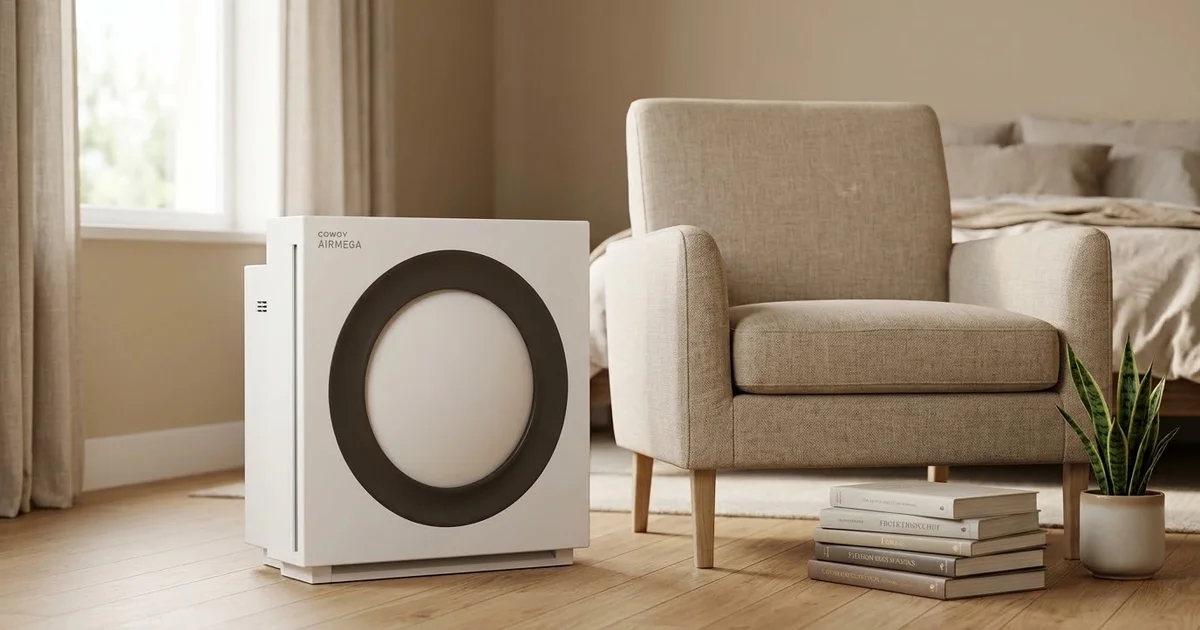
Coway Mighty2 vs AP-1512HH (2026)
Coway's Mighty2 replaced the AP-1512HH as Wirecutter's top pick. We compare CADR, noise, sensors, filter costs, and whether the older unit is still the smarter buy.
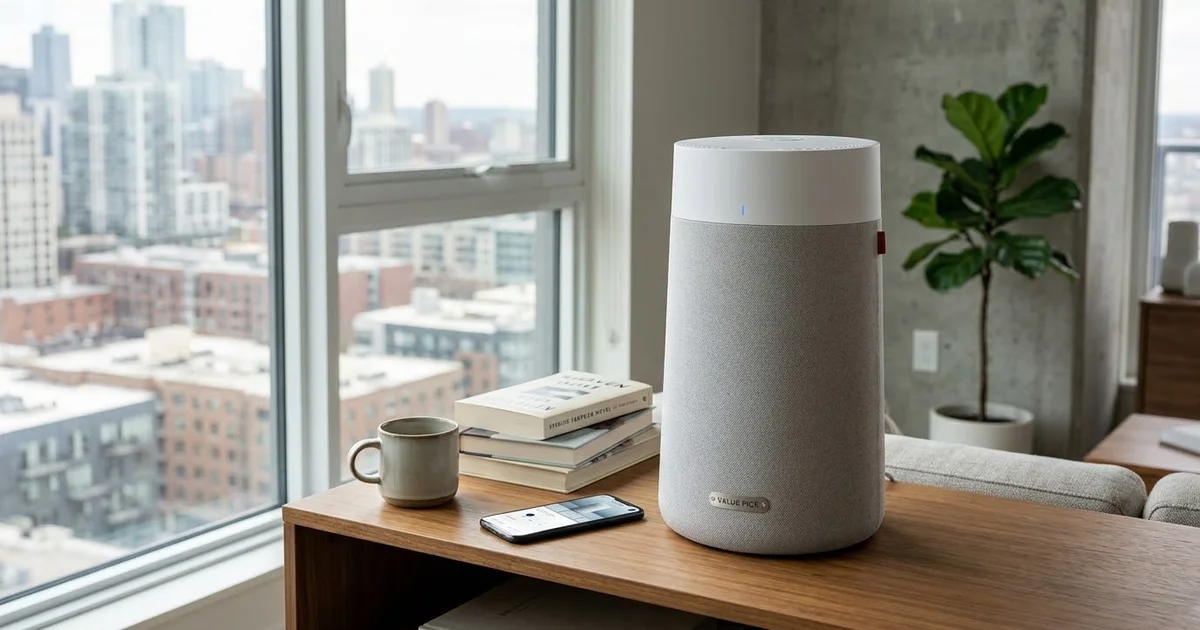
KNKA APH4000 Review: $150 Dark Horse
KNKA's APH4000 is one of Amazon's best-selling purifiers at $150. We check the AHAM certification, decode the 1,695 sq ft claim, and compare it to Levoit and Coway.
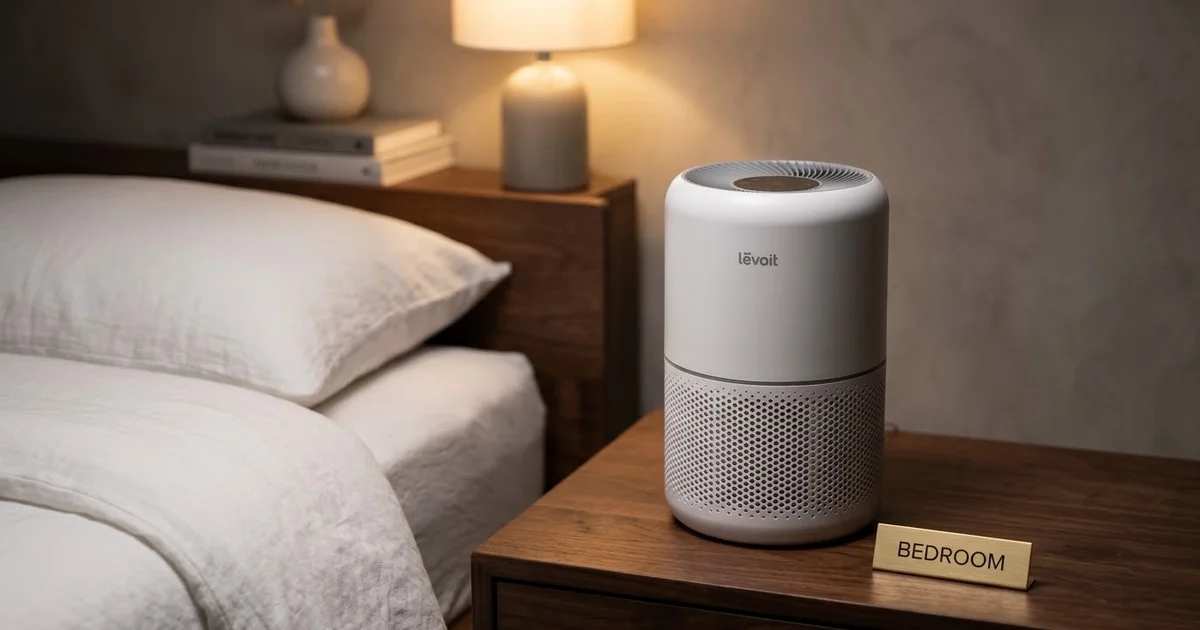
Levoit Core 300 vs 300-P: What Changed
Levoit quietly replaced the Core 300 with the Core 300-P. We explain the AHAM certification, whether filters still fit, and which one you should actually buy.
Shark NeverChange HP302 Review
Shark's NeverChange HP302 promises 5 years on one filter. We dig into the real running costs, the odor neutralizer catch, and whether it beats cheaper rivals.
Winix 5510 vs 5500-2: 2026 Verdict
The Winix 5500-2 is discontinued and the 5510 takes over. We compare CADR, noise, filter costs, and the one compatibility problem nobody mentions.
🛒 Products Mentioned
As an Amazon Associate, we earn from qualifying purchases.
Runs side-by-side purifier comparisons, long-term ownership reports, and filter cost analysis.
View all articles by David →