The Short Answer: Running costs are primarily filter replacements ($30-120/year) and electricity ($2-8/month). The cheapest long-term options have washable pre-filters and affordable replacement filters. Energy Star models save 15-40% on electricity.
Editor’s note (September 2026): The Winix 5500-2 has been discontinued and remaining stock is limited. Winix’s official successor is the Winix 5510, which adds app control and uses a new filter. Read our Winix 5510 vs 5500-2 comparison before you buy either one.
One of the most common questions we hear from readers considering their first air purifier is: “How much will it cost to run this thing all day?” The concern is understandable. Running any appliance 24 hours a day, 7 days a week sounds like it should send your electricity bill through the roof. But air purifiers are not space heaters, and they are not air conditioners. The actual cost to run one continuously is far lower than most people expect, often less than a single cup of coffee per month.
In this guide, we will break down exactly how much electricity air purifiers consume, provide a detailed cost comparison of the most popular models, show you how to calculate your own costs, and share practical tips to keep your energy bill as low as possible while still breathing clean air.
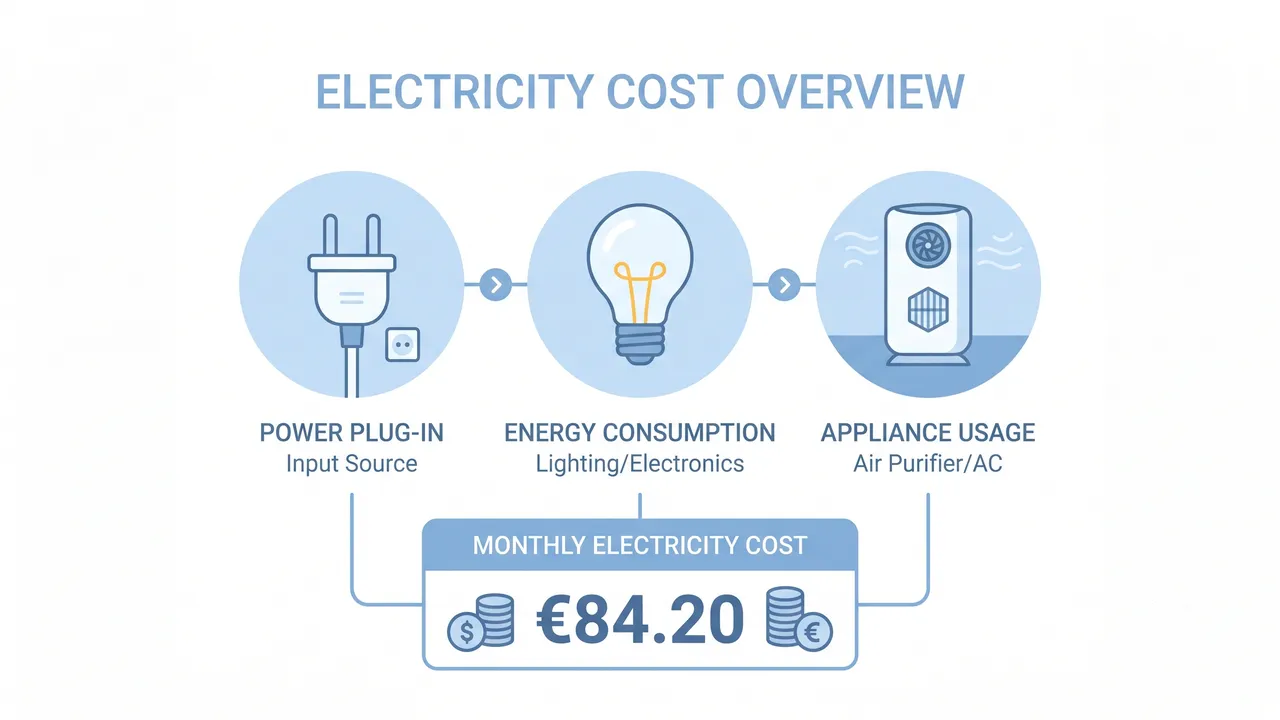
How Air Purifier Energy Consumption Works
Air purifiers are fundamentally simple machines. At their core, they consist of a fan motor pushing air through a filter (or set of filters). The fan is the primary energy consumer. Unlike a space heater that converts electricity directly into heat at 1,000–1,500 watts, or a window air conditioner that runs a compressor at 500–1,500 watts, an air purifier fan typically draws between 4 and 82 watts depending on the model and fan speed setting.
To put those numbers in context, here is how an air purifier compares to common household appliances:
| Appliance | Typical Wattage |
|---|---|
| Night light | 1–5 W |
| Air purifier (low speed) | 4–10 W |
| Phone charger | 5–15 W |
| Laptop computer | 50–100 W |
| Air purifier (high speed) | 30–82 W |
| Ceiling fan | 60–75 W |
| Refrigerator | 100–250 W |
| Window air conditioner | 500–1,500 W |
| Space heater | 1,000–1,500 W |
As you can see, even at its highest speed setting, a typical air purifier uses roughly the same electricity as a ceiling fan. At low speed, which is where most purifiers spend the majority of their time in auto mode, the consumption drops to the level of a phone charger.
How to Calculate Your Air Purifier’s Electricity Cost
If you want to run the numbers yourself, the formula is straightforward:
Annual Cost = (Watts ÷ 1,000) × Hours Per Day × Days Per Year × Electricity Rate ($/kWh)
For a purifier running 24/7, that simplifies to:
Annual Cost = (Watts ÷ 1,000) × 8,760 × Your Electricity Rate
For example, a Coway AP-1512HH running on medium speed (12 watts) at the U.S. average rate of $0.17/kWh:
12 ÷ 1,000 × 8,760 × $0.17 = $17.87 per year
That works out to roughly $1.49 per month, less than a single gas station coffee.
Finding Your Electricity Rate
The U.S. national average residential electricity rate as of January 2026 is $0.17 per kilowatt-hour (kWh) according to the Energy Information Administration (EIA). However, rates vary significantly by state:
- Lowest rates: Idaho ($0.10/kWh), Utah ($0.11/kWh), Wyoming ($0.11/kWh)
- Highest rates: Hawaii ($0.44/kWh), Connecticut ($0.28/kWh), Massachusetts ($0.27/kWh), California ($0.27/kWh)
Check your utility bill or your state’s public utilities commission website to find your exact rate. If you live in Hawaii, your costs will be roughly 2.5× the national average figures we use below. If you live in Idaho, they will be about 40% lower.
Energy Cost by Popular Model: The Complete Breakdown
We calculated the annual electricity cost for 10 of the best-selling air purifiers on the market, at each speed setting, running 24 hours a day, 365 days a year at $0.17/kWh. All models listed are ENERGY STAR certified.
| Model | Low (W) | Medium (W) | High (W) | Annual Cost (Low) | Annual Cost (Medium) | Annual Cost (High) |
|---|---|---|---|---|---|---|
| Coway AP-1512HH | 5 | 12 | 45 | $7.43 | $17.87 | $66.80 |
| Winix 5500-2 | 6 | 13 | 52 | $8.91 | $19.30 | $77.22 |
| Levoit Core 300 | 4 | 11 | 34 | $5.94 | $16.34 | $50.50 |
| Blueair Blue Pure 211i Max | 4 | 12 | 52 | $5.94 | $17.87 | $77.22 |
| Levoit Core 600S | 5 | 13 | 55 | $7.43 | $19.30 | $81.68 |
| Coway Airmega 400 | 6 | 15 | 64 | $8.91 | $22.27 | $95.04 |
| IQAir HealthPro Plus | 6 | 20 | 82 | $8.91 | $29.70 | $121.78 |
| Levoit Vital 200S | 5 | 12 | 47 | $7.43 | $17.87 | $69.80 |
| Coway Airmega 250 | 5 | 13 | 54 | $7.43 | $19.30 | $80.20 |
| Honeywell HPA300 | 6 | 14 | 58 | $8.91 | $20.80 | $86.14 |
The key takeaway: every single model costs under $20 per year at medium speed. Even the most powerful purifier on this list, the IQAir HealthPro Plus at 82 watts on high, costs just $121.78 per year running at full blast around the clock. At the low and medium speeds most people actually use, the cost drops to $6–$20 annually.
For more details on these specific models, see our complete best air purifiers 2026 guide and our budget air purifier picks under $100.
Real-World Usage: What People Actually Spend
The table above assumes 24/7 operation at a single speed, but that is not how most people use their air purifier. A more realistic usage pattern looks like this:
- Auto mode during the day: The purifier’s built-in air quality sensor adjusts the fan speed automatically. When the air is clean, the fan drops to its lowest setting (4–8 watts). When particles are detected, it ramps up briefly (20–40 watts), then returns to low. Average draw: 8–15 watts.
- Low or sleep mode at night: Many people switch to a quiet low-speed setting for sleeping, which consumes 4–12 watts.
- High speed bursts: During cooking, cleaning, vacuuming, or when outdoor air quality drops (check our guide on how to read AQI), you might run high speed for 1–3 hours.
Under this typical pattern, a mid-size purifier uses roughly 10–15 watts on average throughout the day. That translates to:
- $14.87–$22.30 per year at the national average rate
- $1.24–$1.86 per month
Compare that to the filter replacement cost of $50–80 per year (see our filter replacement guide). The electricity cost is 3–5 times cheaper than the filters. You will spend far more money replacing filters than powering the machine.
Energy Star Certified Purifiers
ENERGY STAR certification for air purifiers means the unit meets a minimum efficiency standard, specifically, a minimum Clean Air Delivery Rate (CADR) per watt ratio. This guarantees you are getting a meaningful amount of clean air for each unit of electricity consumed.
All ten models in our comparison table above carry ENERGY STAR certification. When shopping for a new purifier, look for the ENERGY STAR label on the product listing or the manufacturer’s specifications page. Our CADR and ACH buying guide explains how to evaluate efficiency beyond just the ENERGY STAR label.
As of 2026, ENERGY STAR certified air purifiers must deliver at least:
- 2.0 CADR/watt for units with particle-based sensors
- 2.0 CADR/watt for units without sensors
In practice, most quality purifiers exceed this threshold comfortably. The Coway AP-1512HH, for example, delivers a CADR of 246 for dust at 45 watts on high, that is 5.47 CADR/watt, nearly three times the ENERGY STAR minimum.
The ENERGY STAR label is not just about your electricity bill. More efficient purifiers also tend to run quieter at equivalent cleaning performance, because they can move more air with less fan effort.
Energy-Saving Tips for Air Purifier Owners
Running an air purifier 24/7 is the recommended approach for maintaining consistently clean indoor air, but there are several ways to minimize the electricity cost without sacrificing air quality:
1. Use Auto Mode
This is the single most impactful tip. If your purifier has a built-in air quality sensor and an auto mode, use it. The purifier will ramp the fan up only when particles are detected and drop to a whisper-quiet, low-watt idle when the air is clean. Most people find that auto mode runs at the lowest speed 70–80% of the time, which can save $15–25 per year compared to running on manual high speed.
2. Size Your Purifier Correctly
An undersized purifier forced to work at maximum capacity 24/7 in a room that is too large will consume significantly more energy than a properly sized unit running on medium. Check our room-by-room air purifier guide to match your purifier to your space. A good rule of thumb: the purifier’s CADR should be sufficient to achieve at least 4–5 air changes per hour (ACH) in your room.
3. Clean the Pre-Filter Regularly
A clogged pre-filter restricts airflow, forcing the fan motor to work harder to push the same volume of air through the filters. This increases both energy consumption and noise. Most pre-filters should be vacuumed or washed every 2–4 weeks. Our pre-filter cleaning guide walks you through the process step by step.
4. Close Windows and Doors
Running an air purifier with the windows open is like trying to fill a bathtub with the drain unplugged. The purifier has to work continuously against a constant influx of outdoor particles, pollen, pollution, dust, which keeps the fan at higher speeds and drives up electricity use. Close the room when the purifier is running for maximum efficiency.
5. Place the Purifier for Optimal Airflow
Position your purifier at least 12–18 inches away from walls, curtains, and furniture. Blocked intake or exhaust vents make the fan work harder. See our air purifier placement guide for specific recommendations on positioning.
6. Turn It Off When You Are Away (Sometimes)
If you will be out of the house for more than 24 hours and the indoor air quality is good, there is no harm in turning the purifier off. However, for shorter absences, leaving it on auto mode is usually better, it will drop to low speed and maintain clean air so you come home to a healthy environment. For extended vacations, see our leaving your air purifier on vacation guide.
Smart Plugs and Scheduling: Automate Your Savings
One of the most effective ways to manage air purifier energy use is through smart plugs and scheduling. Most air purifiers draw 2–5 watts even when turned “off” but still plugged in (standby or “vampire” draw, particularly for WiFi-enabled models). A smart plug can eliminate this standby draw entirely and enable more sophisticated scheduling.
Smart Plug Setup
A basic smart plug costs $10–15 and lets you:
- Schedule on/off times: Run the purifier at low speed during sleeping hours, auto mode during evening hours, and turn it off entirely during work hours when the house is empty
- Monitor energy consumption: Many smart plugs include energy monitoring features that track actual wattage in real time, so you can see exactly how much your purifier is costing you
- Control remotely: Turn the purifier on before you arrive home using your phone
- Integrate with smart home systems: Link to Alexa, Google Home, or Apple HomeKit for voice control and automation
Sample Schedule for Maximum Savings
Here is a scheduling pattern that balances clean air with minimal energy use:
| Time | Setting | Why |
|---|---|---|
| 6:00 AM – 8:00 AM | Auto mode | Morning activity, cooking, getting ready |
| 8:00 AM – 5:00 PM | Off (or low) | House empty during work hours |
| 5:00 PM – 10:00 PM | Auto mode | Evening activity, cooking, cleaning |
| 10:00 PM – 6:00 AM | Low / Sleep mode | Quiet, low-energy overnight operation |
This schedule reduces total runtime by 8–9 hours per day compared to 24/7 operation, potentially saving 30–40% on electricity costs. However, if anyone in your household has allergies or respiratory conditions like asthma or COPD, we recommend keeping the purifier running continuously on auto mode for consistent air quality.
Recommended Smart Plugs
- Kasa Smart Plug EP25: Reliable, energy monitoring, works with Alexa and Google
- Meross Smart Plug Mini: Budget option, compact design, HomeKit compatible
- TP-Link Tapo P125M: Matter-compatible for future-proof smart home integration
Important: Make sure your air purifier turns back on automatically after a power interruption if you are using a smart plug. Some purifiers default to “off” after losing power, which means a brief outage would leave your purifier off until you manually restart it. Models from Coway, Levoit, and Winix generally resume their previous state after power is restored.
The Standby Power Drain Most People Overlook
ENERGY STAR ratings cover active power consumption, but the standby draw, when the purifier is plugged in but “off”, deserves attention. WiFi-enabled models typically draw 2–5 watts in standby mode to maintain their network connection. At the national average rate:
- 2 watts standby = $2.97/year
- 5 watts standby = $7.43/year
This is trivial for a single unit, but if you run two or three purifiers throughout your home (as many families do), the combined standby cost can reach $15–22 per year. A smart plug that physically cuts power when the purifier is “off” eliminates this entirely.
Frequently Asked Questions
Does an air purifier use a lot of electricity?
No. Most air purifiers use between 4 and 60 watts, which is comparable to a light bulb or a laptop computer. Running a typical air purifier 24/7 for an entire year costs approximately $10–20 in electricity, less than $2 per month. The filter replacements cost 3–5 times more than the electricity.
Is it cheaper to run an air purifier on low speed all the time or on auto mode?
Auto mode is typically cheaper and more effective. On auto mode, the purifier runs at its lowest speed when the air is clean and only ramps up when particles are detected. Since most indoor air is clean most of the time, auto mode averages much lower power consumption than a fixed medium or high speed setting. It also extends filter life because the fan is not running at full speed unnecessarily.
How much does it cost to run an air purifier 24/7 in California?
California’s average residential electricity rate is approximately $0.27/kWh, about 59% higher than the national average. For a purifier running on medium speed at 12 watts, the annual cost would be about $28.38 ($2.37/month) instead of the national average of $17.87 ($1.49/month). Still very affordable for the health benefits provided.
Do air purifiers use more electricity than fans?
A standard ceiling fan uses 60–75 watts on medium speed. Most air purifiers on low or medium speed use 4–15 watts. So air purifiers generally use less electricity than ceiling fans. However, a large room air purifier running on its highest speed (50–80 watts) may approach the consumption of a ceiling fan.
Should I turn off my air purifier at night to save electricity?
We do not recommend it. Nighttime is when many people benefit most from an air purifier, bedroom air quality directly affects sleep quality. Instead, switch to sleep mode or the lowest speed setting, which uses just 4–8 watts (roughly $6–12 per year). This keeps the air clean while you sleep at minimal cost. See our guide on how long to run your air purifier for more detail.
Comparing Energy Costs to Other Air Quality Solutions
Air purifiers are not the only way to improve indoor air quality. Here is how the energy costs compare:
| Solution | Typical Wattage | Annual Cost (24/7) |
|---|---|---|
| Air purifier (medium speed) | 10–15 W | $14.87–$22.30 |
| Whole-house HVAC filtration | 200–400 W (fan) | $297–$594 |
| Portable HEPA unit + window fan | 50–80 W | $74.22–$118.75 |
| Opening windows (no energy cost) | 0 W | $0* |
*Opening windows is free in terms of electricity, but introduces outdoor pollutants including pollen, traffic pollution, and wildfire smoke. In many areas and seasons, outdoor air quality is worse than indoor air quality. See our air purifier vs. opening windows comparison for a detailed analysis.
For most households, a standalone portable HEPA air purifier running on auto mode offers the best balance of clean air performance and energy efficiency. Whole-house systems can be effective but consume significantly more energy and cost far more to install.
The Bottom Line: Air Purifiers Are Remarkably Cheap to Run
If you have been hesitating to buy or run an air purifier because of electricity costs, let us put your mind at ease:
- $10–20 per year for most models at realistic usage levels
- $1–2 per month, less than a single cup of coffee
- 3–5× cheaper than filter replacements
- ENERGY STAR certified models guarantee efficient operation
- Auto mode saves even more by adjusting speed to actual air quality
An air purifier is one of the most cost-effective health appliances you can own. The electricity cost is negligible. The filter costs are modest. And the health benefits, reduced allergens, fewer respiratory symptoms, better sleep, protection from wildfire smoke and VOCs, far outweigh the running expenses.
Stop worrying about the electricity bill and start breathing cleaner air. Your lungs, and your wallet, will both be fine.
Disclosure: This article contains affiliate links. If you purchase through our links, we may earn a commission at no additional cost to you. All electricity costs are calculated at the U.S. national average rate of $0.17/kWh unless otherwise noted. Your actual costs will vary based on your local electricity rate, usage patterns, and specific purifier model. See our complete air purifier buying guide for model recommendations, and our brand comparison rankings for detailed brand analysis.
Support This Guide
Helpful? Add The Air Purifier Guide as a preferred source on Google so our guides show up in your search results.
Related Articles
Coway Mighty2 vs AP-1512HH (2026)
Coway's Mighty2 replaced the AP-1512HH as Wirecutter's top pick. We compare CADR, noise, sensors, filter costs, and whether the older unit is still the smarter buy.
KNKA APH4000 Review: $150 Dark Horse
KNKA's APH4000 is one of Amazon's best-selling purifiers at $150. We check the AHAM certification, decode the 1,695 sq ft claim, and compare it to Levoit and Coway.
Levoit Core 300 vs 300-P: What Changed
Levoit quietly replaced the Core 300 with the Core 300-P. We explain the AHAM certification, whether filters still fit, and which one you should actually buy.
Shark NeverChange HP302 Review
Shark's NeverChange HP302 promises 5 years on one filter. We dig into the real running costs, the odor neutralizer catch, and whether it beats cheaper rivals.
Winix 5510 vs 5500-2: 2026 Verdict
The Winix 5500-2 is discontinued and the 5510 takes over. We compare CADR, noise, filter costs, and the one compatibility problem nobody mentions.
🛒 Products Mentioned
As an Amazon Associate, we earn from qualifying purchases.
Runs side-by-side purifier comparisons, long-term ownership reports, and filter cost analysis.
View all articles by David →