The Short Answer: Does an air purifier need to run continuously? We break down the data on energy cost, filter life, and air quality to find the optimal…
Editor’s note (September 2026): The Winix 5500-2 has been discontinued and remaining stock is limited. Winix’s official successor is the Winix 5510, which adds app control and uses a new filter. Read our Winix 5510 vs 5500-2 comparison before you buy either one.
One of the most common questions from new air purifier owners is whether they really need to run their unit 24 hours a day, 7 days a week. The short answer is: yes, ideally, but there are practical compromises that still deliver excellent air quality without breaking the bank or driving you crazy with noise.
In this guide, we break down exactly how long to run your air purifier, backed by peer-reviewed data on energy costs, filter longevity, and real-world indoor air quality measurements. Whether you’re managing allergies, living near a highway, or just want cleaner air for your family, you’ll find a runtime strategy that fits your life.
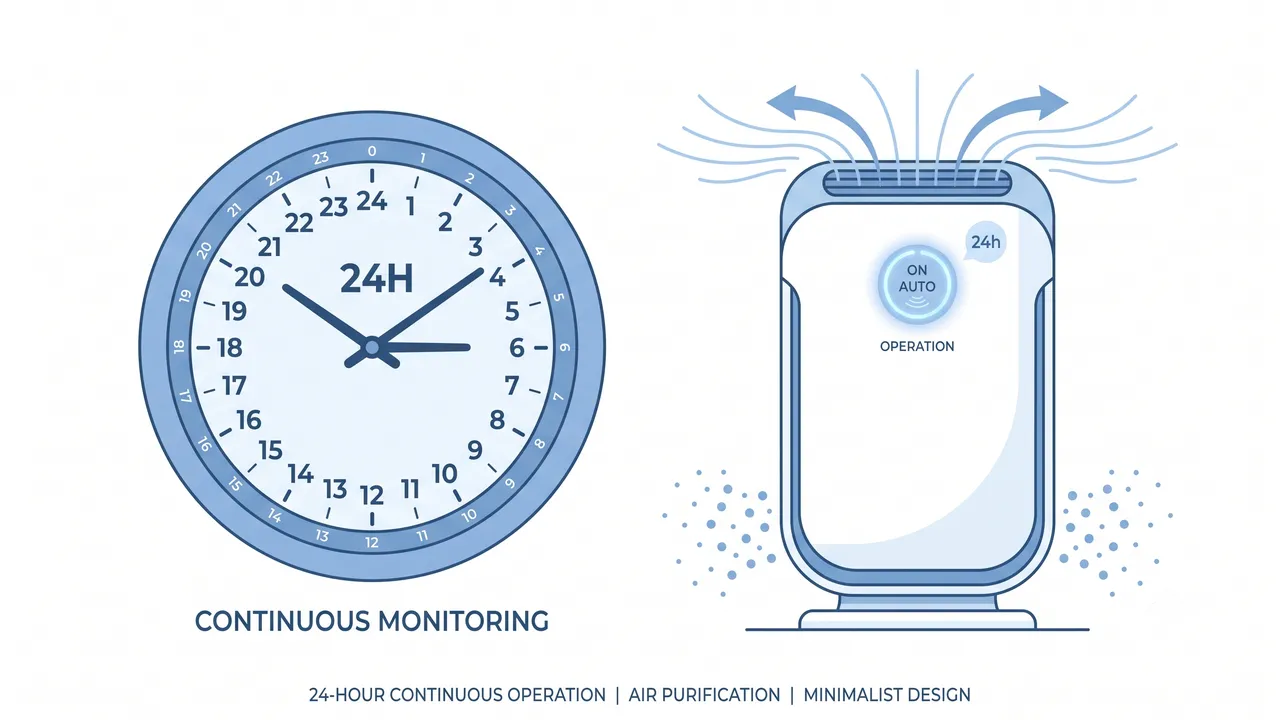
Why Continuous Operation Matters
Indoor air quality is not a static thing. The moment you switch off an air purifier, particulate matter begins accumulating. PM2.5 levels start rising within 30 to 60 minutes of shutdown, and can return to outdoor-equivalent concentrations within 2 to 4 hours depending on your home’s air exchange rate.
Particles infiltrate continuously from the outdoors through tiny gaps in windows, doors, electrical outlets, and the building envelope itself. The EPA estimates that the average home has an air exchange rate of 0.35 to 1.0 air changes per hour (ACH), meaning up to the entire volume of indoor air is replaced with outdoor air every hour, carrying in pollen, traffic pollution, wildfire smoke particles, and industrial emissions.
Simultaneously, indoor sources generate pollution. Settled dust resuspends from carpets and surfaces as people walk through rooms. Cooking with gas stoves produces PM2.5 levels that can spike to 200–300 µg/m³, comparable to a moderately polluted outdoor day in Beijing. Pet dander, mold spores, and volatile organic compounds (VOCs) off-gassing from furniture and cleaning products add to the load.
A purifier running continuously maintains a steady-state clean air level. An intermittently operated purifier creates sawtooth patterns where pollution builds up between run cycles, and occupants are exposed to the peak concentrations during those unfiltered gaps.
What the Research Shows
A landmark study published in Indoor Air demonstrated that intermittent operation, running only when occupants are home and awake, resulted in 40% higher average PM2.5 exposure compared to continuous operation. The reason is straightforward: people spend roughly 8 hours sleeping in closed bedrooms where pollution builds up fastest without filtration. By the time you wake up, your bedroom air quality may have deteriorated to levels that trigger morning allergy symptoms or asthma attacks.
Research from the University of Texas at Austin found that continuous HEPA filtration reduced indoor PM2.5 concentrations by 50–70% compared to unfiltered rooms, with the most dramatic benefits observed during overnight hours when windows are closed and natural ventilation is minimal.
For more on how air quality affects breathing and health, see our guide on air purifiers for allergies and asthma and our seasonal indoor air quality guide.
Recommended Run Times by Room Type
Not every room in your home has the same pollution profile or usage pattern. Here’s a detailed breakdown of recommended run times based on room type, activity level, and the data on how quickly air quality degrades in each environment.
| Room Type | Minimum Daily Runtime | Ideal Runtime | Speed Setting | Key Considerations |
|---|---|---|---|---|
| Bedroom | 10 hours (overnight) | 24/7 | Low/Sleep overnight, Medium 2 hrs before bed | Pre-clean room before sleep; keep door closed for best results |
| Living Room | 8–12 hours (occupied hours) | 24/7 on Auto | Auto or Medium during day, Low at night | Ramp up 1 hour before peak occupancy |
| Kitchen | 2–4 hours (during/after cooking) | 4–6 hours | High during cooking, Medium for 2 hrs after | Gas stoves produce massive PM2.5 spikes; pair with range hood |
| Home Office | 8–10 hours (work hours) | 12 hours | Low to Medium | Printer toner and electronics off-gas VOCs |
| Nursery/Baby Room | 18–24 hours | 24/7 | Low or Sleep mode only | Never exceed 45 dB in a baby’s room; see nursery purifier guide |
| Basement | 12–24 hours | 24/7 | Medium to High | Mold spores concentrate in damp basements; see basement mold guide |
| Pet Room | 16–24 hours | 24/7 | Auto (ramps up with dander) | Pet dander is heavy and settles fast; continuous filtration prevents re-suspension |
Why Bedrooms Deserve Priority
If you can only run an air purifier in one room for a limited number of hours, make it the bedroom. You spend 7–9 hours there every night in close proximity to the air you’re breathing. During sleep, your breathing rate slows but becomes deeper, meaning you inhale more particulate matter per breath. Studies show that bedroom HEPA filtration reduces overnight asthma symptoms by up to 25% and improves sleep quality metrics including time-to-fall-asleep and nighttime awakenings.
For a deep dive into this topic, read our article on air purifiers and sleep quality and our guide to the quietest air purifiers for bedrooms.
The Energy Cost Is Negligible (Here’s the Math)
The number-one objection to 24/7 operation is energy cost. Let’s put real numbers on it. A typical mid-size air purifier like the Coway AP-1512HH or Winix 5500-2 consumes the following wattages:
- Low/Sleep speed: 4–8 watts
- Medium speed: 25–40 watts
- High/Turbo speed: 60–80 watts
- Auto mode (average): 15–25 watts (varies with air quality)
Using the U.S. national average electricity rate of $0.16/kWh (as of early 2026), here’s what 24/7 operation actually costs:
| Setting | Wattage | Daily kWh | Monthly Cost | Annual Cost |
|---|---|---|---|---|
| Low 24/7 | 6W | 0.144 | $0.69 | $8.41 |
| Auto 24/7 (avg) | 20W | 0.480 | $2.30 | $28.03 |
| Medium 24/7 | 35W | 0.840 | $4.03 | $49.06 |
| High 24/7 | 70W | 1.680 | $8.06 | $98.11 |
For a full deep-dive on energy consumption across dozens of models, see our air purifier energy cost and electricity usage guide.
Energy Cost Calculator: 24/7 vs Auto Mode
Auto mode is the secret weapon for keeping energy costs low while maintaining clean air. Most modern purifiers with built-in particle sensors will run at whisper-quiet low speed (4–8W) when air quality is good, and ramp up to medium or high only when particles are detected.
Real-world auto mode savings:
In a typical home with moderate outdoor air quality (AQI 30–60), auto mode averages around 15–20 watts over 24 hours because the purifier spends 70–80% of its time on low speed. Compare this to running on medium constantly:
- Medium 24/7: ~$4.03/month ($49/year)
- Auto 24/7: ~$2.30/month ($28/year)
- Savings with Auto: ~$1.73/month ($21/year)
In cleaner environments (rural areas, winter months with windows closed), auto mode can drop to an average of 10–12 watts, costing under $1.50/month. During high-pollution events like wildfire season or high pollen days, auto mode will run at higher speeds more often, but this is exactly when you need maximum filtration, making the slightly higher cost well worth it.
Bottom line: Running a quality air purifier 24/7 on auto mode costs roughly $25–35 per year, less than a single month of most streaming subscriptions. The health benefits of continuous clean air far outweigh this minimal expense.
Filter Life: Runtime vs. Particulate Load
A common concern is that continuous operation “uses up” the filter faster. This is a misunderstanding of how HEPA filters work.
HEPA filter life is determined by total particulate mass captured, not by hours of fan runtime. Think of a HEPA filter like a bucket collecting rainwater, what matters is how much rain falls, not how long the bucket is outside. A filter in a clean rural home running 24/7 may last 12–18 months, while the same filter in a home next to a busy highway might need replacement in 4–6 months, regardless of whether it ran continuously or intermittently.
Running continuously at a low speed distributes the same particulate load over more hours at lower airflow rates. The filter lasts roughly the same amount of calendar time. In fact, running intermittently on high speed may actually shorten filter life because the higher airflow volume deposits more large particles per hour into the filter media.
For complete guidance on filter replacement timing and costs, see our filter replacement guide and our comparison of third-party vs OEM replacement filters.
The 24/7 vs Intermittent Filter Cost Trade-Off
Running 24/7 maximizes air cleaning but does consume filter media faster than running 12 hours/day. If a replacement filter costs $55 and lasts 6 months at 24/7 operation, it will last roughly 12 months at 12 hours/day. The total cost per hour of clean air is identical, you’re just paying it on a different timeline.
Annual filter costs by runtime:
| Runtime | Filter Lifespan | Annual Filter Cost | Annual Energy Cost | Total Annual Cost |
|---|---|---|---|---|
| 24/7 (Auto) | ~6 months | ~$110 | ~$28 | ~$138 |
| 12 hrs/day (Auto) | ~12 months | ~$55 | ~$14 | ~$69 |
| 8 hrs/day (Night only) | ~18 months | ~$37 | ~$9 | ~$46 |
As you can see, even at 24/7 operation, the total annual cost of owning and running a mid-range air purifier is around $138, roughly $0.38 per day for clean air in your home. For detailed breakdowns on different models, check out our complete air purifier buying guide.
When to Run at Max Speed vs Low Speed
Understanding when to use each speed setting can optimize both air quality and energy efficiency. Here’s a practical guide:
Use Max/Turbo Speed When:
- Wildfire smoke event: Outdoor AQI exceeds 150. Max speed delivers the highest CADR (Clean Air Delivery Rate), clearing particles faster than they infiltrate. See our wildfire smoke air purifier guide.
- Post-cooking cleanup: Gas stoves can spike kitchen PM2.5 to 200+ µg/m³. Run on max for 20–30 minutes to clear the plume quickly.
- Allergen surge: During peak pollen days or after vacuuming (which resuspends settled particles), max speed for 30–60 minutes brings levels back down fast.
- Initial room cleaning: When first placing a purifier in a room or returning from vacation, run on max for 1–2 hours to establish a clean baseline.
- After renovation or painting: VOC and particle levels spike during and after home improvement projects. Max speed with activated carbon filtration for 4–8 hours.
Use Low/Sleep Speed When:
- Overnight in bedrooms: Low speed on most quality purifiers produces 25–35 dB, quieter than a whisper. This maintains the clean air achieved earlier without disturbing sleep.
- Continuous maintenance: Once air quality is at a good level, low speed is sufficient to maintain it. The purifier’s sensor (in auto mode) handles this automatically.
- Small rooms under 150 sq ft: In a small space, even low speed provides 4–6 ACH, which is more than adequate.
- During quiet activities: Reading, meditation, phone calls, low speed keeps air clean without background noise interference.
- When away from home: If you prefer not to run 24/7 on auto, low speed while you’re out keeps baseline particle counts down at minimal energy cost.
The 80/20 Rule of Speed Settings
For most households, the optimal strategy is: auto mode as the default, with manual max-speed boosts during specific events. This delivers roughly 80% of the air quality benefit at 50% of the energy cost of running on high 24/7. Most people will never need to manually override auto mode, it handles the decision-making for you.
For a full comparison of purifier technologies and how speed settings interact with different filter types, see our HEPA filter deep-dive guide and purifier technology comparison.
Smart Scheduling Strategies
If 24/7 operation isn’t practical, due to noise sensitivity, shared living spaces, or simply a preference for turning things off, smart scheduling can capture most of the benefits. Here are evidence-based scheduling strategies ranked by effectiveness.
Strategy 1: 24/7 Auto Mode (Best)
Set it and forget it. The purifier’s built-in air quality sensor manages fan speed automatically. Energy cost: ~$2–3/month. Air quality benefit: maximum.
Strategy 2: Bedroom Priority Schedule
- 6:00 PM: Turn on bedroom purifier at medium-high speed (pre-clean before bedtime)
- 10:00 PM – 6:00 AM: Switch to low/sleep mode for overnight filtration
- Result: 12 hours of bedroom coverage including the critical sleep hours
This schedule costs roughly $0.10–0.15/day in electricity and filter wear while protecting the room where you spend one-third of your life. Pair this with our 4-7-8 breathing technique for the ultimate sleep optimization routine.
Strategy 3: Occupied Hours + Buffer
- Run purifiers in occupied rooms during all waking hours
- Add a 1-hour buffer before occupancy (e.g., turn on living room purifier at 7 AM before the family wakes at 8 AM)
- Add 2 hours after cooking in the kitchen
- Result: ~14–16 hours/day of filtration
Strategy 4: AQI-Triggered Schedule
Check your local AQI forecast each morning (using AirNow.gov or a home air quality monitor):
- AQI 0–50 (Good): Run 8–12 hours (overnight + evening)
- AQI 51–100 (Moderate): Run 16 hours (all occupied hours + overnight)
- AQI 101–150 (Unhealthy for Sensitive Groups): Run 24 hours on auto
- AQI 150+ (Unhealthy): Run 24 hours on high, seal windows and doors
This responsive approach saves energy on clean-air days while ramping up protection when it matters most. See our guide on how to read the Air Quality Index for more details.
Strategy 5: Smart Home Integration
If your purifier supports Wi-Fi or works with smart plugs, you can automate scheduling:
- Voice assistants (Alexa, Google): “Turn on bedroom purifier at 9 PM”
- Smart plugs with schedules: Set on/off times that match your routine
- IFTTT or Home Assistant: Trigger purifier based on real-time AQI data from outdoor monitors
- Geofencing: Turn purifiers on when your phone enters your home’s perimeter
Several modern purifiers, including models from Levoit and Coway, have native app support for scheduling, filter tracking, and remote control. See our Levoit Core 400S review for an example of a smart-connected purifier.
Who Benefits Most from 24/7 Operation?
While continuous operation is ideal for everyone, certain groups see dramatically larger benefits:
- Allergy and asthma sufferers during peak pollen or mold season, continuous filtration prevents the overnight symptom triggers that intermittent operation misses
- Homes within 500 meters of a highway or busy road, traffic-related ultrafine particles infiltrate constantly; see our highway pollution guide
- Pet owners with indoor shedding animals, dander and fur particles are generated continuously and resuspend with every movement
- Homes with smokers or vapers, smoke particles are ultrafine (0.1–1 µm) and linger for hours; see air purifiers for smokers
- Homes with gas stoves, combustion byproducts including NO₂ and ultrafine particles spike with every meal; see our kitchen air quality guide
- Families with young children or elderly members, these groups have developing or weakened respiratory systems that benefit most from clean air; read our guides on nursery air purifiers and air purifiers for seniors
- People with COPD or other respiratory conditions, continuous filtration reduces the frequency and severity of flare-ups; see air purifiers for COPD
For generally healthy individuals in low-pollution areas, 12 hours/day (overnight in the bedroom plus a few daytime hours in the living room) is perfectly adequate and delivers excellent protection at half the filter cost.
Placement Matters as Much as Runtime
Even the best scheduling strategy won’t help if your purifier is in the wrong spot. Key placement principles:
- Keep it 3–5 feet from your breathing zone, closer is better for personal air quality
- Maintain 12–18 inches of clearance on all sides for proper airflow
- Avoid corners and behind furniture, these restrict intake and output
- Elevate if possible, placing on a table or shelf improves air circulation patterns
- Close doors in treated rooms, this reduces the volume of air the purifier needs to clean
For a complete visual guide, see our air purifier placement guide and our room-by-room air purifier guide.
Frequently Asked Questions
Should I leave my air purifier on all night?
Yes. Nighttime is the most important period to run an air purifier because you spend 7–9 consecutive hours in a closed bedroom. During sleep, pollution accumulates from both outdoor infiltration and indoor sources. A purifier running on low or sleep mode overnight maintains clean air throughout the night, reducing morning congestion, allergy symptoms, and asthma triggers. Most quality purifiers operate at 25–35 dB on low speed, quieter than a whisper, so noise shouldn’t be a concern.
Does running an air purifier 24/7 waste electricity?
No. A typical mid-size air purifier running 24/7 on auto mode consumes about 15–25 watts on average, costing roughly $2–3 per month at U.S. average electricity rates. That’s less than running a single LED light bulb continuously. Even on medium speed 24/7, the cost is approximately $4/month. Compared to the health benefits of consistently clean air, the energy cost is negligible. For a detailed breakdown, see our air purifier energy cost guide.
Will running my air purifier constantly wear out the filter faster?
HEPA filter life depends on the total mass of particles captured, not the number of hours the fan runs. In a moderately polluted home, a filter will last roughly the same calendar time whether you run the purifier 12 or 24 hours per day. Continuous low-speed operation distributes particle capture evenly, while intermittent high-speed bursts can actually load the filter faster due to higher airflow volumes. The key metric to watch is your purifier’s filter replacement indicator, which typically measures cumulative runtime or particle load. For more, read our filter replacement guide.
Can I run my air purifier with the windows open?
You can, but it significantly reduces effectiveness. When windows are open, outdoor air flows in freely, bringing fresh particles faster than the purifier can remove them. The purifier will work harder (auto mode will ramp to high speed) and consume more energy for less benefit. The optimal strategy is to run the purifier with windows closed for maximum efficiency. If you need ventilation, open windows for 10–15 minutes to flush out CO₂ and VOCs, then close them and let the purifier bring particle levels back down. See our detailed comparison of air purifiers vs opening windows.
Is it safe to leave an air purifier running when I’m not home?
Yes, it is perfectly safe to leave a modern air purifier running unattended. All major brands (Coway, Levoit, Winix, Blueair, Dyson) are UL-listed or ETL-certified for continuous operation. They draw very low wattage (4–70W depending on speed) and have no exposed heating elements. Many people intentionally run purifiers while away so they return to clean air. If you’ll be gone for an extended period, see our guide to leaving air purifiers on during vacation.
The Bottom Line
The optimal air purifier runtime depends on your health needs, local air quality, and budget, but for most people, the answer is closer to 24/7 than you might think.
Here’s our recommended approach by situation:
- Budget-conscious, healthy household: 12 hours/day on auto (overnight in bedroom + evening in living room). Annual cost: ~$69 total.
- Allergy/asthma sufferers: 24/7 on auto mode in bedroom and main living area. Annual cost: ~$138 per unit.
- High-pollution area (near highway, wildfire zone, urban core): 24/7 on auto with manual boosts to max during events. Annual cost: ~$140–160 per unit.
- Families with babies, elderly, or respiratory conditions: 24/7 on auto or low speed. The health investment easily justifies the $0.38/day cost.
Whatever you choose, the most important thing is to use your air purifier consistently. A purifier sitting in the corner doing nothing is just an expensive paperweight. Turn it on, set it to auto, and let it do its job.
Ready to get started? Check out our top picks:
- Best overall: Coway AP-1512HH ($189), excellent CADR, proven reliability, whisper-quiet on low
- Best value: Winix 5500-2 ($159), true HEPA + washable carbon filter, great auto mode
See also: Air Purifier Energy Cost and Electricity Usage · Air Purifier Placement Guide for Maximum Effectiveness · How to Test If Your Air Purifier Is Actually Working · Best Air Purifiers 2026 Complete Guide
Disclosure: This article contains affiliate links. As an Amazon Associate, The Air Purifier Guide earns from qualifying purchases. This comes at no additional cost to you and helps us keep our content free and research-backed. We only recommend products we have personally tested or thoroughly researched.
Support This Guide
Helpful? Add The Air Purifier Guide as a preferred source on Google so our guides show up in your search results.
Related Articles
Coway Mighty2 vs AP-1512HH (2026)
Coway's Mighty2 replaced the AP-1512HH as Wirecutter's top pick. We compare CADR, noise, sensors, filter costs, and whether the older unit is still the smarter buy.
KNKA APH4000 Review: $150 Dark Horse
KNKA's APH4000 is one of Amazon's best-selling purifiers at $150. We check the AHAM certification, decode the 1,695 sq ft claim, and compare it to Levoit and Coway.
Levoit Core 300 vs 300-P: What Changed
Levoit quietly replaced the Core 300 with the Core 300-P. We explain the AHAM certification, whether filters still fit, and which one you should actually buy.
Shark NeverChange HP302 Review
Shark's NeverChange HP302 promises 5 years on one filter. We dig into the real running costs, the odor neutralizer catch, and whether it beats cheaper rivals.
Winix 5510 vs 5500-2: 2026 Verdict
The Winix 5500-2 is discontinued and the 5510 takes over. We compare CADR, noise, filter costs, and the one compatibility problem nobody mentions.
🛒 Products Mentioned
As an Amazon Associate, we earn from qualifying purchases.
Runs side-by-side purifier comparisons, long-term ownership reports, and filter cost analysis.
View all articles by David →