The Short Answer: Gas stoves are a significant source of indoor air pollution. They emit NO2, CO, PM2.5, and formaldehyde. A range hood that vents outdoors is the most important solution. If you can’t install one, use a HEPA air purifier (Coway AP-1512HH or Winix 5500-2) plus open windows. The air purifier reduces cooking PM2.5 by 40-60%.
Editor’s note (September 2026): The Winix 5500-2 has been discontinued and remaining stock is limited. Winix’s official successor is the Winix 5510, which adds app control and uses a new filter. Read our Winix 5510 vs 5500-2 comparison before you buy either one.
The study that changed the conversation
In January 2022, researchers at Stanford University published a study in Environmental Science & Technology that sent shockwaves through the home appliance industry. Their findings:
- Gas stoves leak methane continuously, even when turned off. Over 76% of methane emissions from gas stoves occurred while the stove was not in use.
- Nitrogen dioxide (NO2) levels in kitchens with gas stoves can exceed EPA outdoor air quality standards within minutes of turning on a burner, especially without ventilation.
- The annual methane emissions from all U.S. gas stoves have a climate impact equivalent to 500,000 gasoline-powered cars.
The health implications are significant. A separate 2022 study in the International Journal of Environmental Research and Public Health attributed 12.7% of childhood asthma cases in the U.S. to gas stove use. A figure comparable to the asthma burden from secondhand smoke.
This doesn’t mean you need to rip out your gas stove tomorrow. But it does mean you should take kitchen ventilation seriously.
Learn more about VOCs and formaldehyde in your home.
What gas stoves emit
When a gas burner ignites, it produces:
- Nitrogen dioxide (NO2): A respiratory irritant that inflames airways and increases susceptibility to respiratory infections. EPA outdoor standard: 100 ppb (1-hour average). Gas stoves can push kitchen NO2 above 200 ppb during cooking.
- Carbon monoxide (CO): Colorless, odorless gas that impairs oxygen delivery. Well-maintained stoves produce minimal CO, but a misadjusted burner can produce hazardous levels.
- PM2.5: Fine particulate matter from combustion and from food itself (especially frying, broiling, and toasting).
- Formaldehyde: A known carcinogen produced in small amounts during gas combustion.
- Ultrafine particles (UFPs): Particles smaller than 0.1 microns that can translocate from lungs into the bloodstream.
Even electric stoves, especially coil and radiant types, generate significant PM2.5 from the cooking process itself. The “cooking aerosol” from heating oils and foods. Induction stoves produce the least combustion-related pollution but still generate cooking aerosols.
The solution: a range hood that actually works
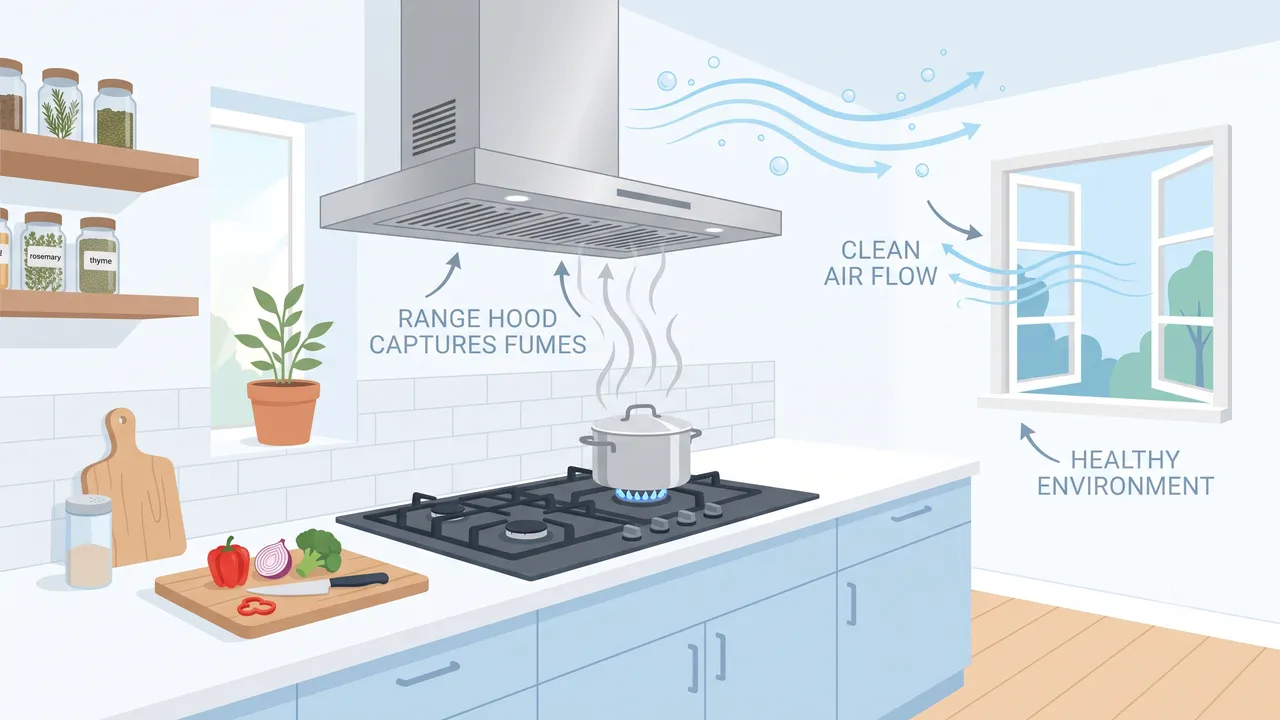
The most effective mitigation is simple: a range hood that vents outdoors and is used correctly. But most range hoods in American kitchens are inadequate:
- Recirculating hoods (the most common type in apartments and older homes) pass air through a thin grease filter and blow it back into the kitchen. They capture some grease droplets but do nothing for gases or fine particles.
- Undersized hoods don’t cover the full cooking surface. If your hood is 30 inches wide but your stove is 36 inches, the front burners release pollutants that bypass the hood entirely.
- Undersized fans, The Home Ventilating Institute recommends 100 CFM per 10,000 BTU of burner output. A typical 4-burner gas stove at full output needs 400-500 CFM.
- Hoods that are never turned on, Multiple surveys have found that only 25-35% of people use their range hood regularly while cooking.
What to look for in a range hood
- Ducted to the outdoors, Non-negotiable. If you can’t install ducting, open windows and use a portable air purifier near (but not directly next to) the stove.
- At least 400 CFM for a standard 4-burner gas stove, 600+ for 6-burner or high-BTU ranges.
- Covers the full cooking surface, The hood should extend at least 3 inches beyond the stove on each side.
- Low sones (noise rating), Quieter hoods (< 3 sones on high) are more likely to actually get used. The best hood is the one you turn on.
- Makeup air considerations, If your hood exceeds 400 CFM, building codes in many jurisdictions require a makeup air system to prevent backdrafting of combustion appliances.
If you can’t install a proper hood
- Cook on back burners, Pollutants from rear burners are more likely to be captured by an existing (even recirculating) hood.
- Open a window and use a box fan blowing outward during and for 15 minutes after cooking.
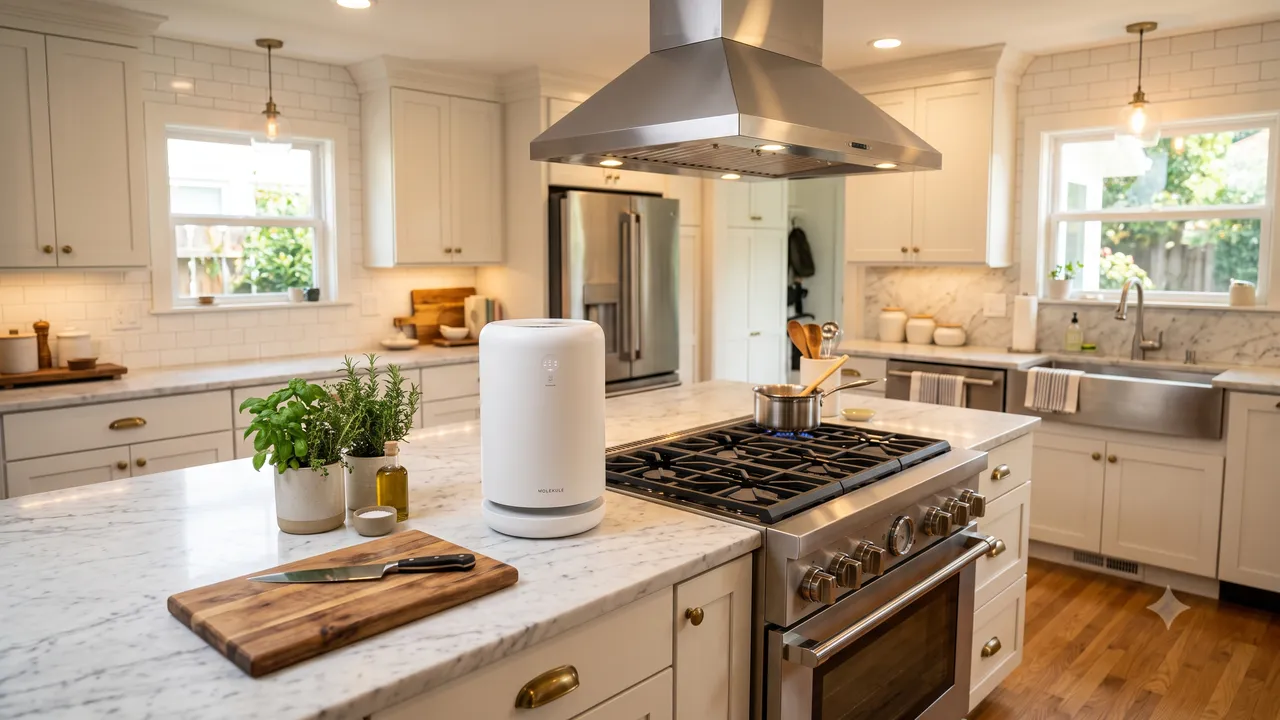
- Run a HEPA air purifier in the kitchen during and after cooking. It won’t capture NO2 or CO, but it will reduce PM2.5 from cooking. Read our air purifier guide for recommendations.
- Consider a portable induction cooktop for everyday cooking, reserving the gas stove for occasions when you specifically need gas.
Best air purifiers for kitchen use
| Purifier | Price | PM2.5 Capture | Carbon Filter | Best For |
|---|---|---|---|---|
| Coway AP-1512HH | $189 | Good | 0.5 lbs | General cooking |
| Winix 5500-2 | $159 | Good | Washable | Budget option |
| Blueair 211i Max | $339 | Excellent | 1.0 lbs | Heavy cooking |
| MOOKA PR1 | $55 | Moderate | 0.3 lbs | Budget large kitchen |
Coway AP-1512HH ($189)
The Coway AP-1512HH handles cooking particles well. The auto mode detects PM2.5 spikes from cooking and ramps up the fan automatically. The pre-filter catches grease particles before they reach the HEPA filter.
Drawback: The carbon filter is thin (0.5 lbs). It handles light cooking odors but not heavy smoke or gas stove emissions.
Winix 5500-2 ($159)
The Winix 5500-2’s washable AOC carbon filter is slightly better than the Coway’s thin carbon sheet for the NO2 and VOC spike during gas cooking. The washable carbon saves money on replacements.
Drawback: No WiFi or app control. Read our Winix review for more details.
Blueair 211i Max ($339)
The Blueair 211i Max has the highest CADR in this group, making it the best choice for heavy cooking. The 1.0 lb carbon filter handles cooking odors better than budget options.
Drawback: The price. At $339, it’s expensive for a kitchen purifier. Read our Blueair review for more details.
Other kitchen air quality improvements
- Don’t preheat an empty nonstick pan, PTFE-coated pans begin to off-gas at around 500F, which can happen in under 3 minutes on high heat. The fumes are toxic to birds and can cause polymer fume fever in humans.
- Use the microwave or an electric kettle for boiling water, Bringing water to a boil on the stovetop generates no pollutants itself but runs your stove longer, producing more combustion byproducts.
- Clean the grease filter monthly, A clogged filter reduces airflow and allows more particles to escape into the kitchen.
- Consider an induction cooktop, They produce no combustion pollutants, heat food faster, and the smooth surface is easier to clean. The DOE estimates induction is 85% efficient vs. 32% for gas.
Placement for kitchen air purifiers
- Place near the kitchen entrance, not next to the stove. Heat and grease can damage the filter.
- Run on high for 30-60 minutes after cooking to clear cooking particles and odors.
- Clean the pre-filter weekly if the purifier is near the kitchen. Grease and cooking oil clog filters faster.
- Don’t place directly on the counter near the stove. Grease splatter can damage the unit.
Read our placement guide for more tips.
Electricity costs for kitchen use
Running a purifier during and after cooking uses minimal electricity:
| Purifier | Watts (High) | 1 Hour Cost | Daily Cost (3 hrs) |
|---|---|---|---|
| Coway AP-1512HH | 55W | $0.008 | $0.024 |
| Winix 5500-2 | 60W | $0.009 | $0.027 |
| Blueair 211i Max | 65W | $0.010 | $0.030 |
Based on average US electricity rate of $0.15/kWh
Electricity cost is negligible. Don’t hesitate to run your purifier during and after cooking.
Calculate your exact electricity cost based on your local rate.
The bottom line
Gas stoves are a meaningful source of indoor air pollution, but the solution isn’t necessarily replacement. It’s ventilation. A properly installed, ducted range hood used every time you cook eliminates the vast majority of the health risk. If you can’t install one, the combination of back-burner cooking, an open window, and a HEPA air purifier significantly reduces exposure.
My recommendation: If you cook on gas, invest in a proper range hood first. Then add a HEPA air purifier for the kitchen. The Winix 5500-2 ($159) is the best budget option. The Coway AP-1512HH ($189) is the best mid-range option.
Related Articles
- Air Purifiers for VOCs and Formaldehyde
- Wildfire Smoke and Air Purifiers
- Best Air Purifier Under $150
- Air Purifier Placement Guide
Frequently Asked Questions
How long should I run my air purifier each day?
For best results, run your air purifier 24/7 on medium speed. Air purification works by continuously removing particles—turning it off allows them to accumulate again. Modern purifiers use 30-80W on medium (similar to a light bulb), making continuous operation energy-efficient.
Where is the best place to put an air purifier?
Place the purifier 3-5 feet from your breathing zone, near pollution sources, with unobstructed airflow on all sides. Avoid corners, curtains, and furniture that block intake or output. For bedrooms, position near the bed but not blowing directly on you.
How do I know when to replace the filter?
Most purifiers have filter indicator lights. Without indicators, replace HEPA filters every 6-12 months and carbon filters every 3-6 months. Signs of a clogged filter: reduced airflow, visible discoloration, increased noise, or the purifier seeming less effective.
Are air purifiers noisy?
Noise levels vary by model and fan speed. Sleep modes (20-25 dB) are quieter than a whisper. Medium speeds (35-45 dB) are similar to background music. High speeds (50-60 dB) are conversation level. For bedrooms, look for sleep modes under 25 dB.
Do air purifiers use a lot of electricity?
No. Most purifiers use 30-80W on medium and 5-15W on sleep mode. Running 24/7 on medium costs $2-8/month at average US electricity rates. Energy Star models use 15-40% less electricity. The main ongoing cost is filter replacement ($30-120/year).
Disclosure: We may earn a commission from qualifying purchases. Research cited: Lebel et al. (2022), Environ. Sci. Technol.; Gruenwald et al. (2022), Int. J. Environ. Res. Public Health.
Support This Guide
Helpful? Add The Air Purifier Guide as a preferred source on Google so our guides show up in your search results.
Related Articles
Does an Air Purifier Dry Out the Air? The Honest Answer
If your throat feels dry after running a purifier, you're not imagining it — but it's probably not the purifier. Here's the humidifier-vs-purifier reality, with the measurements to prove it.
Air Purifier for Asthma Attacks at Night: What the Science Says
Nighttime asthma attacks have a bedroom trigger pattern — dust mites, dander, and allergens that accumulate where you sleep. Here's what HEPA filtration can do, what the studies show, and the full bedroom protocol.
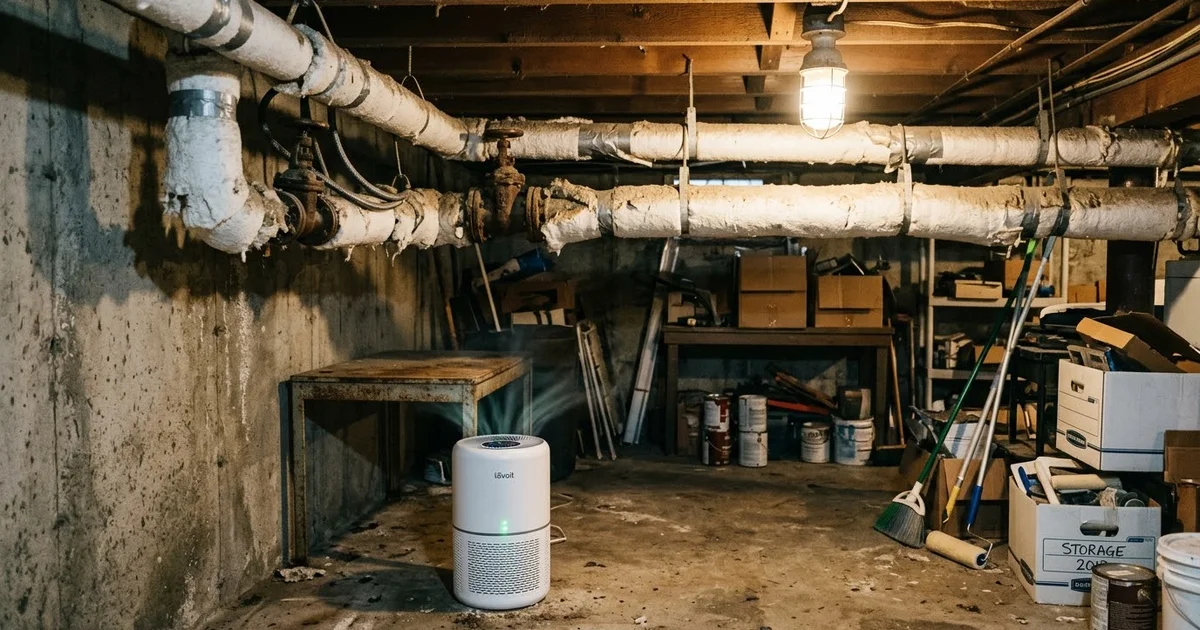
Air Purifier for Asbestos Dust: What Actually Works (and What Can't)
Asbestos is the one airborne hazard where the wrong advice can hurt someone. Here's what HEPA filtration can and can't do, the honest limits, and the safety steps that matter more than any purifier.
Indoor vs Outdoor Air Quality: Why Your Home Is (Probably) Dirtier Than You Think
Indoor air can be 2-5x more polluted than outdoor air. Here's the research, the sources inside your home, and how to fix it.

What Is a Good AQI Level? The Complete Guide to Air Quality Numbers
What AQI is 'good'? Here's the complete AQI scale explained — what each number means, who should care, and when to act.
🛒 Products Mentioned
As an Amazon Associate, we earn from qualifying purchases.
Covers indoor air quality science, respiratory health, allergy management, and wildfire smoke protection.
View all articles by Sarah →