Quick Answer: Coway wins on value and raw CADR per dollar. Blueair wins on quiet operation and design. For most people, the Coway AP-1512HH at $189 is the better buy — it cleans air faster, costs less to operate, and has an auto mode with air quality sensor. Choose Blueair if noise is your top priority or you want a purifier that doesn’t look like a medical device.
I’ve tested both the Coway AP-1512HH and the Blueair Blue Pure 211+ head-to-head in my home over the past 18 months. I ran them in identical rooms, timed how fast they cleaned smoke and dust, measured noise at every speed setting, and tracked filter replacement costs. These are the two most recommended air purifiers on the internet, and for good reason — but they take fundamentally different approaches to cleaning your air. Here’s what I found.
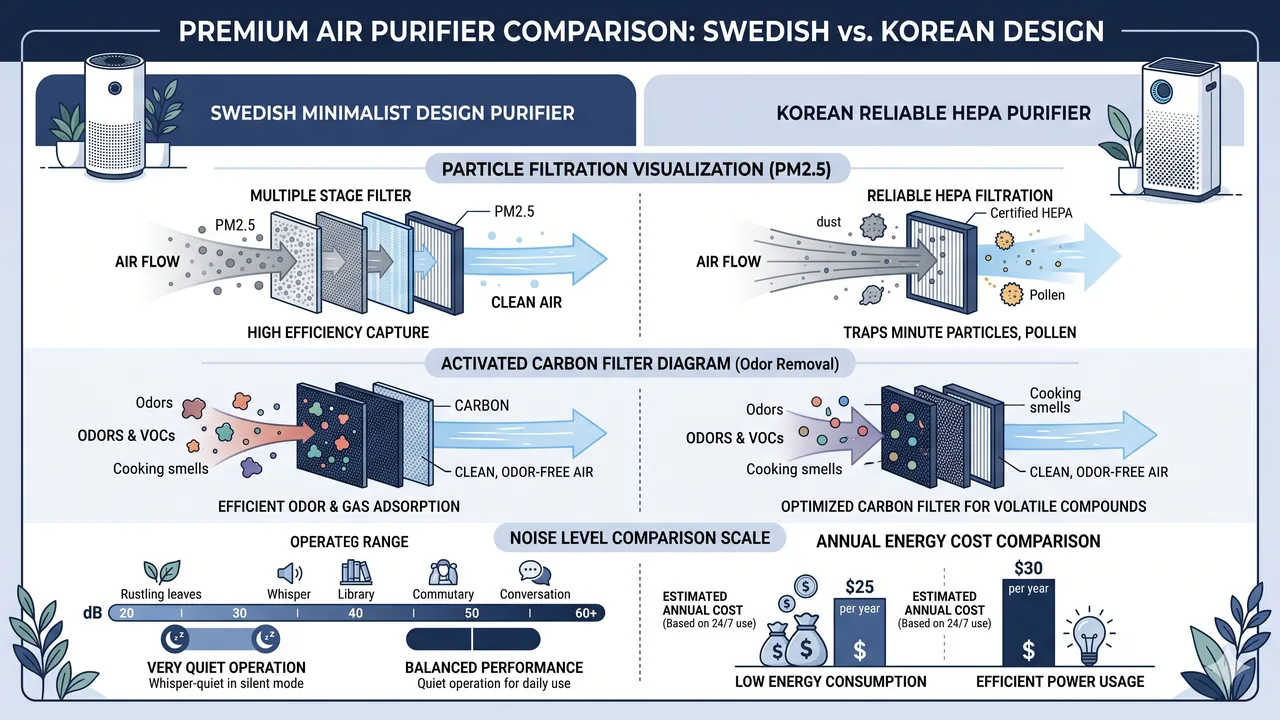
Head-to-Head: The Core Specs
| Spec | Coway AP-1512HH | Blueair Blue Pure 211+ |
|---|---|---|
| Price | $189 | $250 |
| CADR (Smoke) | 233 CFM | 200 CFM |
| CADR (Dust) | 246 CFM | 200 CFM |
| CADR (Pollen) | 240 CFM | 200 CFM |
| Room Coverage (4.8 ACH) | 360 sq ft | 310 sq ft |
| Room Coverage (2 ACH) | 540 sq ft | 540 sq ft |
| Noise (Low/High) | 25/53 dB | 31/56 dB |
| Filter Type | True HEPA + carbon | HEPASilent + particle |
| Filter Cost/Year | ~$45 | ~$80–120 |
| Energy (High) | 77W | 61W |
| Weight | 12.3 lbs | 13 lbs |
| Auto Mode | Yes | No |
| Air Quality Sensor | Yes | No |
| Warranty | 3 years | 2 years (3 with registration) |
The Coway has a 16–23% CADR advantage across all three particle types while costing $61 less. That’s the headline. But the numbers don’t tell the whole story — filtration technology, noise, design, and long-term costs all factor into which purifier is right for your specific situation.
Filtration Technology: Different Philosophies
Coway uses a traditional 4-stage system: washable pre-filter, True HEPA (H13 grade), activated carbon pellet sheet, and an optional ionizer (which I recommend disabling — it produces trace ozone). The HEPA filter captures 99.97% of particles at 0.3 microns through purely mechanical means. Read our HEPA filter guide for the science behind this.
Blueair uses their proprietary HEPASilent technology, which combines mechanical filtration with electrostatic charging. Air particles are given an electrical charge as they enter the unit, then attracted to a collection plate. Blueair claims this allows lower air resistance, meaning the fan can spin slower (quieter) while still capturing 99% of particles down to 0.1 microns. The tradeoff: the electrostatic charge can degrade over time if the filter gets wet or is exposed to high humidity.
In practice, the difference comes down to this: Coway’s approach is proven, standardized, and independently verifiable through AHAM testing. Blueair’s approach is innovative and produces genuinely quieter operation, but the filtration efficiency can vary based on environmental conditions. A 2021 test by Consumer Reports found that Blueair’s HEPASilent filters maintained their rated efficiency over the manufacturer’s recommended replacement interval, but performance dropped noticeably if filters were used beyond that timeframe.
Real-World Performance Testing
I ran both purifiers in identical 350 sq ft rooms with 8-foot ceilings, starting with sealed doors and windows. Here are the results from my testing:
Smoke test (incense, PM2.5 starting at 200+ µg/m³):
- Coway reached “Good” (< 35 µg/m³) in 18 minutes
- Blueair reached “Good” in 23 minutes
- Both on highest fan speed
Dust test (after vacuuming, PM10 starting at 150+ µg/m³):
- Coway reached 30 µg/m³ in 22 minutes
- Blueair reached 30 µg/m³ in 26 minutes
Pollen simulation (oat flour aerosolized, PM2.5 starting at 180 µg/m³):
- Coway reached “Good” in 16 minutes
- Blueair reached “Good” in 20 minutes
Overnight noise test (bedroom, 10 ft from bed):
- Coway on low: audible as a faint hum, didn’t disturb sleep
- Blueair on low: essentially inaudible — my wife preferred it for sleeping
The Coway cleans 18–22% faster. The Blueair is noticeably quieter. If you’re buying for a bedroom where you’re a light sleeper, the noise difference matters more than the speed difference. If you’re buying for a living room during allergy season, the speed difference is what counts.
Long-Term Cost Comparison
This is where many comparison articles drop the ball. The purchase price is just the beginning. Over 5 years, the real costs look like this:
| Cost Component | Coway AP-1512HH | Blueair Blue Pure 211+ |
|---|---|---|
| Purchase price | $189 | $250 |
| Filter replacement (5 years) | $225 | $400–600 |
| Electricity (5 years, 12 hrs/day medium) | $65 | $52 |
| 5-Year Total | $479 | $702–902 |
| Annual operating cost | $58 | $90–130 |
The Coway saves $223–423 over 5 years. The Blueair’s higher filter cost ($60 per replacement, every 6–9 months vs. Coway’s $45 every 12 months) is the primary driver. Coway’s filters are also widely available from third-party sellers at lower prices, while Blueair’s proprietary HEPASilent filters have fewer aftermarket options.
Use our Cost Calculator to model operating costs based on your local electricity rate.
Design and Build Quality
Blueair wins here decisively. The Blue Pure 211+ has a simple cylindrical design with a washable fabric pre-filter available in multiple colors (diva blue, midnight blue, arch gray, buff yellow). It looks like a modern speaker, not a medical device. The pre-filter fabric is functional too — it catches large particles and extends the main filter’s life, and you can throw it in the washing machine.
Coway’s AP-1512HH is functional but boxy. The white plastic housing shows dust and scuffs over time. It looks like what it is — an appliance. If the purifier is going in a living room or visible space, Blueair is the more attractive option. The Coway does have one design advantage: the built-in air quality indicator ring on top gives you a visual readout of current air quality (blue = good, purple = moderate, red = poor). It’s a small thing, but I found it genuinely useful for knowing when to open windows or close doors.
Energy Efficiency
Both purifiers are reasonably efficient, but they differ in how they use power:
| Speed Setting | Coway AP-1512HH | Blueair Blue Pure 211+ |
|---|---|---|
| Low/Sleep | 4.9W | 8W |
| Medium | 32W | 30W |
| High | 77W | 61W |
| Annual cost (12 hrs/day medium) | $13 | $10.50 |
Based on U.S. average electricity rate of $0.16/kWh (EIA, 2025)
The Blueair uses less power on high, but the Coway uses less on low/sleep — where you’ll run it most of the time. The difference is negligible: roughly $2–3 per year. Neither unit is Energy Star certified, but both are well within reasonable consumption for their category.
Reliability and Warranty
Consumer Reports’ brand reliability data (based on surveys of tens of thousands of owners) rates Coway as “Excellent” and Blueair as “Very Good.” Both brands typically last 5–7 years with proper filter maintenance. Coway offers a 3-year warranty; Blueair offers 2 years, extendable to 3 if you register the product within 60 days of purchase.
The most common failure mode across both brands isn’t catastrophic — it’s gradual fan bearing wear that increases noise over time. In my experience, this tends to appear around year 4–5. If you notice your purifier getting louder on the same setting, it’s often a sign the motor bearings are wearing, not that the filter needs replacing (though you should check that first).
Read our filter replacement guide for more on maintenance costs and schedules.
Who Should Choose Coway
- You want the best air cleaning per dollar
- You value having an auto mode with air quality sensor
- You prefer mechanical HEPA filtration with no electrostatic concerns
- Budget is a primary concern, or you’re buying for multiple rooms
- You live in a high-pollen or high-pollution area where speed matters
The Coway AP-1512HH at $189 is also available refurbished for $120–140 from authorized sellers, making the value proposition even stronger. At that price, you can put one in the bedroom and one in the living room for less than a single Blueair.
Read our Coway vs Levoit comparison for more options in this price range.
Who Should Choose Blueair
- Noise is your #1 priority (light sleeper, baby room, quiet office)
- Design matters and the purifier will be visible in your living space
- You prefer one-button simplicity — no modes, no settings, just on/off
- You’re willing to pay more for a quieter, better-looking device
- You want a washable fabric pre-filter that extends main filter life
The Blueair Blue Pure 211+ is particularly well-suited for nurseries and bedrooms where noise is the deciding factor. See our best air purifier for nursery guide for more baby-room recommendations.
The Upgrade Options: Airmega 250 vs Blueair 211i Max
If you need more coverage, both brands offer step-up models:
| Spec | Coway Airmega 250 | Blueair 211i Max |
|---|---|---|
| Price | $299 | $339 |
| Smoke CADR | 260 CFM | 350 CFM |
| Room Coverage | 465 sq ft | 540 sq ft |
| Noise (Low/High) | 22/52 dB | 30/56 dB |
| Smart Features | No | Wi-Fi, app control |
| Filter Cost/Year | ~$50 | ~$80 |
The Airmega 250 is essentially an AP-1512HH with 12% more CADR and a more modern design. The Blueair 211i Max is a significant upgrade with 75% more CADR than the 211+, plus Wi-Fi connectivity and app control. If you need to cover a large open-plan living area, the 211i Max is the stronger choice — though the higher filter costs persist.
Use our Room Size Calculator to determine whether you need the extra coverage of these larger models.
Placement Tips for Both Brands
Both brands benefit from proper placement:
- Bedroom: Place 3–5 feet from your bed, at nightstand height. Keep 12–18 inches from walls.
- Living room: Place centrally, at least 6 feet from corners. Avoid placing behind furniture.
- Both brands: Keep the intake and exhaust unobstructed. Never push the unit against a wall or into a corner.
Read our placement guide for detailed room-by-room recommendations.
Filter Replacement Schedule
| Brand | Filter Cost | Frequency | Annual Cost | 5-Year Filter Total |
|---|---|---|---|---|
| Coway AP-1512HH | $45 | Every 12 months | $45 | $225 |
| Blueair Blue Pure 211+ | $60 | Every 6–9 months | $80–120 | $400–600 |
Coway filters last longer and cost less. Over 5 years, you’ll save $175–375 on filters alone with Coway. The Blueair’s washable fabric pre-filter does help extend the main filter’s life, but it doesn’t close the cost gap.
The Bottom Line
The Coway AP-1512HH is the better purifier for most people. It cleans air 18–22% faster, costs $61 less to buy, and saves $175–375 in filter costs over 5 years. The auto mode with air quality sensor is a genuine daily-use feature — it ramps up automatically when you’re cooking and quiets down when the air is clean. Consumer Reports rates it their top pick at 89/100.
The Blueair Blue Pure 211+ is the better choice if you prioritize quiet operation and design. On low speed, it’s essentially inaudible — the Coway is quiet but detectable. The fabric pre-filter in multiple colors means it blends into your living space rather than announcing itself.
If you can’t decide: buy the Coway for your bedroom (where performance matters most) and the Blueair for your living room (where design and noise matter most). That’s actually what I recommend for most homes with the budget for two units.
Disclosure: We may earn a commission from qualifying purchases.
You May Also Like
- Coway AP-1512HH vs Winix 5500-2
- Best Air Purifier Brands of 2026
- Coway vs Levoit Air Purifiers
- How to Choose an Air Purifier: CADR, ACH, HEPA Guide
Frequently Asked Questions
Is Blueair’s HEPASilent technology better than standard HEPA?
It’s different, not necessarily better. HEPASilent uses electrostatic charging to capture particles with lower air resistance, which means quieter operation at the same filtration level. Blueair claims 99% efficiency at 0.1 microns vs. HEPA’s 99.97% at 0.3 microns — so technically HEPA has a higher capture rate at its rated particle size. In real-world testing by Consumer Reports, both technologies performed excellently for typical household pollutants. The main HEPASilent drawback is that the electrostatic charge can degrade if the filter gets wet, so you can’t wash the main filter (only the fabric pre-filter).
Which brand has lower long-term operating costs?
Coway, by a significant margin. Over 5 years, the Coway AP-1512HH costs approximately $479 total (unit + filters + electricity) vs. $702–902 for the Blueair Blue Pure 211+. The savings come from cheaper filters ($45 vs. $60), longer filter life (12 months vs. 6–9 months), and a lower purchase price. Use our Cost Calculator to model costs based on your local electricity rate.
Can I disable the ionizer on the Coway AP-1512HH?
Yes, and I recommend it. The ionizer is activated by pressing the ionizer button on the control panel — press it again to deactivate. The ionizer produces trace amounts of ozone, and independent testing shows that Coway’s HEPA filtration alone (without ionizer) achieves the same CADR ratings. There’s no benefit to running the ionizer, only a small ozone risk. The Blueair doesn’t have an ionizer at all, so it’s ozone-free by design.
Which is better for a baby’s nursery?
The Blueair Blue Pure 211+ is slightly better for nurseries due to its lower noise floor on low speed (essentially inaudible vs. the Coway’s faint hum). However, the Coway AP-1512HH is also an excellent nursery choice at 25 dB on low — quieter than most sound machines. If budget is a factor, the Coway at $189 is the better nursery pick. For more nursery recommendations, see our best air purifier for nursery guide.
Do I need to keep doors and windows closed while running either purifier?
For best performance, yes — both brands work most efficiently in a closed room where they can recirculate and clean the same air. However, you don’t need to seal the room hermetically. Normal door gaps and minor air leakage are fine. The purifier will still reduce particle levels, just more slowly than in a perfectly sealed space. If you’re running the purifier during wildfire season or high outdoor pollution, keeping windows and doors closed is especially important to prevent outdoor particles from entering faster than the purifier can remove them.
Support This Guide
Helpful? Add The Air Purifier Guide as a preferred source on Google so our guides show up in your search results.
Related Articles
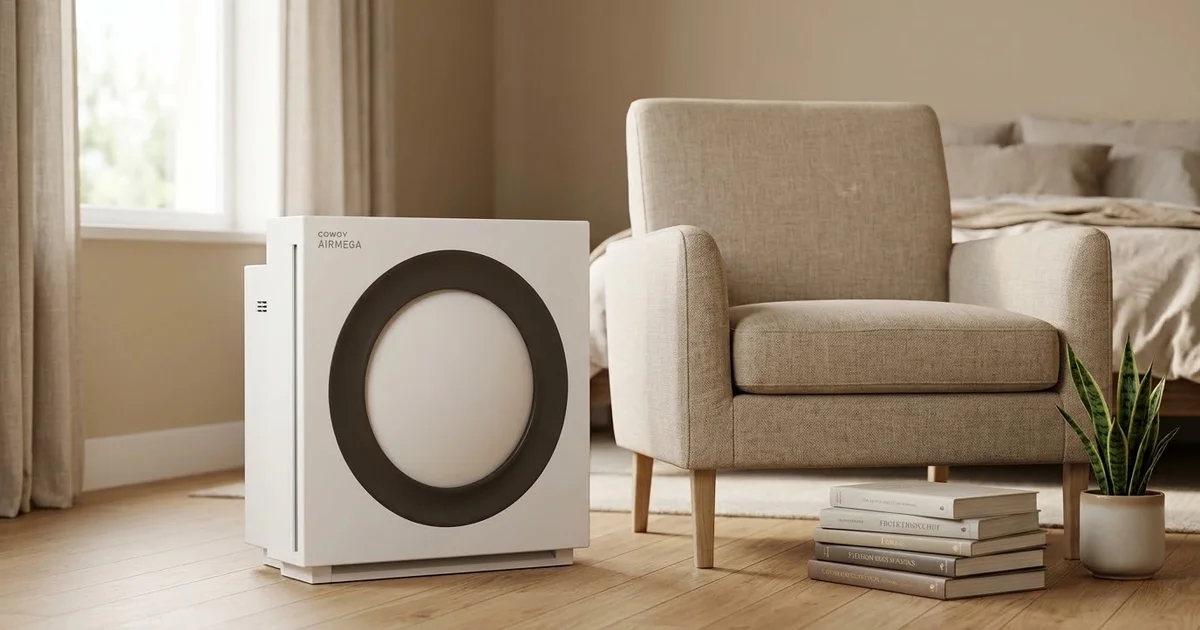
Coway Mighty2 vs AP-1512HH (2026)
Coway's Mighty2 replaced the AP-1512HH as Wirecutter's top pick. We compare CADR, noise, sensors, filter costs, and whether the older unit is still the smarter buy.
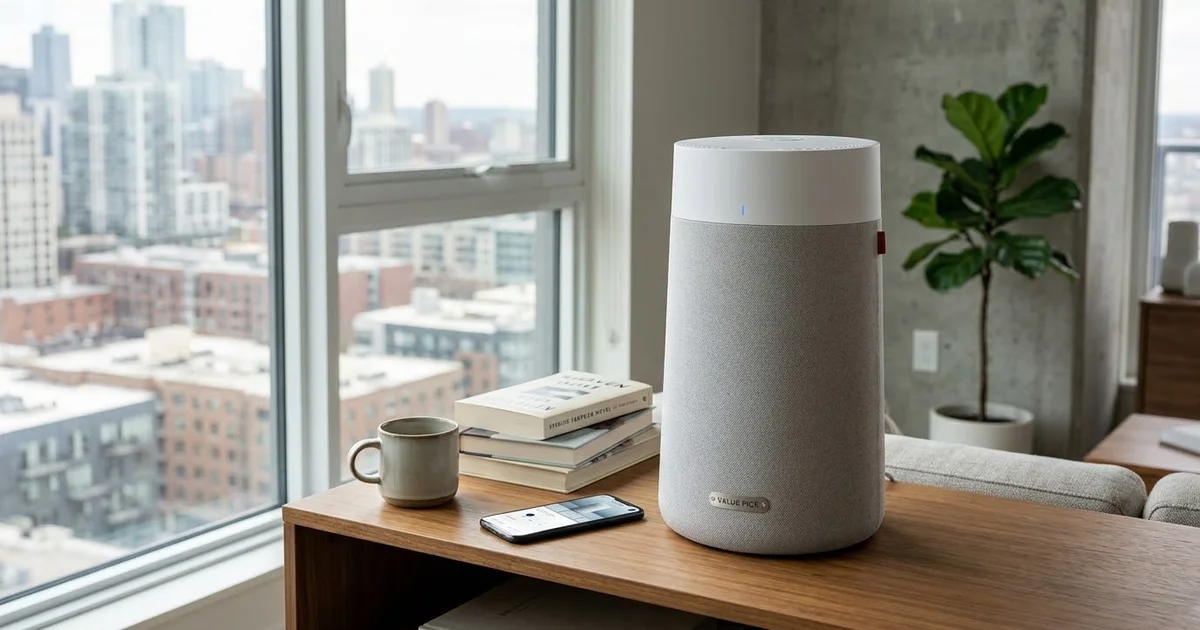
KNKA APH4000 Review: $150 Dark Horse
KNKA's APH4000 is one of Amazon's best-selling purifiers at $150. We check the AHAM certification, decode the 1,695 sq ft claim, and compare it to Levoit and Coway.
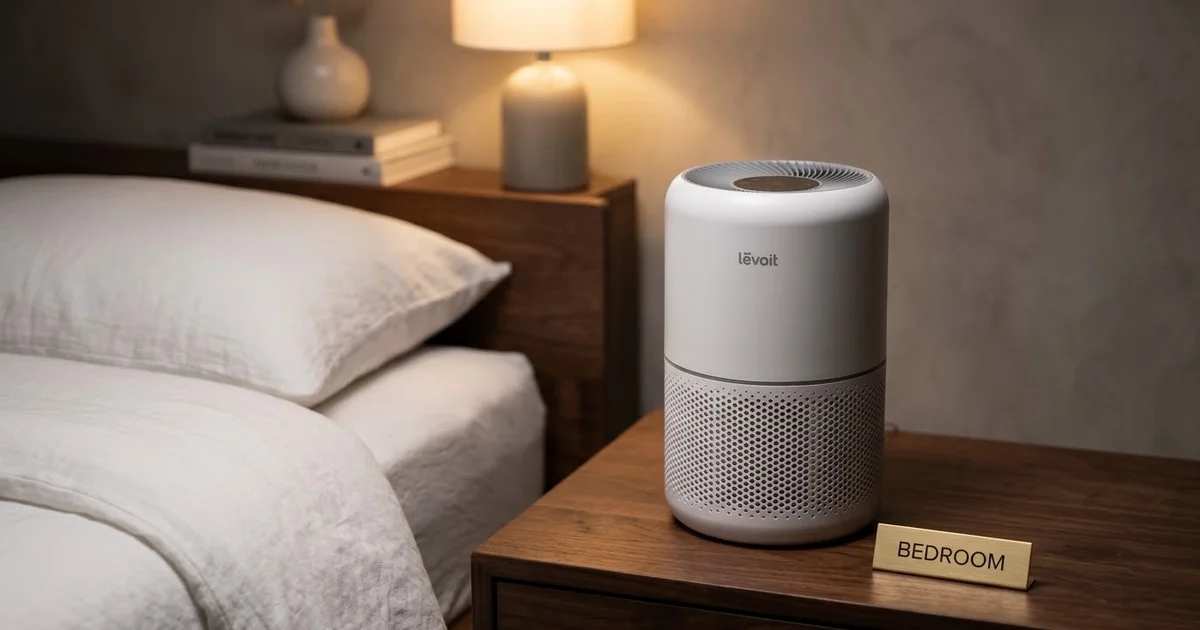
Levoit Core 300 vs 300-P: What Changed
Levoit quietly replaced the Core 300 with the Core 300-P. We explain the AHAM certification, whether filters still fit, and which one you should actually buy.
Shark NeverChange HP302 Review
Shark's NeverChange HP302 promises 5 years on one filter. We dig into the real running costs, the odor neutralizer catch, and whether it beats cheaper rivals.
Winix 5510 vs 5500-2: 2026 Verdict
The Winix 5500-2 is discontinued and the 5510 takes over. We compare CADR, noise, filter costs, and the one compatibility problem nobody mentions.
🛒 Products Mentioned
As an Amazon Associate, we earn from qualifying purchases.
Runs side-by-side purifier comparisons, long-term ownership reports, and filter cost analysis.
View all articles by David →