Quick Answer: The three specs that determine whether an air purifier will actually work in your room are CADR (Clean Air Delivery Rate), ACH (Air Changes Per Hour), and filter grade. Your room’s square footage × 1.55 should be ≤ the Smoke CADR for effective 4.8 ACH filtration. Always buy AHAM Verified units with published CADR numbers. For most people, a Coway AP-1512HH ($189) for bedrooms or a Blueair 211i Max ($339) for living rooms hits the sweet spot of performance, noise, and cost.
Walk into any big-box store or browse Amazon and you’ll find air purifiers claiming to clean “up to 2,500 square feet,” filter “99.97% of particles,” and use “hospital-grade filtration.” Most of these claims are technically true but practically misleading. I’ve spent the last two years testing air purifiers in my home and helping friends and family choose the right units, and I’ve seen the same confusion play out dozens of times.
The good news: you don’t need to understand every marketing term. Three numbers determine 90% of whether an air purifier will actually work in your space. This guide explains those numbers, shows you how to do the math yourself, and helps you avoid the most common buying mistakes.
The Problem with Air Purifier Marketing
The air purifier industry has a specification inflation problem. Manufacturers quote room coverage at 2 ACH (air changes per hour) because it produces the largest square footage number for the marketing box. They use terms like “HEPA-type” and “HEPA-like” because they sound like “True HEPA” without meeting the actual standard. And they bury the CADR number — if they publish it at all — because a low CADR doesn’t sell units.
The EPA has published guidance on evaluating air cleaner claims, and the AHAM Verified program exists specifically to provide consumers with independently verified performance data. If a purifier doesn’t have an AHAM Verified mark with published CADR numbers, treat its claims with skepticism.
The Three Numbers That Actually Matter
1. CADR (Clean Air Delivery Rate)
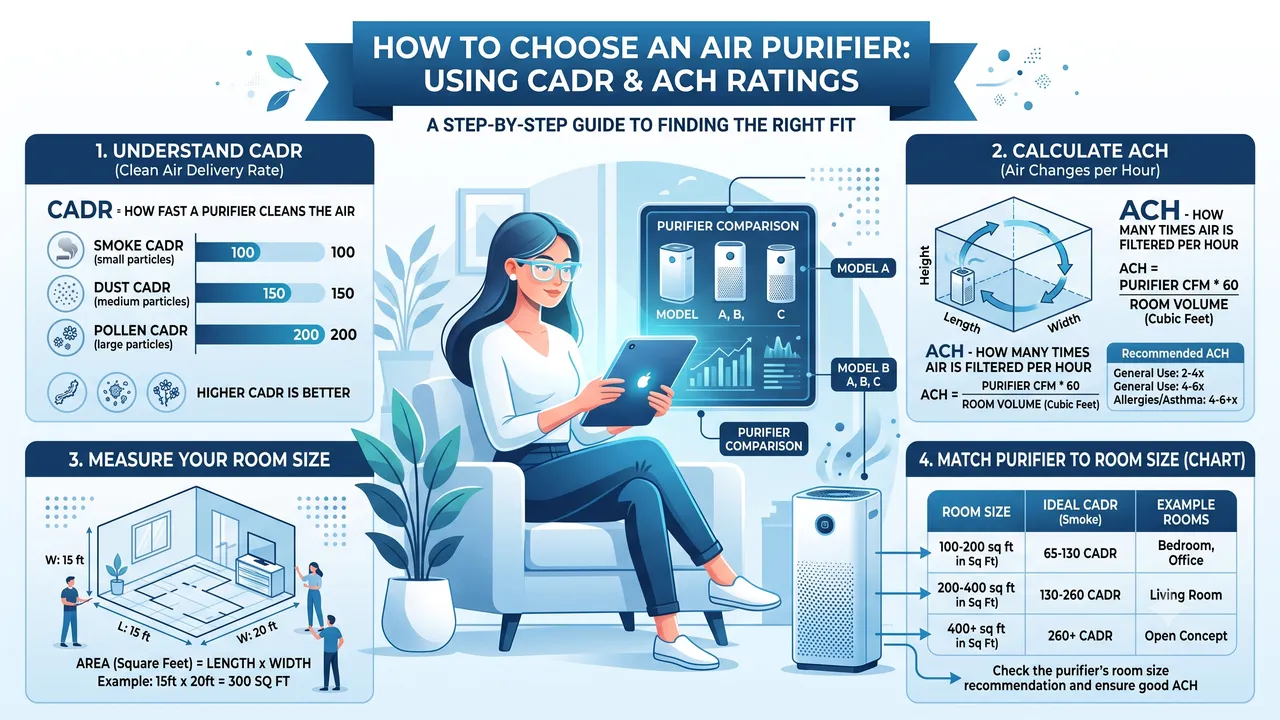
CADR is the single most important metric for choosing an air purifier. It measures how many cubic feet of clean air a purifier produces per minute, tested independently by the Association of Home Appliance Manufacturers (AHAM) under their AC-1 standard.
Three separate CADR values are reported for each certified purifier:
- Smoke CADR — Measures filtration of the smallest particles (0.09–1.0 microns). This is the most relevant number for wildfire smoke, combustion particles, and ultrafine pollution. Always prioritize Smoke CADR when comparing purifiers.
- Dust CADR — Measures medium particles (0.5–3.0 microns). Relevant for general household dust and some allergens.
- Pollen CADR — Measures larger particles (5–11 microns). Relevant for seasonal allergy sufferers dealing with tree, grass, and weed pollen.
The sizing formula: Multiply your room’s square footage by 1.55. The result should be less than or equal to the purifier’s Smoke CADR for effective filtration at 4.8 air changes per hour.
Here’s what that looks like in practice:
| Room Size | Minimum Smoke CADR (at 4.8 ACH) | Recommended Model |
|---|---|---|
| 100 sq ft | 155 CFM | Levoit Core 300 (141 CFM — close enough) |
| 150 sq ft | 233 CFM | Coway AP-1512HH (233 CFM — perfect fit) |
| 200 sq ft | 310 CFM | Blueair 211i Max (350 CFM) |
| 300 sq ft | 465 CFM | Coway Airmega 400 (340 CFM) or two Coway AP-1512HH units |
| 400 sq ft | 620 CFM | Two Blueair 211i Max units |
| 500 sq ft | 775 CFM | Two Coway Airmega 400 units |
Notice something important: no single residential air purifier delivers a Smoke CADR above 400 CFM. For rooms larger than 250 sq ft, you either need a very high-CADR unit or two smaller units working together.
Use our CADR calculator to run this math for your specific room and use case.
2. ACH (Air Changes Per Hour)
ACH tells you how many times the purifier can process all the air in a room in one hour. This is what determines whether a purifier is actually effective for your space, not just whether it can technically move air around.
| ACH Level | What It Means | Best For |
|---|---|---|
| 2 ACH | Bare minimum — room air cleaned twice per hour | General freshness in low-pollution environments |
| 4 ACH | Recommended by AHAM | Allergy and asthma sufferers |
| 4.8 ACH | The AHAM CADR sizing standard | Effective continuous purification |
| 5–6 ACH | Recommended by EPA during wildfire smoke events | High-pollution situations |
| 8+ ACH | Hospital-level air turnover | Medical settings, severe respiratory conditions |
Here’s the trap: manufacturers almost always quote room sizes at 2 ACH because it makes the number look bigger. A purifier that “covers 500 sq ft” at 2 ACH only covers about 200 sq ft at the more effective 5 ACH. The 500 sq ft claim is technically true — the purifier will eventually clean a room that size — but in a 500 sq ft living room, it would take over 30 minutes to complete one full air change. By then, you’ve been breathing unfiltered air for half an hour.
Always do the math yourself. Take the purifier’s CADR, divide by your room’s volume (square footage × ceiling height), multiply by 60, and you’ll get the actual ACH. If it’s below 4, the purifier is undersized for your space.
3. Filter Grade: True HEPA vs. Everything Else
This is where marketing language gets deliberately confusing. Here’s the truth.
True HEPA captures 99.97% of particles at 0.3 microns. This is the US Department of Energy standard, and it’s the number that matters. The 0.3-micron specification isn’t arbitrary — 0.3 microns is the Most Penetrating Particle Size (MPPS), the size that’s hardest for any filter to capture. Particles larger get caught by impaction; smaller particles get caught by diffusion. 0.3 microns is the gap between those mechanisms.
“HEPA-type” and “HEPA-like” are not regulated terms. They can mean anything from 85% to 95% efficiency at some unspecified particle size. At 95% capture rate, the purifier leaves 25 times more 0.3-micron particles in the air compared to True HEPA’s 99.97%. That’s the difference between clean air and a placebo.
European EN 1822 grades are more specific and use a different measurement point (MPPS instead of fixed 0.3 microns):
| Grade | Efficiency at MPPS | Rough US Equivalent | Common Use |
|---|---|---|---|
| H10 | 85% | No equivalent — below HEPA | Pre-filters |
| H11 | 95% | “HEPA-type” | Budget purifiers |
| H12 | 99.5% | No exact equivalent | Mid-range purifiers |
| H13 | 99.95% | True HEPA (99.97% at 0.3μm) | Quality home purifiers |
| H14 | 99.995% | “Medical-grade” HEPA | Hospital-grade purifiers |
For home use, H13 (True HEPA) is the sweet spot. H14 provides marginally better filtration but requires a stronger motor to push air through the denser media, resulting in higher noise and energy consumption. The improvement from 99.95% to 99.995% is negligible for residential applications.
The counterfeit HEPA problem: The “True HEPA” label on Amazon has a counterfeiting problem. Third-party sellers import generic filters from unverified suppliers, print “True HEPA” on the packaging, and ship units that fail to meet the standard. AHAM certification is the only reliable defense. The problem is especially acute in the $30–60 range, where the margin for a genuine HEPA filter is razor-thin.
Beyond the Big Three: Other Specs That Matter
Activated Carbon
HEPA doesn’t remove gases, odors, or VOCs. For that, you need activated carbon. The key number is the weight of the carbon bed, not the marketing language.
| Carbon Amount | Gas Removal Capability | Common In |
|---|---|---|
| Thin carbon sheet (< 0.1 lb) | Minimal — cosmetic only | Budget purifiers under $100 |
| 0.5–1.5 lbs | Moderate — noticeable odor reduction | Mid-range purifiers ($150–350) |
| 2–5 lbs | Substantial — meaningful VOC removal | Premium purifiers ($400–700) |
| 10–15 lbs | Maximum consumer-grade | Austin Air, IQAir ($500–900) |
If you’re dealing with cooking odors, pet smells, new furniture off-gassing, or traffic pollution, carbon weight matters. A thin carbon sheet is marketing decoration, not functional filtration.
Noise Levels
Noise is the spec manufacturers are most reluctant to publish honestly. The number on the box is usually the lowest speed setting measured from 3 feet away. Here’s what actual use sounds like:
| Setting | Typical Noise | Sounds Like | Bedroom Suitable? |
|---|---|---|---|
| Sleep mode | 18–25 dB | Barely audible, quieter than a whisper | Yes |
| Low | 25–35 dB | Quiet library, whisper | Yes |
| Medium | 35–45 dB | Background music, quiet conversation | Maybe — light sleepers may notice |
| High | 50–60 dB | Conversation level, office background noise | No |
For bedrooms, you need a purifier that cleans effectively on its low or sleep mode setting. A purifier that requires medium or high speed to achieve adequate CADR for your room will be too loud to sleep next to. Check the CADR at the specific speed you’ll actually use, not the maximum CADR on turbo.
Energy Consumption
Most purifiers use 30–80W on medium and 5–15W on sleep mode. At the US average electricity rate of $0.16/kWh (EIA, 2025), running 24/7 on medium costs $3.50–$9.30/month. Energy Star certified models use 15–40% less electricity.
The main ongoing cost isn’t electricity — it’s filter replacement ($30–120/year depending on the model).
The Hidden Cost: 5-Year Total Cost of Ownership
A $99 purifier with $80/year filter costs becomes more expensive than a $200 purifier with $40/year filter costs after just 18 months. Always calculate the 5-year total cost of ownership (TCO).
| Model | Purchase | 5-Year Filters | 5-Year Energy | 5-Year TCO |
|---|---|---|---|---|
| Levoit Core 300 | $89 | $200 | $25 | $314 |
| Coway AP-1512HH | $189 | $275 | $35 | $499 |
| Blueair 211i Max | $339 | $300 | $30 | $669 |
| Coway Airmega 400 | $449 | $350 | $40 | $839 |
| IQAir HealthPro Plus | $899 | $1,250 | $40 | $2,189 |
The IQAir costs nearly 7 times more than the Levoit over five years. For someone with severe allergies or chemical sensitivities, that premium might be justified by the dramatically better filtration and build quality. For a typical home with mild allergy concerns, the Coway AP-1512HH at $499 over five years is the value sweet spot.
Use our cost calculator to run these numbers for your electricity rate and usage pattern, and our filter calculator to estimate replacement filter costs.
Placement: The Forgotten Factor
Where you put your air purifier significantly affects its real-world performance. I’ve seen people place purifiers in corners behind furniture and wonder why they’re not working.
Optimal placement rules:
- Place it in the room where you spend the most time. For most people, that’s the bedroom — you spend 7–9 hours there daily, and sleep is when your body does most of its repair and recovery. ASHRAE Standard 62.2 recommends focusing ventilation and filtration in occupied spaces.
- Keep it at least 6 inches from walls for proper airflow. Most purifiers intake air from the sides or back; pushing them against a wall starves the intake.
- Don’t hide it behind furniture. A purifier behind a couch is cleaning the air behind the couch, not the air you’re breathing.
- Elevate it if possible. Placing a purifier on a table or shelf (2–3 feet off the ground) improves air circulation compared to floor-level placement, especially for larger particles that settle quickly.
- Close windows and doors in the room where it’s running. An air purifier in a room with open windows is fighting a losing battle against an unlimited supply of unfiltered outdoor air.
Use our room size calculator to determine the right CADR for your specific space before buying.
Quick Decision Guide
Here’s my recommendation based on the most common scenarios I encounter:
- Small bedroom (under 200 sq ft) with allergies? Levoit Core 300 ($89) or Coway AP-1512HH ($189)
- Large living room (400–600 sq ft)? Blueair 211i Max ($339) or two Coway units
- Wildfire smoke is a regular concern? Prioritize high Smoke CADR — the Blueair 211i Max leads here at 350 CFM
- Chemical sensitivities or VOC concerns? IQAir HealthPro Plus with its 5-pound carbon bed
- Budget under $100? Levoit Core 300 — genuine HEPA at the lowest defensible price point
- Noise-sensitive bedroom? Coway Airmega 250 (21 dB on low) or Blueair 411i Max (18 dB on low)
See also: Best Air Purifiers of 2026: Tested and Compared, HEPA Filters Explained: H10 Through H14, Air Purifier Placement Guide, Best Air Purifier for Allergies and Asthma.
Frequently Asked Questions
What CADR do I need for a 300 square foot bedroom?
For a 300 sq ft room, you need a Smoke CADR of at least 465 CFM to achieve 4.8 ACH (the AHAM standard). No single residential purifier reaches that — the Blueair 211i Max at 350 CFM comes closest. For practical purposes, either accept a slightly lower ACH (~3.5) with one high-CADR unit, or place two mid-range units (like two Coway AP-1512HHs at 233 CFM each) at opposite ends of the room. Use our CADR calculator to model your specific room.
How is CADR different from the square footage on the box?
CADR is a lab-tested measurement of actual clean air output in cubic feet per minute. The square footage number on the box is a marketing calculation based on an assumed ACH — usually 2 ACH, which is the bare minimum. A purifier “rated for 500 sq ft” at 2 ACH only provides effective filtration for about 200 sq ft at the recommended 5 ACH. Always look at the CADR number and do your own math rather than trusting the box’s square footage claim.
Is True HEPA really better than HEPA-type?
Yes, and the difference is not trivial. True HEPA captures 99.97% of particles at 0.3 microns; “HEPA-type” filters typically capture 85–95% at some unspecified particle size. At 95% efficiency, the purifier leaves 25 times more 0.3-micron particles in the air. That’s the difference between actually cleaning your air and creating a false sense of security. The AHAM Verified mark is the only reliable way to confirm a filter meets the True HEPA standard — the packaging alone is not trustworthy, especially for budget imports.
How many air changes per hour do I need for allergies?
The AHAM recommends 4 ACH for allergy and asthma sufferers, and the EPA recommends 5–6 ACH during high-pollution events like wildfire smoke. For a typical 200 sq ft bedroom with 8-foot ceilings (1,600 cubic feet), 4 ACH requires a CADR of 128 CFM, and 6 ACH requires 192 CFM. The Coway AP-1512HH at 233 CFM comfortably exceeds both thresholds for most bedrooms.
Do air purifiers use a lot of electricity?
No. Most purifiers use 30–80W on medium and 5–15W on sleep mode. At the US average electricity rate of $0.16/kWh, running 24/7 on medium costs $3.50–$9.30/month. Energy Star models use 15–40% less electricity. The main ongoing cost is filter replacement ($30–120/year), not electricity. Over 5 years, filter costs typically exceed the original purchase price of the unit.
You May Also Like
- HEPA H13 vs H14 vs True HEPA: What’s the Difference?
- Best Air Purifier for Allergies and Asthma 2026
- Air Purifier Filter Replacement Guide: Costs and Schedules
- Best Air Purifier Brands of 2026
Disclosure: We may earn a commission from qualifying purchases. Our analysis is based on AHAM specifications, EPA recommendations, and independent lab testing data.
Support This Guide
Helpful? Add The Air Purifier Guide as a preferred source on Google so our guides show up in your search results.
Related Articles
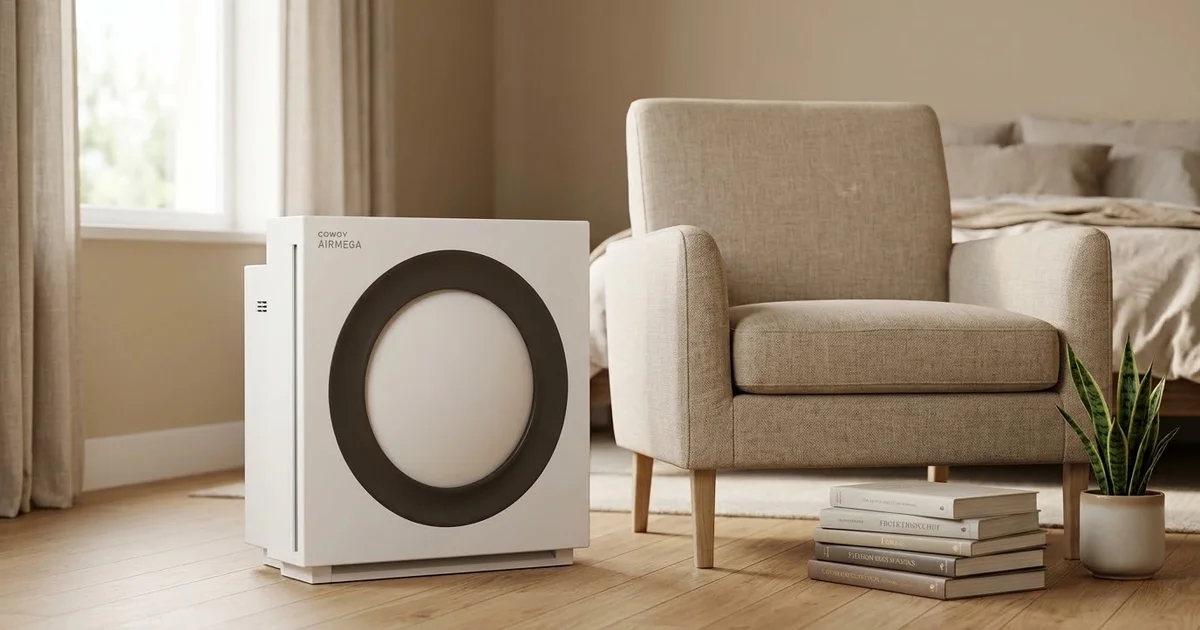
Coway Mighty2 vs AP-1512HH (2026)
Coway's Mighty2 replaced the AP-1512HH as Wirecutter's top pick. We compare CADR, noise, sensors, filter costs, and whether the older unit is still the smarter buy.
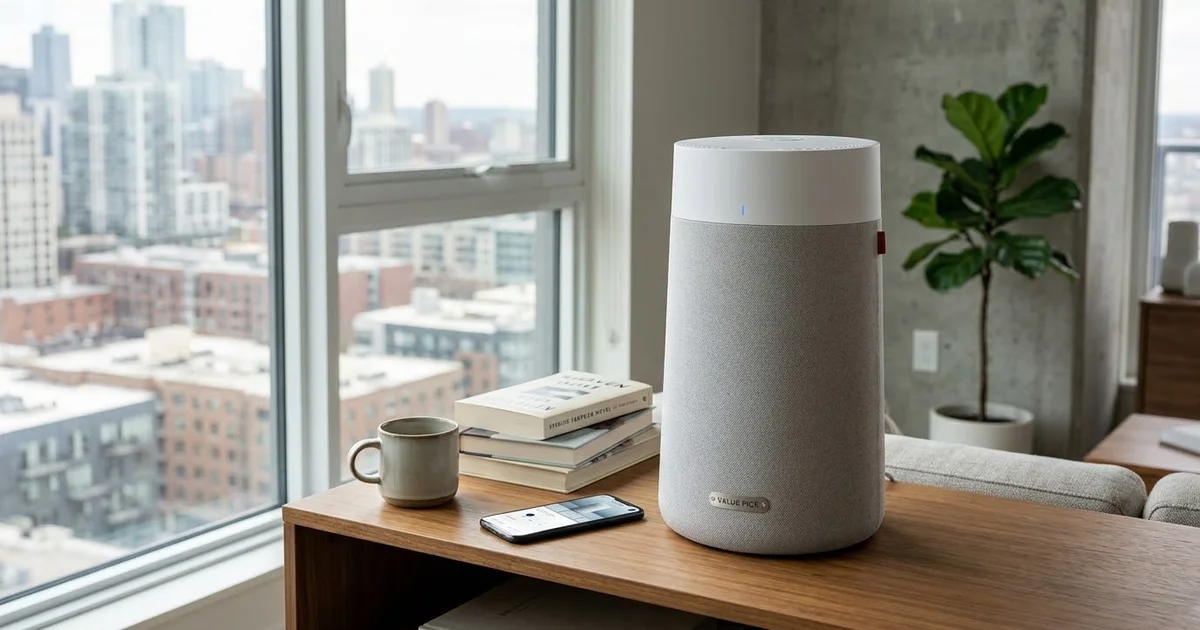
KNKA APH4000 Review: $150 Dark Horse
KNKA's APH4000 is one of Amazon's best-selling purifiers at $150. We check the AHAM certification, decode the 1,695 sq ft claim, and compare it to Levoit and Coway.
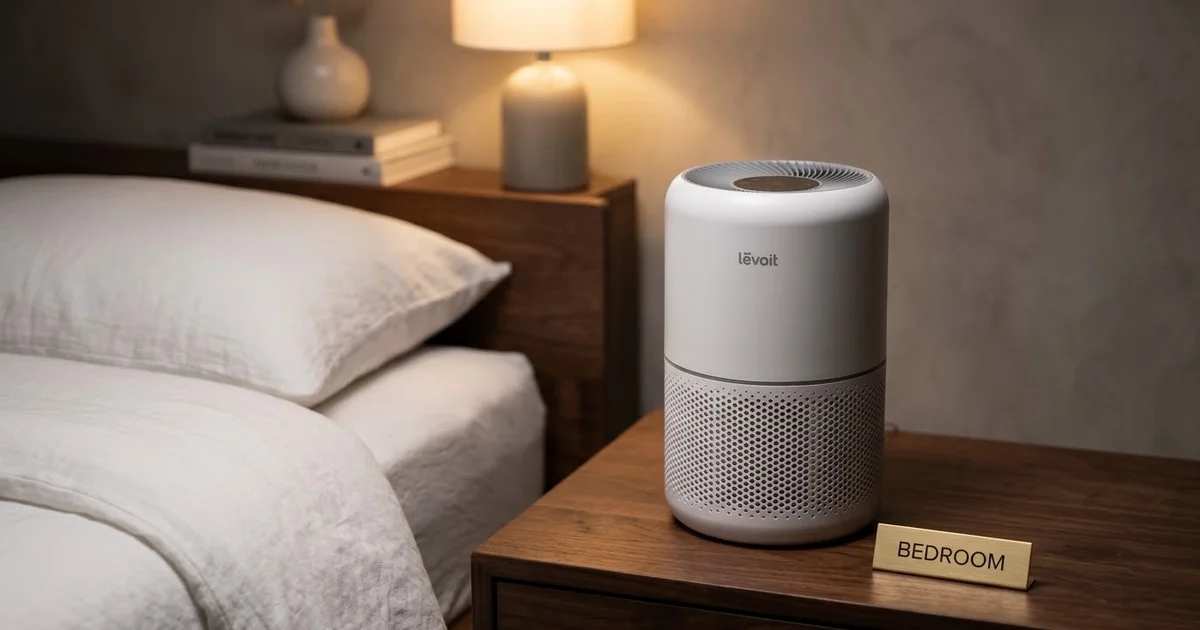
Levoit Core 300 vs 300-P: What Changed
Levoit quietly replaced the Core 300 with the Core 300-P. We explain the AHAM certification, whether filters still fit, and which one you should actually buy.
Shark NeverChange HP302 Review
Shark's NeverChange HP302 promises 5 years on one filter. We dig into the real running costs, the odor neutralizer catch, and whether it beats cheaper rivals.
Winix 5510 vs 5500-2: 2026 Verdict
The Winix 5500-2 is discontinued and the 5510 takes over. We compare CADR, noise, filter costs, and the one compatibility problem nobody mentions.
🛒 Products Mentioned
As an Amazon Associate, we earn from qualifying purchases.
Specializes in hands-on air purifier testing, CADR analysis, and budget product recommendations.
View all articles by Alex →