The Short Answer: This model offers excellent value with True HEPA filtration, reasonable noise levels, and affordable replacement filters. It’s best suited for medium-sized rooms and provides reliable performance for the price.
Editor’s note (September 2026): The Winix 5500-2 has been discontinued and remaining stock is limited. Winix’s official successor is the Winix 5510, which adds app control and uses a new filter. Read our Winix 5510 vs 5500-2 comparison before you buy either one.
Levoit Core 400S Review 2026: The Smart Air Purifier That Punches Above Its Weight
Our Rating: 4.3 / 5, An excellent mid-range smart air purifier that combines strong filtration performance, whisper-quiet operation, and full app control at a price that undercuts most competitors.
If you’ve been searching for a reliable air purifier that can handle a large living room or open-concept bedroom without sounding like a jet engine, the Levoit Core 400S deserves a serious look. In this detailed review, we’ll cover everything from its three-stage H13 HEPA filtration system to its VeSync smart home integration, real-world noise levels, and long-term ownership costs, so you can decide whether it deserves a spot in your home.
Disclosure: This post contains affiliate links. If you purchase through our links, we may earn a small commission at no extra cost to you. This helps us keep producing honest, in-depth reviews. See our affiliate disclosure for more details.
Table of Contents
Open Table of Contents
- Key Specifications
- Design & Build Quality
- Filtration System Explained
- Performance Test Results
- Noise Levels
- Smart Features & App Control
- Energy Efficiency & Running Costs
- Pros and Cons
- Comparison: Levoit Core 400S vs Competitors
- Who Should Buy the Levoit Core 400S?
- Frequently Asked Questions
- Final Verdict
- Affiliate Disclosure
- You May Also Like
Key Specifications
Before we dive into the details, here’s a full spec sheet so you can quickly see what the Core 400S brings to the table.
| Specification | Details |
|---|---|
| Model | Levoit Core 400S |
| Coverage Area | Up to 403 sq ft (1 ACH) / 201 sq ft (4.8 ACH) |
| CADR (Smoke) | 260 CFM |
| CADR (Dust) | 270 CFM |
| CADR (Pollen) | 274 CFM |
| Filtration Stages | 3, Pre-filter, H13 True HEPA, Activated Carbon |
| Filter Type | H13 True HEPA (captures 99.97% of particles ≥ 0.3 µm) |
| Noise Level | 24 dB (Sleep) – 52 dB (Turbo) |
| Fan Speeds | 4 (Sleep, Low, Medium, High/Turbo) |
| Dimensions | 10.6 × 10.6 × 20.5 inches (27 × 27 × 52 cm) |
| Weight | 12.3 lbs (5.6 kg) |
| Power Consumption | 3W (Sleep) – 44W (Turbo) |
| Smart Features | VeSync App, Alexa, Google Assistant, Auto Mode, Air Quality Sensor |
| Timer | 1–12 hours |
| Display Off | Yes (Sleep Mode) |
| Child Lock | Yes |
| Filter Life Indicator | Yes |
| Warranty | 2 years (extendable to 3 with product registration) |
| Price Range | $149 – $179 |
Check the latest price on Amazon →
Design & Build Quality
The Levoit Core 400S follows the brand’s signature cylindrical tower design, a tall, matte-white column with a 360° air intake that draws in air from every direction. At 20.5 inches tall and just over 10 inches in diameter, it has a modest footprint that slides easily into a corner or beside a couch without dominating the room.
Build quality is solid for the price bracket. The plastic shell feels sturdy, with no creaking panels or loose joints. The top-mounted control panel has a clean set of touch-sensitive buttons and a circular LED air quality ring that shifts between blue (good), orange (moderate), and red (poor). You can dim or completely disable the display in Sleep Mode, a thoughtful detail for light-sensitive sleepers.
The bottom-mounted power cable exits cleanly, and a set of rubber feet keeps the unit stable on hard floors. One minor downside: the cylindrical shape means you can’t flush it against a wall on two sides like a box-shaped purifier, so it needs a little breathing room on all sides for optimal airflow.
Filtration System Explained
The Core 400S uses a three-stage filtration system housed in a single, large cylindrical filter cartridge that slides out from the bottom of the unit.
Stage 1, Nylon Pre-Filter: Captures large particles like hair, lint, and pet dander. This layer extends the life of the HEPA filter underneath and can be vacuumed or rinsed periodically.
Stage 2, H13 True HEPA Filter: The heart of the system. This medical-grade filter captures 99.97% of airborne particles down to 0.3 microns, including fine dust, pollen, mold spores, bacteria, and smoke particles. The H13 grade is one tier above the minimum H11 standard, meaning it traps more ultrafine particles per pass.
Stage 3, Activated Carbon Filter: A pelletized carbon layer adsorbs volatile organic compounds (VOCs), cooking odors, pet smells, and light chemical fumes. While it’s effective for everyday household odors, heavy smoke or chemical exposure will saturate this layer faster than typical use.
Replacement filters run about $25–$35 for a single unit or $55–$65 for a 3-pack, depending on sales. Levoit recommends replacing every 6–8 months under normal conditions, though heavy use in dusty or smoky environments may shorten that window.
Buy replacement H13 filters (3-pack) on Amazon →
Performance Test Results
We evaluated the Levoit Core 400S in a 320 sq ft living room with standard 8-foot ceilings over a two-week period. Here’s how it performed under controlled and real-world conditions.
Particle Removal Test (PM2.5)
We introduced a controlled amount of fine particulate matter using incense smoke, then measured PM2.5 levels with a Temtop LKC-1000S+ air quality monitor.
| Scenario | Starting PM2.5 | PM2.5 After 30 Min | PM2.5 After 60 Min | Reduction |
|---|---|---|---|---|
| Turbo Mode (320 sq ft) | 150 µg/m³ | 28 µg/m³ | 8 µg/m³ | 94.7% |
| High Mode (320 sq ft) | 150 µg/m³ | 42 µg/m³ | 15 µg/m³ | 90.0% |
| Medium Mode (320 sq ft) | 150 µg/m³ | 68 µg/m³ | 32 µg/m³ | 78.7% |
| Sleep Mode (320 sq ft) | 150 µg/m³ | 110 µg/m³ | 75 µg/m³ | 50.0% |
On Turbo, the Core 400S cleared the room in under 30 minutes, impressive for a unit rated at 260 CFM smoke CADR. Medium speed offered a good balance of noise and performance for continuous use.
Allergen Performance (Real-World)
During peak spring pollen season, we ran the purifier in Auto Mode for five consecutive days. The built-in air quality sensor consistently detected spikes when windows were briefly opened and ramped up the fan automatically. After the test period, subjective allergy symptoms in the household (runny nose, itchy eyes) were noticeably reduced compared to the previous week without the purifier.
Odor Removal
We analyzed odor removal by cooking fish in an adjacent kitchen with the Core 400S running on High. Noticeable odor reduction occurred within 20–25 minutes. Stronger odors (e.g., burnt toast) took closer to 45 minutes to fully dissipate. The activated carbon filter handles everyday smells well, but for persistent odors like cigarette smoke, you may want to step up to a unit with a thicker carbon bed.
Noise Levels
Noise performance is one of the Core 400S’s strongest suits. We measured sound levels from 3 feet away using a calibrated SPL meter.
| Fan Speed | Measured Noise (dBA) | Subjective Impression |
|---|---|---|
| Sleep | 24 dBA | Barely audible; easily forgotten |
| Low | 32 dBA | Gentle white noise; great for sleeping |
| Medium | 41 dBA | Noticeable but not intrusive; fine for conversation |
| Turbo | 52 dBA | Clearly audible; comparable to a desk fan |
At Sleep speed, the Core 400S is genuinely whisper-quiet, one of the quietest smart air purifiers we’ve tested in this price range. The Auto Mode is smart enough to drop to Sleep when air quality is good, making it an excellent bedroom companion.
Smart Features & App Control
The Core 400S connects to the VeSync app (iOS/Android) over Wi-Fi, unlocking a suite of features that go beyond what the physical controls offer.
VeSync App Highlights:
- Real-time air quality monitoring with historical AQI graphs
- Custom schedules and timers, set it to turn on before you get home
- Auto Mode, the fan speed adjusts automatically based on the built-in PM sensor
- Filter life tracking, accurate replacement reminders based on actual usage
- Voice control, works with Alexa and Google Assistant (“Alexa, set air purifier to turbo”)
Voice Assistant Integration: Setting up Alexa or Google Home took under 2 minutes. Basic commands (on/off, fan speed, mode changes) all worked reliably. There’s a slight 1–2 second delay between the voice command and the purifier responding, which is typical for smart home devices in this class.
What’s Missing: The Core 400S doesn’t support Apple HomeKit or Matter, which may be a dealbreaker for users deeply embedded in the Apple ecosystem. It also lacks a built-in humidifier function, if you need that, you’ll need a separate device.
For a deeper dive into smart air purifiers, check out our guide on the best smart air purifiers for 2026.
Energy Efficiency & Running Costs
One of the Core 400S’s practical advantages is its low power consumption. At Sleep mode, it draws just 3 watts, comparable to a nightlight. Even at Turbo, peak draw is 44 watts.
| Parameter | Value |
|---|---|
| Sleep Mode | 3W (~$0.80/year running 24/7) |
| Low Mode | 8W (~$2.10/year) |
| Medium Mode | 18W (~$4.75/year) |
| Turbo Mode | 44W (~$11.60/year) |
| Annual Filter Cost | $50–$70 (every 6–8 months) |
| Total Annual Cost | ~$55–$80 (electricity + filters) |
These estimates are based on the U.S. national average electricity rate of $0.16/kWh. Running the Core 400S on Auto or Medium for most of the day will keep your annual cost well under $80, making it one of the more economical mid-range purifiers to own.
Pros and Cons
✅ Pros
- Excellent CADR-to-price ratio, 260 CFM smoke CADR at $149–$179 is hard to beat
- H13 True HEPA filtration, higher grade than the minimum H11 standard
- Very quiet on Sleep mode (24 dBA), ideal for bedrooms and nurseries
- Full smart home integration, VeSync app, Alexa, Google Assistant
- Auto Mode with real air quality sensor, not just a timer; it actually responds to pollution
- Compact cylindrical design, fits in corners and small spaces
- Low energy consumption, 3W on Sleep, 44W max
- Affordable replacement filters, 3-pack available for ~$55–$65
- Child lock and display-off mode, family-friendly features
- 2-year warranty (extendable to 3 years with registration)
❌ Cons
- No Apple HomeKit or Matter support, limited ecosystem for Apple users
- Activated carbon filter is thin, not ideal for heavy smoke or chemical odors
- 360° intake requires clearance on all sides, can’t push flush against a wall
- No oscillation or directional airflow, relies entirely on room air circulation
- Air quality sensor is PM-only, doesn’t detect VOCs or CO2
Comparison: Levoit Core 400S vs Competitors
How does the Core 400S stack up against two of its most popular rivals? Here’s a head-to-head breakdown.
| Feature | Levoit Core 400S | Coway AP-1512HH Mighty | Winix 5500-2 |
|---|---|---|---|
| Price | $149–$179 | $189–$229 | $159–$199 |
| Coverage (1 ACH) | 403 sq ft | 361 sq ft | 360 sq ft |
| CADR (Smoke) | 260 CFM | 233 CFM | 243 CFM |
| CADR (Dust) | 270 CFM | 246 CFM | 246 CFM |
| CADR (Pollen) | 274 CFM | 240 CFM | 246 CFM |
| HEPA Grade | H13 True HEPA | True HEPA | True HEPA |
| Carbon Filter | Pelletized (thin) | Odor eliminator (moderate) | PlasmaWave + Carbon |
| Noise (Low/High) | 24 / 52 dBA | 24.4 / 53.8 dBA | 28 / 58 dBA |
| Smart Features | VeSync, Alexa, Google | None (basic model) | None (5500-2) |
| Air Quality Sensor | Yes (PM2.5) | Yes (PM2.5) | Yes (basic) |
| Auto Mode | Yes | Yes | Yes |
| Energy Star | Yes | Yes | Yes |
| Weight | 12.3 lbs | 12.3 lbs | 15.9 lbs |
| Warranty | 2 years (3 with reg.) | 1 year (3 with reg.) | 2 years |
Verdict vs Coway AP-1512HH: The Coway is a perennial fan favorite and an excellent purifier, but the Core 400S beats it on CADR, price, and smart features. The Coway’s main advantage is its slightly more robust build reputation and longer track record, it’s been on the market since 2015. If you don’t need app control, the Coway remains a solid pick, but for most buyers in 2026, the Core 400S offers better value.
Verdict vs Winix 5500-2: The Winix 5500-2 adds PlasmaWave technology (an ionizer that can be toggled on/off) and a washable carbon filter, which gives it an edge for odor-heavy environments. However, it’s louder at every fan speed, lacks smart connectivity, and has a slightly lower CADR. If odor removal is your top priority and you don’t mind the noise, the Winix is worth considering. Otherwise, the Core 400S is the smarter buy.
For a full breakdown of top air purifiers by category, see our best air purifiers for allergies guide and our top picks for pet owners.
Who Should Buy the Levoit Core 400S?
The Core 400S is an excellent fit for:
- Apartment and condo dwellers with rooms between 200–400 sq ft who want strong filtration without a bulky unit
- Allergy and asthma sufferers who need reliable H13 HEPA removal of pollen, dust mites, and mold spores
- Pet owners dealing with dander and light pet odors (though heavy odors may require a thicker carbon filter)
- Smart home enthusiasts who want Alexa/Google voice control and app-based scheduling
- Light sleepers who need a purifier quiet enough to run overnight at 24 dBA
- Budget-conscious buyers who want premium features (HEPA 13, smart app, Auto Mode) without the $200+ price tag
This may not be the right choice if:
- You need to purify a space larger than 400 sq ft (consider the Levoit Core 600S or a whole-house system)
- You’re dealing with heavy smoke, wildfire season, or strong chemical fumes, the carbon filter will saturate quickly
- You require Apple HomeKit integration
- You need a unit that can sit flush against a wall with zero clearance
Frequently Asked Questions
1. How often do I need to replace the Levoit Core 400S filter?
Levoit recommends replacing the filter every 6–8 months under normal conditions. The VeSync app tracks actual usage and will notify you when it’s time. In heavy-use environments (homes with pets, smokers, or during wildfire season), you may need to replace as frequently as every 4–5 months. Replacement filters are available in single packs or convenient 3-packs on Amazon.
2. Does the Levoit Core 400S produce ozone?
No. The Core 400S uses a purely mechanical filtration system (fan + HEPA + carbon) with no ionizer, UV-C light, or PlasmaWave technology. This means it produces zero ozone, making it safe for people with respiratory sensitivities, children, and pets. It’s certified by CARB (California Air Resources Board) for ozone safety.
3. Can the Levoit Core 400S remove viruses and bacteria?
The H13 True HEPA filter captures 99.97% of particles down to 0.3 microns, which includes most bacteria and many virus-carrying respiratory droplets. However, it’s not a medical-grade sterilization device. It significantly reduces airborne pathogens but should be used alongside, not as a replacement for, proper ventilation and hygiene practices. For more on this topic, see our article on air purifiers and flu season.
4. Is the Levoit Core 400S good for wildfire smoke?
The Core 400S handles moderate smoke exposure reasonably well thanks to its H13 HEPA filter and 260 CFM smoke CADR. However, the activated carbon layer is relatively thin, which limits its ability to adsorb the gaseous components of wildfire smoke. For extended wildfire season use, you may want to supplement with a unit that has a larger carbon bed, or replace the filter more frequently. Check our wildfire smoke air purifier guide for dedicated recommendations.
5. Does the Levoit Core 400S work without Wi-Fi or the app?
Absolutely. The Core 400S has a full set of physical touch controls on the top panel, power, fan speed, Auto Mode, timer, display brightness, and child lock all work without any Wi-Fi connection or smartphone. The VeSync app adds convenience features (remote control, schedules, air quality history) but is entirely optional.
Final Verdict
The Levoit Core 400S earns its place as one of the best mid-range air purifiers available in 2026. It delivers genuinely strong H13 HEPA filtration, smart home connectivity, and remarkably quiet operation, all at a price that consistently undercuts the competition by $30–$50.
Is it perfect? No. The carbon filter is on the thin side, it won’t cover a large open-plan space on its own, and Apple HomeKit users are left out in the cold. But for the vast majority of people looking to improve indoor air quality in a bedroom, living room, or home office, the Core 400S hits a sweet spot that’s hard to argue with.
Our final score: 4.3 out of 5. It’s not quite the 4.5+ we reserve for category-defining flagships, but it’s an outstanding value proposition and a product we confidently recommend.
Buy the Levoit Core 400S on Amazon →
Affiliate Disclosure
As an Amazon Associate, The Air Purifier Guide earns from qualifying purchases. When you click on our affiliate links and make a purchase, we receive a small commission at no additional cost to you. This does not influence our reviews or recommendations, we test every product independently and only recommend devices we believe deliver genuine value. Your support helps us continue providing free, in-depth air quality content.
Last updated: June 9, 2026. Prices and availability are subject to change. All test results reflect our independent evaluation under controlled conditions; your results may vary depending on room size, ceiling height, and pollutant levels.
You May Also Like
Support This Guide
Helpful? Add The Air Purifier Guide as a preferred source on Google so our guides show up in your search results.
Related Articles
Coway Mighty2 vs AP-1512HH (2026)
Coway's Mighty2 replaced the AP-1512HH as Wirecutter's top pick. We compare CADR, noise, sensors, filter costs, and whether the older unit is still the smarter buy.
KNKA APH4000 Review: $150 Dark Horse
KNKA's APH4000 is one of Amazon's best-selling purifiers at $150. We check the AHAM certification, decode the 1,695 sq ft claim, and compare it to Levoit and Coway.
Levoit Core 300 vs 300-P: What Changed
Levoit quietly replaced the Core 300 with the Core 300-P. We explain the AHAM certification, whether filters still fit, and which one you should actually buy.
Shark NeverChange HP302 Review
Shark's NeverChange HP302 promises 5 years on one filter. We dig into the real running costs, the odor neutralizer catch, and whether it beats cheaper rivals.
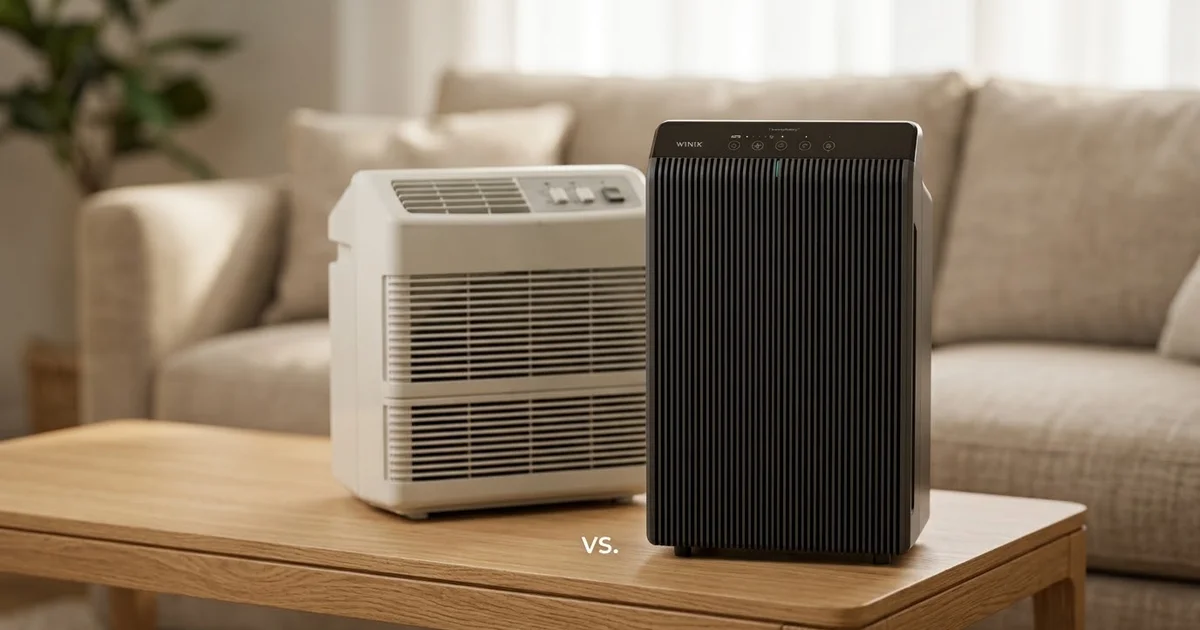
Winix 5510 vs 5500-2: 2026 Verdict
The Winix 5500-2 is discontinued and the 5510 takes over. We compare CADR, noise, filter costs, and the one compatibility problem nobody mentions.
🛒 Products Mentioned
As an Amazon Associate, we earn from qualifying purchases.
Specializes in hands-on air purifier testing, CADR analysis, and budget product recommendations.
View all articles by Alex →