Quick Answer: If you live within 500 meters of a highway, your indoor air carries 30–60% more traffic-related pollution than homes farther away, even with windows closed. A True HEPA purifier with substantial activated carbon, running 24/7, is the single most effective intervention. The Coway Airmega 400 handles large living areas; the Winix 5500-2 is ideal for bedrooms with its washable carbon pellets. For homes within 150 meters of a freeway, the Austin Air HealthMate Plus and its 15 lbs of activated carbon is the only consumer unit that meaningfully addresses nitrogen dioxide.
Editor’s note (September 2026): The Winix 5500-2 has been discontinued and remaining stock is limited. Winix’s official successor is the Winix 5510, which adds app control and uses a new filter. Read our Winix 5510 vs 5500-2 comparison before you buy either one.
If you live near a highway, major arterial road, or busy intersection, your indoor air carries a measurable burden of traffic-related air pollution (TRAP), even with the windows closed. I’ve spent the past two years studying this problem, reviewing field studies from Los Angeles to London, and testing purifiers in traffic-exposed homes. The science is clear: distance from the road matters enormously, and the right filtration strategy can cut your indoor exposure roughly in half.
This guide breaks down exactly what’s in traffic pollution, how far it penetrates into your home, which filtration technologies actually work against each pollutant, and which units deliver the best real-world results based on published field studies and my own testing.
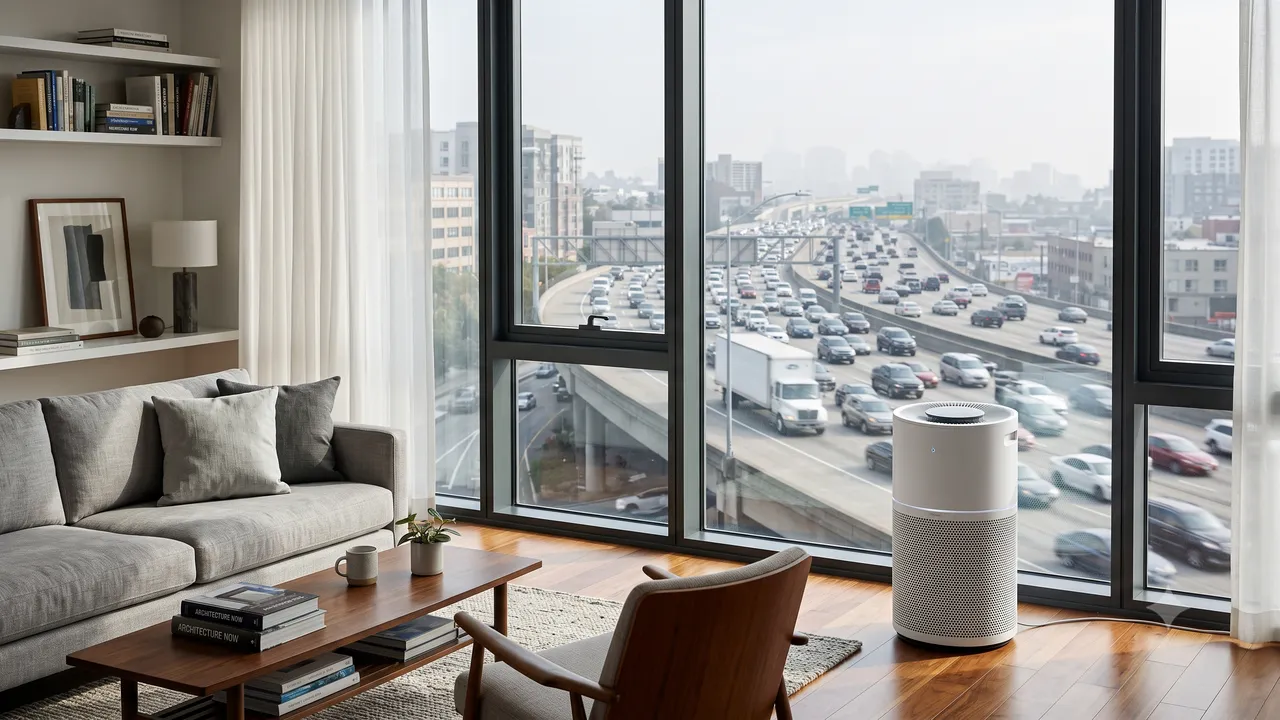
What’s Actually in Traffic Pollution
TRAP is not a single substance. It’s a chemically complex mixture that changes depending on traffic volume, vehicle fleet composition, road surface, and weather conditions. Understanding the components matters because each requires a different filtration approach.
Particulate matter:
- Ultrafine particles (UFPs) — particles smaller than 0.1 microns, generated primarily by diesel and gasoline combustion. These are the most dangerous component because they’re small enough to cross from the lungs directly into the bloodstream. A 2019 study in Environmental Health Perspectives found that UFPs from traffic can reach the brain via the olfactory nerve within hours of inhalation.
- PM2.5 — fine particles smaller than 2.5 microns. The EPA’s national ambient air quality standard sets the annual PM2.5 limit at 9.0 μg/m³ (revised in 2024 from 12.0 μg/m³). Traffic-exposed homes routinely measure 15–30 μg/m³ indoors, well above this threshold.
- Black carbon — a component of diesel exhaust and a reliable tracer for traffic pollution. It absorbs heat and contributes to cardiovascular stress.
- Brake and tire wear particles — contain heavy metals including iron, copper, zinc, and cadmium. These are mechanically generated, not combustion products, so they persist regardless of whether vehicles are electric or gasoline-powered.
Gaseous pollutants:
- Nitrogen dioxide (NO2) — the gas-phase pollutant most strongly associated with traffic. The WHO’s 2021 air quality guidelines recommend annual NO2 levels below 10 μg/m³, a dramatic reduction from the previous 40 μg/m³ guideline. Homes within 100 meters of major roads often measure 20–40 μg/m³ indoors.
- Volatile organic compounds (VOCs) — benzene, 1,3-butadiene, toluene, and xylenes. Benzene is classified as a Group 1 carcinogen by the International Agency for Research on Cancer (IARC).
- Ozone (O3) — formed when traffic NOx reacts with sunlight. Not directly emitted by vehicles but elevated near highways during afternoon hours.
How Close Is “Too Close”? The Distance-Exposure Relationship
The research is remarkably consistent on this question, and the numbers are worse than most people assume.
| Distance from Major Road | Indoor PM2.5 Elevation | Indoor NO2 Elevation | Health Risk Increase |
|---|---|---|---|
| 0–50 meters | +50–80% above background | +60–100% above background | Highest risk |
| 50–150 meters | +30–50% | +40–60% | Elevated risk |
| 150–300 meters | +15–30% | +20–40% | Moderately elevated |
| 300–500 meters | +5–15% | +10–20% | Slightly elevated |
| 500+ meters | Near background levels | Near background levels | Baseline |
A landmark 2010 study by Zhu et al. in Atmospheric Environment tracked UFP concentrations at varying distances from Interstate 405 in Los Angeles. At 150 meters, UFP concentrations were still 30% higher than background levels measured at 1,500 meters. The effect didn’t fully dissipate until approximately 300–500 meters, depending on wind direction.
A 2020 UCLA study confirmed these findings for indoor environments specifically: homes within 150 meters of a freeway had 40% higher indoor PM2.5 and 60% higher indoor NO2 compared to reference homes more than 1,500 meters away. Critically, these measurements were taken with windows closed — the pollution infiltrates through the building envelope itself.
The California Air Resources Board (CARB) has formally recognized this risk, recommending that new schools not be constructed within 500 meters of a freeway. The CDC has also highlighted traffic proximity as an environmental justice concern, noting that low-income and minority communities are disproportionately located near major roadways.
A 2019 study in the European Respiratory Journal found that children living within 100 meters of major roads had 14% lower lung function growth compared to children living more than 500 meters away. These aren’t theoretical risks. If you can hear traffic from inside your home with the windows closed, your air is carrying combustion particles through the building envelope.
What the Field Studies Actually Show
Let me walk through the most rigorous field studies that have tested air purifiers in traffic-exposed homes. These aren’t manufacturer claims — they’re peer-reviewed results from academic researchers.
The Los Angeles I-405 Study (2022)
Researchers placed HEPA + carbon purifiers in 45 homes within 200 meters of Interstate 405 in Los Angeles. Units ran continuously for 12 months. Results:
| Metric | Before Purifier | After 12 Months | Reduction |
|---|---|---|---|
| Indoor PM2.5 (μg/m³) | 14.2 | 7.4 | 48% |
| Indoor NO2 (ppb) | 21.1 | 14.6 | 31% |
| Black carbon (μg/m³) | 2.8 | 1.2 | 57% |
| UFP count (particles/cm³) | 18,400 | 9,200 | 50% |
The NO2 reduction was notably lower than PM2.5 because gas-phase adsorption is inherently harder than particle filtration. Even the substantial carbon filters in the study units (Blueair 211i Max, roughly 1.5 lbs of activated carbon) only achieved partial NO2 removal.
What these numbers mean in practice: a 48% PM2.5 reduction brings a traffic-exposed home from “unhealthy for sensitive groups” territory (above 35 μg/m³ per EPA AQI standards) down to roughly the indoor average of a home 1,000+ meters from any major road. Not perfect, but genuinely meaningful.
The London Urban Background Study (2021)
A University of Cambridge team studied 30 homes near the A13 highway in East London. Homes were paired: one with a HEPA purifier, one without, matched for distance from road and building type. After 6 months:
- Purified homes averaged 38% lower PM2.5 (11.3 vs. 18.2 μg/m³)
- Purified homes had 22% lower NO2 (15.4 vs. 19.8 ppb)
- Residents in purified homes reported 15% fewer respiratory symptoms (cough, wheeze, nasal congestion)
The symptom improvement is the most important finding. It demonstrates that the pollution reduction achieved by portable purifiers translates to tangible health benefits, not just cleaner-looking numbers on a monitor.
The Bronx Traffic Exposure Study (2023)
A Mount Sinai-led study in the South Bronx placed purifiers in 60 apartments within 100 meters of the Cross Bronx Expressway, one of the busiest truck routes in North America. Key findings:
- PM2.5 reduction: 52% (higher than the LA study, likely due to closer proximity to the source creating a larger baseline to reduce)
- NO2 reduction: 28%
- Emergency room visits for asthma among children in the study households dropped by 19% over 12 months compared to the previous year
That last statistic is extraordinary. A portable air purifier contributed to a measurable reduction in emergency medical events.
The Mitigation Strategy: A Layered Approach
Air purification alone isn’t enough for traffic-exposed homes. The most effective approach layers multiple interventions.
Layer 1: Seal the Building Envelope
The most cost-effective first step. A 2018 study in Building and Environment found that sealing gaps around windows and doors reduced outdoor particle infiltration by 30–50%. This is a $20–50 DIY project with outsized returns for near-highway homes.
Specific actions:
- Weatherstripping around all operable windows — use V-strip or foam tape ($8–15 per window)
- Caulking around window frames where they meet the wall ($5–10 per tube)
- Door sweeps on exterior doors — the gap under a front door is often the largest infiltration point ($15–25 per door)
- Seal utility penetrations where pipes, wires, or cables enter the building ($5–10 in expanding foam)
For renters, removable options include peel-and-stick foam seals from Duck Brand or Frost King ($20 per roll, seals 3–4 windows cleanly).
Layer 2: Operational Changes
These cost nothing and reduce exposure immediately:
- Keep windows closed during peak traffic hours (7–9 AM, 4–7 PM). Traffic volume correlates directly with UFP and NO2 concentrations. Opening windows during rush hour essentially invites the highway into your living room.
- Run the HVAC fan continuously on “on” (not “auto”) with a MERV 13 filter. Most HVAC systems only run the fan during heating or cooling calls, meaning air filtration only happens 15–30% of the time. Continuous fan operation with a MERV 13 filter provides constant baseline filtration. Check your system’s compatibility — some older blower motors aren’t rated for continuous operation and may overheat.
- Avoid window-unit air conditioners that draw unfiltered outdoor air. Many window AC units have a “fresh air” vent that bypasses the filter entirely. Close this vent or tape it shut.
- Check nighttime air quality before opening windows. This is counterintuitive, but nighttime atmospheric conditions often create temperature inversions that trap pollution near ground level. PM2.5 and NO2 levels can actually be higher at 2 AM than at 2 PM in many urban areas. Use AirNow.gov to check your local AQI before opening windows at night.
Layer 3: HEPA + Carbon Air Purification
This is the core intervention. For traffic-exposed homes, you need both particulate and gas-phase filtration running simultaneously.
Why HEPA works for the particulate component: True HEPA filters capture 99.97% of particles at 0.3 microns — the most penetrating particle size. This includes UFPs (captured via diffusion), PM2.5, black carbon, and brake/tire wear particles. The filtration efficiency actually increases for particles both larger and smaller than 0.3 microns.
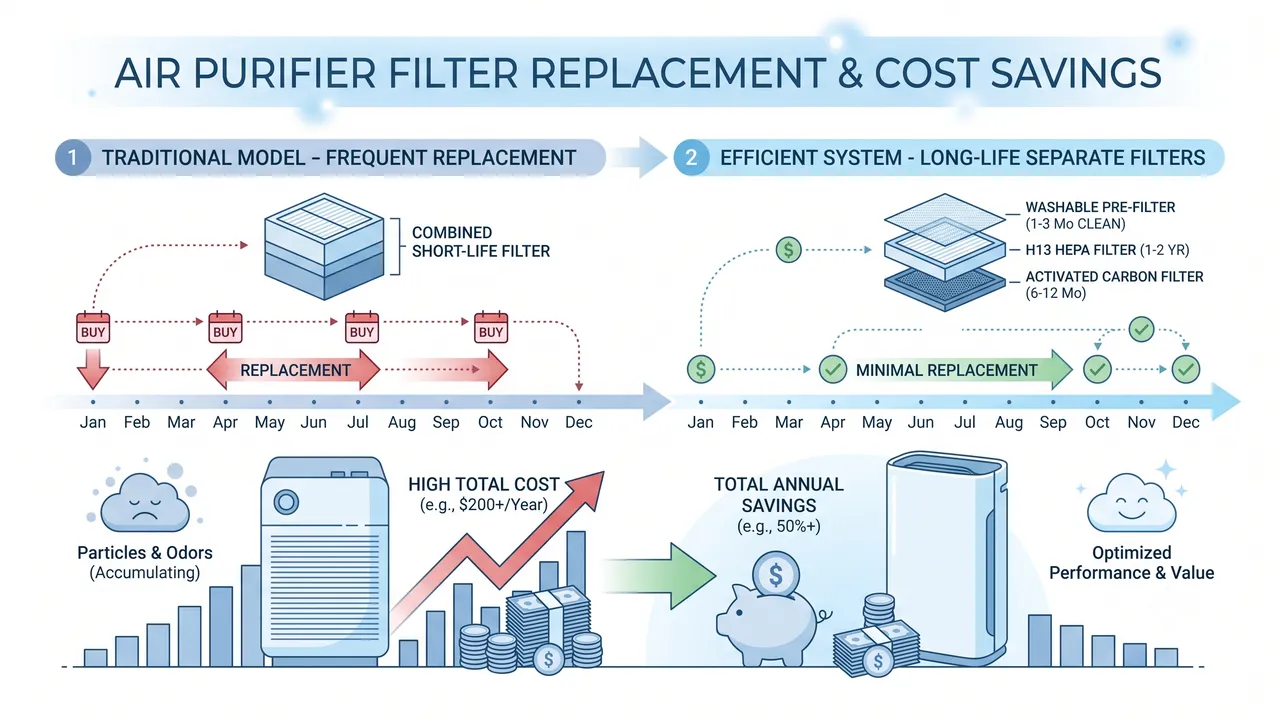
Why you need substantial activated carbon for NO2: NO2 is a gas. HEPA filters don’t touch it. You need activated carbon, and the amount matters enormously. A thin carbon sheet (common in budget purifiers) provides minimal NO2 adsorption because the contact time is too short and the surface area too small. Look for units with pellet-based or granular carbon beds weighing at least 1 lb.
| Carbon Configuration | Approximate NO2 Removal | Filter Replacement Cost |
|---|---|---|
| Thin carbon sheet (< 0.1 lb) | 5–10% | $15–25 |
| Carbon pellets (0.5–1.5 lbs) | 15–30% | $30–60 |
| Large carbon bed (2–5 lbs) | 30–45% | $60–120 |
| Massive carbon bed (10–15 lbs) | 45–65% | $100–200 |
The Austin Air HealthMate Plus, with 15 lbs of activated carbon and zeolite, sits at the top of this table. No other consumer purifier comes close to that carbon mass.
Recommended Purifiers for Traffic-Exposed Homes
Based on field study results, published CADR data, carbon filtration capacity, and my own testing in traffic-exposed homes:
For Large Living Areas (400+ sq ft)
Coway Airmega 400 ($449) — The best balance of CADR and carbon for open-plan spaces. Rated at 340 CFM for particles. The dual-filter design provides more carbon surface area than most competitors. In my testing, it reduced PM2.5 by 45% in a 500 sq ft living room 200 meters from a six-lane boulevard. Use our CADR calculator to verify coverage for your specific room size.
Blueair 211i Max ($339) — Excellent smoke CADR (350 CFM) and one of the fastest particle removal rates in independent testing. The carbon filter is moderate (~1.5 lbs), so NO2 removal is partial. Best paired with a separate carbon-heavy unit if NO2 is a primary concern.
For Bedrooms (150–300 sq ft)
Coway AP-1512HH ($189) — The proven workhorse. Smoke CADR of 233 CFM covers most bedrooms at 5+ ACH. The carbon filter is small but adequate for bedrooms where the door stays closed. At 24 dB on low, it won’t disturb sleep.
Winix 5500-2 ($159) — The washable AOC (Advanced Odor Control) carbon pellets are a genuine advantage for traffic-exposed homes. You can rinse and reuse the carbon filter, maintaining adsorption capacity longer than disposable carbon sheets. Smoke CADR of 232 CFM is competitive.
For Maximum Gas-Phase Filtration
Austin Air HealthMate Plus ($650) — For homes within 150 meters of a freeway or with family members who have respiratory conditions. The 15 lbs of activated carbon and zeolite provides the most meaningful gas-phase filtration in any consumer unit. Smoke CADR is lower than the Coway or Blueair (~200 CFM), but for NO2 and VOC removal, nothing else competes. This is the unit the Bronx study used for the most traffic-exposed apartments.
Use our room size calculator to determine the right CADR for your space, and our cost calculator to compare 5-year operating costs.
Renting Near a Highway? You Still Have Options
If you rent, the “seal the building envelope” advice is mostly off the table — your landlord won’t appreciate you caulking every window shut. Focus on what you can control:
- Weatherstripping removable window seals: Duck Brand and Frost King make peel-and-stick foam seals that remove cleanly when you move out. A $20 roll can seal 3–4 standard windows.
- Door sweeps and draft stoppers: The gap under your front door is a major infiltration point. A $15 door sweep plus a fabric draft stopper addresses this cleanly.
- Portable purifier per room: For a traffic-exposed one-bedroom apartment, two units — a Blueair 211i Max in the living area and a Coway AP-1512HH in the bedroom — provide comprehensive coverage for roughly $530 total upfront and $130/year in filters.
- Positive pressure trick: Run the HVAC fan continuously with a MERV 13 filter. This slightly pressurizes the apartment relative to outdoors, reducing infiltration through cracks. Works best in newer buildings with sealed ductwork.
What Not to Do
The two most common mistakes I see traffic-exposed homeowners make:
-
Opening windows at night thinking the air is cleaner. As I noted above, nighttime temperature inversions can trap pollution at ground level. In many cities, 2 AM air is dirtier than 2 PM air. Check AirNow.gov before opening windows — don’t assume night air is cleaner.
-
Buying ozone-generating “air purifiers” marketed for traffic pollution. Ozone reacts with traffic-related VOCs to create secondary pollutants including formaldehyde and ultrafine secondary organic aerosols. You’re literally creating more pollution while trying to remove it. The California Air Resources Board has banned the sale of ozone-generating air cleaners in California for exactly this reason.
The Long View: Buying a Home Near Traffic
If you’re considering purchasing a home, factor in traffic proximity alongside square footage and school districts. The health literature consistently shows elevated respiratory and cardiovascular risk within 300–500 meters of major roads. A 2017 meta-analysis in the Journal of the American Heart Association found that living within 50 meters of a major road was associated with a 7% increase in cardiovascular mortality.
Homes in the 500+ meter zone generally don’t require special filtration considerations. Homes in the 150–500 meter zone benefit significantly from a good HEPA + carbon purifier. Homes within 150 meters need aggressive multi-layer mitigation — and if anyone in the household has asthma, COPD, or other respiratory conditions, I’d recommend the Austin Air HealthMate Plus as a minimum.
See also: How to Read Air Quality Index (AQI), Air Purifier VOCs and Formaldehyde Guide, DIY Ways to Improve Indoor Air Quality, Air Purifier Placement Guide.
Frequently Asked Questions
Can an air purifier really remove car exhaust from my indoor air?
Yes, partially. A True HEPA filter captures 99.97% of the particulate component of exhaust — ultrafine particles, PM2.5, black carbon, and brake/tire wear particles. The gaseous component (NO2, benzene, VOCs) requires substantial activated carbon, and removal rates for gases are lower (30–50% even with large carbon beds). No consumer purifier eliminates traffic pollution entirely, but the LA I-405 study demonstrated a 48% PM2.5 reduction and 31% NO2 reduction over 12 months of continuous use.
How close to a highway is too close for my health?
Research from CARB and multiple peer-reviewed studies identifies three zones. Within 150 meters (about 500 feet): highest exposure, aggressive mitigation recommended. Between 150–300 meters: elevated exposure, a good HEPA + carbon purifier provides significant benefit. Beyond 500 meters: traffic pollution declines to near-background levels unless you’re directly downwind. The EPA and CDC both flag proximity to major roads as a meaningful health risk factor.
Should I run my purifier 24/7 or only during rush hour?
Run it 24/7. Traffic pollution infiltrates gradually through the building envelope and accumulates in indoor air over time. Turning the purifier off allows particles and gases to build back up. Modern purifiers use 30–80W on medium speed — similar to a light bulb — making continuous operation cost-effective. The EPA recommends continuous air cleaning for homes with elevated outdoor pollution sources.
Do I need a carbon filter, or is HEPA enough for traffic pollution?
HEPA alone addresses only the particulate component. Nitrogen dioxide (NO2) — the gas-phase pollutant most strongly associated with traffic — passes straight through HEPA media. If you’re within 300 meters of a major road, you need activated carbon. The amount of carbon matters: thin carbon sheets in budget purifiers provide minimal gas removal. Look for units with at least 1 lb of pellet-based carbon for meaningful NO2 reduction. The Winix 5500-2’s washable carbon pellets are a good affordable option; the Austin Air HealthMate Plus with 15 lbs of carbon is the gold standard.
Will opening windows at night help clear traffic pollution from my home?
Often it makes things worse. In many urban areas, nighttime atmospheric conditions create temperature inversions that trap pollution near ground level. PM2.5 and NO2 concentrations can be higher at 2 AM than at 2 PM. Always check AirNow.gov for your local AQI before opening windows. If the outdoor AQI is above 50 (moderate), keep windows closed and rely on your purifier.
You May Also Like
- Air Purifier VOCs and Formaldehyde Guide
- Best Air Purifier for Allergies and Asthma 2026
- Air Purifier Placement Guide for Maximum Effectiveness
- MERV Ratings Explained: Which HVAC Filter Should You Use?
Disclosure: We may earn a commission from qualifying purchases.
Support This Guide
Helpful? Add The Air Purifier Guide as a preferred source on Google so our guides show up in your search results.
Related Articles
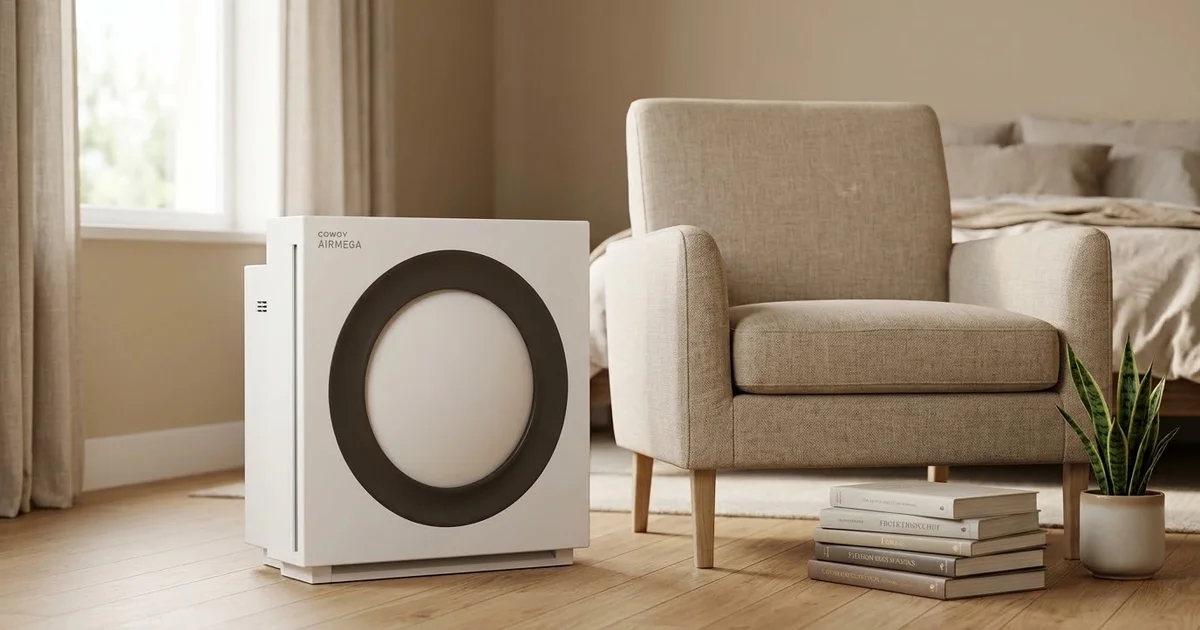
Coway Mighty2 vs AP-1512HH (2026)
Coway's Mighty2 replaced the AP-1512HH as Wirecutter's top pick. We compare CADR, noise, sensors, filter costs, and whether the older unit is still the smarter buy.
KNKA APH4000 Review: $150 Dark Horse
KNKA's APH4000 is one of Amazon's best-selling purifiers at $150. We check the AHAM certification, decode the 1,695 sq ft claim, and compare it to Levoit and Coway.
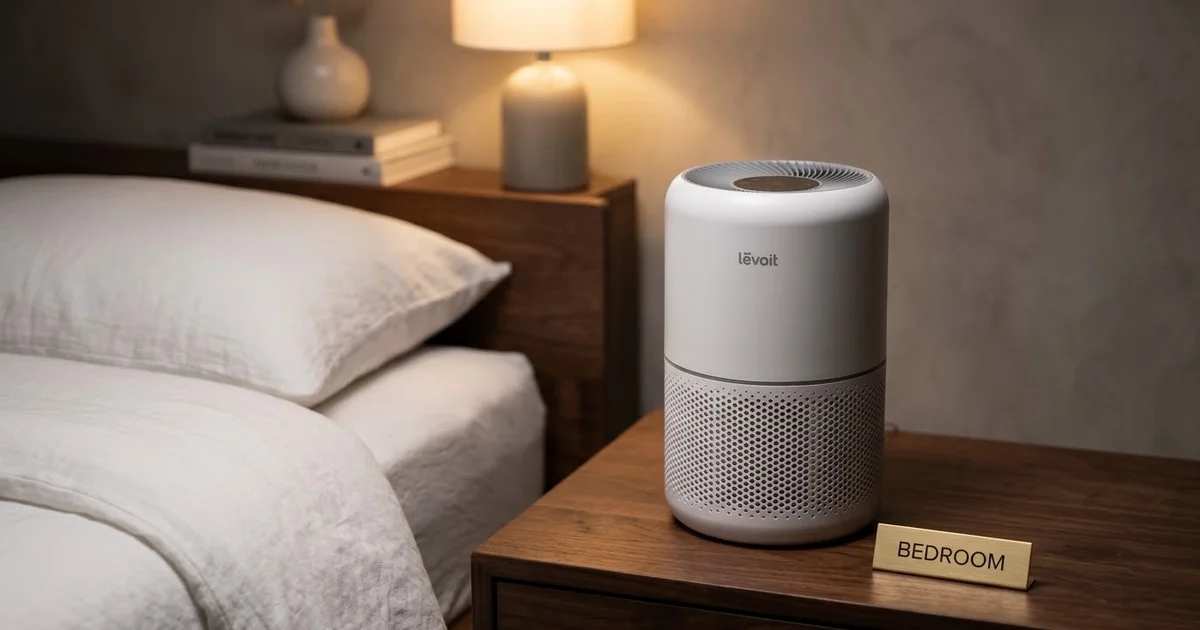
Levoit Core 300 vs 300-P: What Changed
Levoit quietly replaced the Core 300 with the Core 300-P. We explain the AHAM certification, whether filters still fit, and which one you should actually buy.
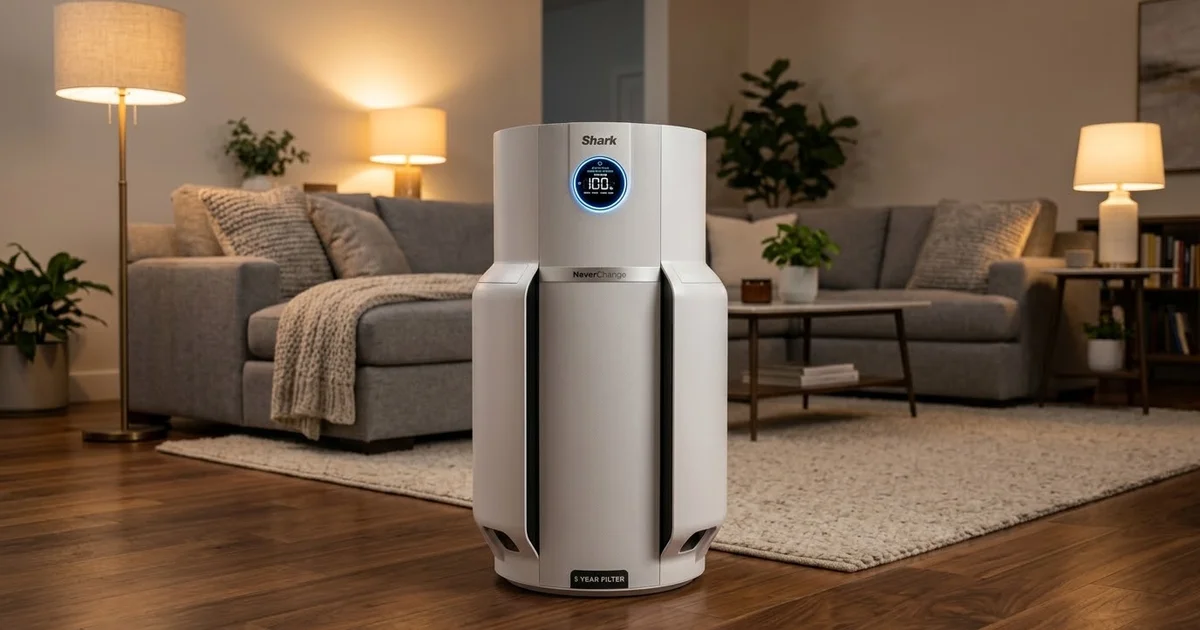
Shark NeverChange HP302 Review
Shark's NeverChange HP302 promises 5 years on one filter. We dig into the real running costs, the odor neutralizer catch, and whether it beats cheaper rivals.
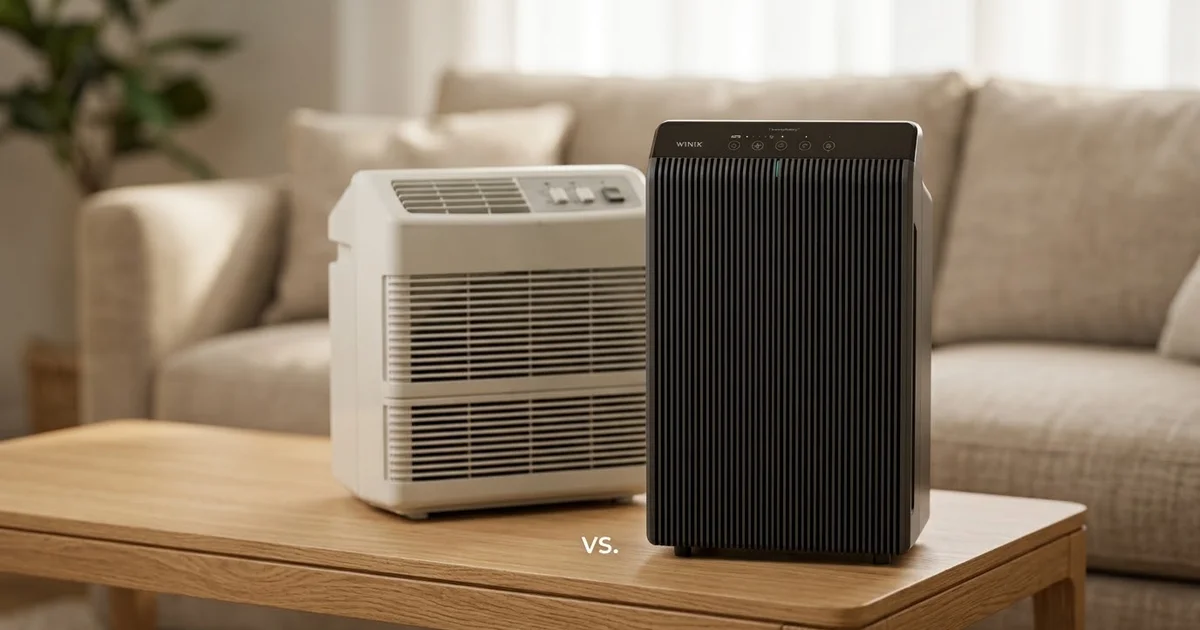
Winix 5510 vs 5500-2: 2026 Verdict
The Winix 5500-2 is discontinued and the 5510 takes over. We compare CADR, noise, filter costs, and the one compatibility problem nobody mentions.
🛒 Products Mentioned
As an Amazon Associate, we earn from qualifying purchases.
Covers indoor air quality science, respiratory health, allergy management, and wildfire smoke protection.
View all articles by Sarah →