Quick Answer: The 4-7-8 breathing technique means you inhale quietly through your nose for 4 seconds, hold your breath for 7 seconds, then exhale slowly through your mouth for 8 seconds — repeating for 4 cycles. That long, controlled exhale activates your parasympathetic nervous system (your “rest-and-digest” mode), which slows your heart rate, lowers stress, and helps you fall asleep faster. It’s free, takes 60 seconds, and works anywhere.
Counting in your head is easy to lose track of when you're tired or anxious. Use our free 4-7-8 Breathing Timer — it paces every inhale, hold, and exhale with a visual guide so you can just breathe and relax.
If you’ve ever lain awake at 2 a.m. with your mind racing, or felt your chest tighten before a stressful meeting, you already know that “just calm down” is useless advice. The nervous system doesn’t respond to willpower — it responds to signals. And one of the most reliable signals you can send your body is a slow, deliberate breath.
The 4-7-8 breathing technique, popularized by Dr. Andrew Weil, is one of the simplest and most effective of these tools. It’s a form of paced breathing that deliberately extends the exhale, and it has quietly become a go-to method for people struggling with insomnia, anxiety, and everyday stress. I’ve spent the past year testing breathing protocols, reading the physiology literature, and talking to people who use them nightly. This guide walks you through exactly what 4-7-8 is, why it works, how to do it correctly, and how to fit it into your life.

What Is the 4-7-8 Breathing Technique?
The 4-7-8 technique is a structured breathing pattern built around three phases with fixed counts:
- Inhale through your nose for a count of 4
- Hold your breath for a count of 7
- Exhale through your mouth for a count of 8
That single sequence is one cycle. You typically repeat it for four cycles, which takes less than two minutes. The defining feature is the extended exhale — your out-breath is twice as long as your in-breath. This ratio is what does the heavy lifting, and it’s the reason 4-7-8 feels so noticeably calming compared to normal breathing.
The technique has roots in pranayama, the ancient yogic practice of breath control. Dr. Weil, a physician trained at Harvard, adapted and simplified it into the memorable 4-7-8 formula so ordinary people could use it without instruction. Unlike meditation, it doesn’t require you to “clear your mind” — you simply focus on counting, which itself pulls attention away from anxious thoughts.
How It Differs From Other Breathing Methods
There are several popular paced-breathing techniques, and it helps to understand where 4-7-8 fits:
| Technique | Pattern | Best For |
|---|---|---|
| 4-7-8 breathing | Inhale 4, hold 7, exhale 8 | Falling asleep, winding down |
| Box breathing | Inhale 4, hold 4, exhale 4, hold 4 | Sustained focus, acute stress |
| Diaphragmatic breathing | Slow belly breaths, no fixed count | General relaxation, beginners |
If you tend to use breathing during the day to steady yourself under pressure, you may prefer the balanced rhythm of box breathing for stress. If your main struggle is panic or spiraling anxious thoughts, a dedicated approach like the one in how to stop anxiety with breathing may suit you better. The 4-7-8 method shines specifically when your goal is to down-regulate — to shift from alert to sleepy, from tense to calm.
The Physiology: Why 4-7-8 Actually Works
This isn’t wellness folklore. The reason a long exhale calms you comes down to well-understood physiology of the autonomic nervous system.
The Parasympathetic Nervous System
Your autonomic nervous system has two branches. The sympathetic branch drives “fight or flight” — racing heart, shallow breathing, muscle tension. The parasympathetic branch drives “rest and digest” — slower heart rate, relaxed muscles, and the calm state you need for sleep and recovery.
Here’s the key insight: breathing is the one part of the autonomic system you can consciously control. When you exhale slowly and for longer than you inhale, you tip the balance toward the parasympathetic side. In other words, a deliberate long exhale is a direct switch you can flip to tell your body it’s safe to relax.
The Vagus Nerve and Heart Rate Variability
The main highway of the parasympathetic system is the vagus nerve, which connects your brainstem to your heart, lungs, and gut. Slow breathing — especially with a prolonged exhale — stimulates the vagus nerve. This is sometimes called increasing “vagal tone.”
One measurable result is a rise in heart rate variability (HRV), the natural beat-to-beat variation in your heartbeat. Counterintuitively, higher variability is a sign of a healthy, adaptable nervous system, while chronically low HRV is associated with stress and poor recovery. Research published in journals such as Frontiers in Psychology and the International Journal of Psychophysiology has repeatedly shown that slow-paced breathing around 6 breaths per minute increases HRV and shifts people toward parasympathetic dominance. The 4-7-8 pattern naturally slows you to roughly this rate.
What the Authorities Say About Breathing and Stress
Major health institutions increasingly recognize controlled breathing as a legitimate, low-risk intervention. The World Health Organization (WHO), in its guidance on managing stress, explicitly recommends slow breathing exercises as a practical grounding tool to reduce physical tension and worry. The U.S. Centers for Disease Control and Prevention (CDC) likewise lists deep, slow breathing among evidence-informed coping strategies for stress management, noting that just a few minutes can help calm the body.
The broader research picture reinforces this. A 2023 systematic review and meta-analysis published in Scientific Reports (part of the Nature portfolio) analyzed controlled breathwork studies and concluded that slow breathing interventions produced small-to-moderate reductions in self-reported stress, anxiety, and depressive symptoms compared to controls. And decades of work in the Journal of Clinical Sleep Medicine and related sleep literature support the idea that calming the nervous system before bed shortens the time it takes to fall asleep. None of this means breathing is a cure — but it’s a well-supported, side-effect-free starting point.
Step-by-Step: How to Do 4-7-8 Breathing Correctly
Here’s the exact protocol. Read it once, then try it. The most common mistake is rushing, so go slower than feels natural.
Before you begin: Sit with your back straight, or lie down if you’re using it to sleep. Rest the tip of your tongue against the ridge of tissue just behind your upper front teeth, and keep it there throughout. Exhale completely through your mouth once to empty your lungs before your first cycle.
Step 1 — Inhale for 4 Seconds
Close your mouth and inhale quietly through your nose while counting to 4. Breathe into your belly, not your chest — your stomach should expand outward while your shoulders stay still. This “belly breathing” fills the lower lungs where gas exchange is most efficient. Keep the inhale gentle and smooth; you’re not gulping air.
Step 2 — Hold for 7 Seconds
Hold your breath for a count of 7. This is the longest single phase, and it may feel awkward at first — that’s normal. The hold gives oxygen time to fully saturate your bloodstream and, importantly, it slows the entire cycle down. If 7 seconds feels impossible in the beginning, don’t strain; just hold comfortably and build up. Never hold to the point of dizziness.
Step 3 — Exhale for 8 Seconds
Now exhale completely through your mouth, making a soft whoosh sound, over a count of 8. Let the air out slowly and steadily around your tongue. This long, controlled exhale is the heart of the technique — it’s what stimulates the vagus nerve and switches on your relaxation response. Empty your lungs fully by the end of the count.
Step 4 — Repeat for 4 Cycles
That completes one full cycle. Without pausing, begin the next inhale and repeat the entire sequence for a total of 4 cycles. Beginners should stop at 4 to avoid lightheadedness. As you get comfortable over a few weeks, you can work up to 8 cycles, but four is genuinely enough for most people to feel a shift.
Tip: The exact number of seconds matters less than the ratio — exhaling for twice as long as you inhale. If holding for 7 makes you tense, scale everything down (try 2-3.5-4) while keeping the same proportions, then build up.
Best Times and Situations to Practice
The 4-7-8 technique is flexible, but a few scenarios stand out where it’s especially useful.
Before Sleep
This is the technique’s flagship use. Practice it lying in bed with the lights off, right after you’ve settled in. Because it down-regulates your nervous system, it eases the transition from wakefulness to sleep and quiets the mental chatter that keeps so many people awake. Many people find that doing 4 cycles as their “last thing” before sleep becomes a powerful signal to the brain that it’s time to shut down.
Your sleep environment matters here too. A calm nervous system helps you fall asleep, but clean, allergen-free bedroom air helps you stay asleep by reducing nighttime congestion and airway irritation. This is why breathing practice and air quality work so well together — see our deep dive on air purifiers and sleep quality for the evidence. A quiet bedroom purifier like the Levoit Core 300 runs near-silently on low, so you get cleaner air without noise disrupting your wind-down routine.
During an Anxiety Spike or Panic
When you feel anxiety rising — a racing heart, tight chest, shallow breathing — 4-7-8 gives your mind something concrete to do besides feed the fear. The counting occupies the anxious brain, and the long exhale physically counteracts the fast, shallow breathing that fuels panic. Use it discreetly at your desk, in the car (parked, not driving), or before a stressful conversation.
Everyday Stress and Focus Resets
You don’t need to be in crisis to benefit. A quick round between tasks, after a tense email, or before a meeting can reset your baseline. Dr. Weil famously recommends practicing it twice a day so the technique becomes second nature — that way it’s already automatic when you actually need it under pressure.
Common Mistakes and Precautions
Even though it’s simple, people trip on a few things:
- Breathing through the chest, not the belly. Shallow chest breathing keeps you in a stress state. Make sure your abdomen rises on the inhale.
- Rushing the counts. If you race through 8 in three seconds, you lose the benefit. Use a steady mental count or, better, a breathing timer to keep honest pacing.
- Straining on the hold. The 7-second hold should feel controlled, not desperate. Build up gradually.
- Doing too many cycles at first. More is not better early on. Stick to 4 cycles until it feels effortless — overdoing it can cause lightheadedness from the change in breathing rhythm.
- Expecting instant sedation the first time. For some people the calming effect is immediate; for others it takes a couple of weeks of consistent practice before the nervous system “learns” the response.
A note on safety: 4-7-8 breathing is safe for the vast majority of healthy adults. However, if you have a respiratory condition such as COPD or asthma, are pregnant, or have a cardiovascular condition, check with your doctor before adding breath-holding exercises. Stop if you feel dizzy, and never practice while driving or operating machinery. Controlled breathing is a wonderful self-help tool, but it is not a replacement for professional care — if you have persistent insomnia, anxiety, or panic attacks, please consult a qualified healthcare provider.
How Long Until You See Results?
Expectations matter, so here’s an honest timeline:
- First session: Many people feel noticeably calmer and a little drowsy right away — a slower heart rate and looser shoulders. Some feel little the first time, which is completely normal.
- First 1–2 weeks: With twice-daily practice, the relaxation response tends to strengthen. Falling asleep may start to feel easier, and the technique becomes more automatic.
- 4–6 weeks and beyond: This is where the technique becomes a reliable, on-demand tool. Because you’ve practiced it when calm, your body knows the pattern well enough to use it during genuine stress.
Think of it like training a muscle. The more consistently you practice when you don’t urgently need it, the more powerful it becomes when you do. Consistency beats intensity every time.
Combining Clean Air With Breathwork
One theme worth underlining: your breath is only as good as the air you’re breathing. Practicing beautiful 4-7-8 cycles in a room full of dust, pollen, or pet dander is like meditating next to a leaf blower. The two habits reinforce each other — a calm nervous system plus clean air is a genuine sleep and wellness upgrade.
This matters even more for sensitive groups. Older adults, whose sleep is often lighter and more easily disrupted, benefit enormously from both calmer evenings and cleaner bedroom air — a topic we cover in air purifiers for elderly and senior health. And if allergies are what’s keeping you congested and awake in the first place, addressing the root cause is essential; our guide to the best air purifiers for allergies in 2026 walks through the top options. A proven all-rounder like the Coway AP-1512HH pairs true-HEPA filtration with a quiet sleep mode, making it an easy companion to a nightly breathing routine.
Frequently Asked Questions
How many times a day should I do 4-7-8 breathing? Aim for twice a day — once in the morning and once before bed is a common routine. Keep it to 4 cycles per session at first. You can do extra rounds any time you feel stressed, but avoid marathon sessions that leave you lightheaded.
Can 4-7-8 breathing really help me fall asleep faster? For many people, yes. By activating the parasympathetic nervous system and slowing the heart rate, it eases the transition into sleep and quiets racing thoughts. It works best as part of a broader wind-down routine in a cool, dark, clean-air bedroom.
What if I can’t hold my breath for 7 seconds? That’s fine and very common. Scale the counts down while keeping the ratio (for example, 2-3.5-4), and build up over time. The proportion — a long exhale relative to the inhale — matters more than the exact seconds.
Is 4-7-8 breathing better than box breathing? They serve different goals. 4-7-8, with its extended exhale, is ideal for winding down and sleep. Box breathing’s balanced rhythm is better for staying calm and focused while alert. Try both and use whichever fits the moment.
Is it safe for everyone? It’s safe for most healthy adults, but people with respiratory or cardiovascular conditions, or who are pregnant, should consult a doctor before doing breath-holds. Stop if you feel dizzy, and never practice while driving.
Do I really need a timer? Not strictly — but a timer removes the mental effort of counting, which is exactly the effort you’re trying to reduce when you’re anxious or sleepy. Our free breathing timer paces each phase visually so you can fully relax into it.
The Bottom Line
The 4-7-8 breathing technique is about as close as wellness gets to a free lunch: it costs nothing, takes under two minutes, has essentially no side effects, and rests on solid physiology. Inhale for 4, hold for 7, exhale for 8, repeat four times. That long exhale flips your nervous system from stressed to settled, making it a genuinely useful tool for sleep, anxiety, and everyday tension.
Start tonight. Lie down, dim the lights, and run four slow cycles — ideally with a breathing timer to keep your pacing honest. Pair it with clean, quiet bedroom air, practice it consistently even when you feel fine, and give it a couple of weeks. Your nervous system, like any well-trained system, will start responding on cue. And if sleep or anxiety problems persist despite your best efforts, treat that as a signal to talk with a healthcare professional — breathwork is a powerful ally, but you deserve real support too.
Support This Guide
Helpful? Add The Air Purifier Guide as a preferred source on Google so our guides show up in your search results.
Related Articles
Coway Mighty2 vs AP-1512HH (2026)
Coway's Mighty2 replaced the AP-1512HH as Wirecutter's top pick. We compare CADR, noise, sensors, filter costs, and whether the older unit is still the smarter buy.
Levoit Core 300 vs 300-P: What Changed
Levoit quietly replaced the Core 300 with the Core 300-P. We explain the AHAM certification, whether filters still fit, and which one you should actually buy.
Shark NeverChange HP302 Review
Shark's NeverChange HP302 promises 5 years on one filter. We dig into the real running costs, the odor neutralizer catch, and whether it beats cheaper rivals.
Winix 5510 vs 5500-2: 2026 Verdict
The Winix 5500-2 is discontinued and the 5510 takes over. We compare CADR, noise, filter costs, and the one compatibility problem nobody mentions.
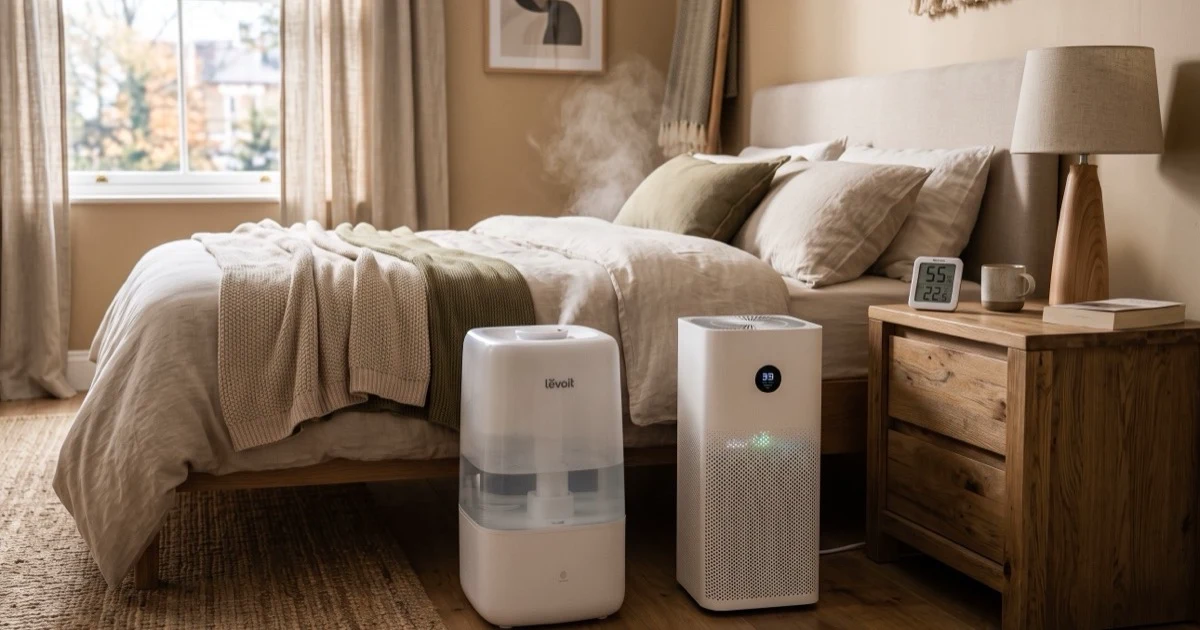
Does an Air Purifier Dry Out the Air? The Honest Answer
If your throat feels dry after running a purifier, you're not imagining it — but it's probably not the purifier. Here's the humidifier-vs-purifier reality, with the measurements to prove it.
🛒 Products Mentioned
As an Amazon Associate, we earn from qualifying purchases.
Covers indoor air quality science, respiratory health, allergy management, and wildfire smoke protection.
View all articles by Sarah →