The Short Answer: Classroom air purifiers should cover at least 350 sq ft, run quietly (under 50 dB), and have True HEPA filtration. Studies show air purification reduces absenteeism by 15-25%. Place units centrally with unobstructed airflow.
Editor’s note (September 2026): The Winix 5500-2 has been discontinued and remaining stock is limited. Winix’s official successor is the Winix 5510, which adds app control and uses a new filter. Read our Winix 5510 vs 5500-2 comparison before you buy either one.
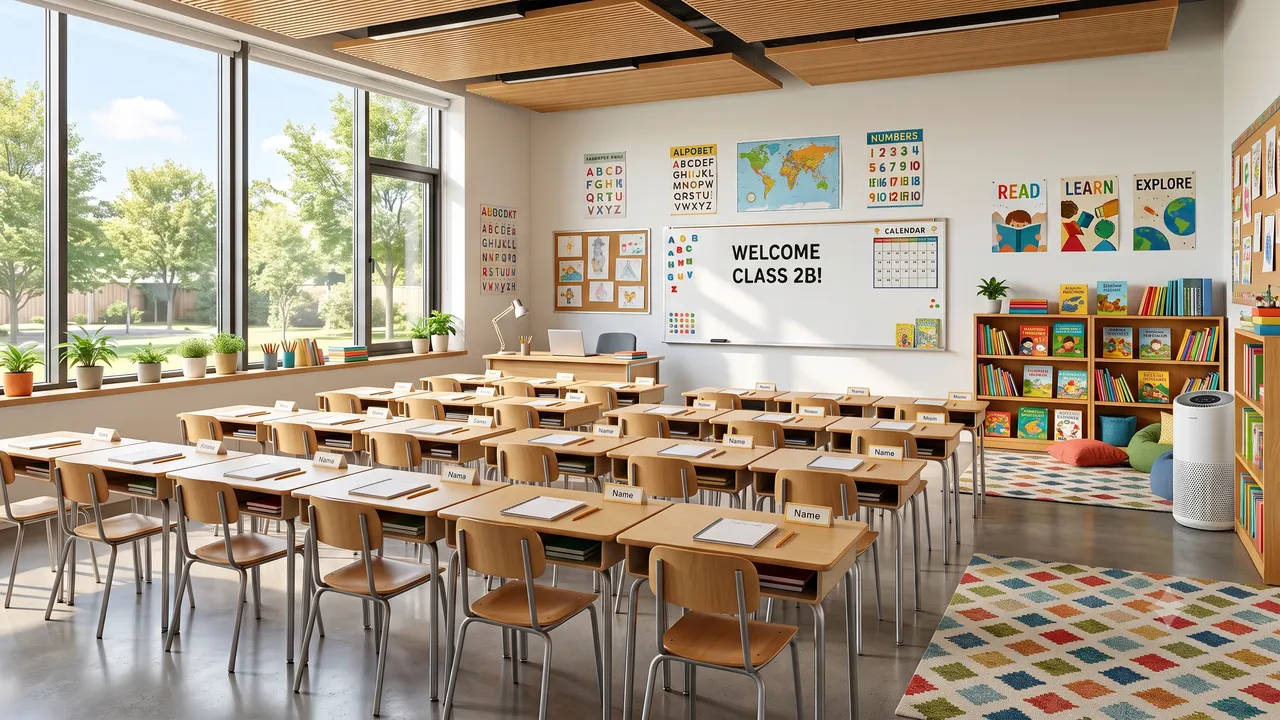
Classrooms are among the most challenging indoor environments for air quality. Thirty students packed into 900 square feet, sharing air for six or seven hours a day, five days a week, it’s an ideal setup for respiratory virus transmission, allergen buildup, and elevated CO₂ levels. And in many American schools, the HVAC systems responsible for ventilating these rooms are 30 to 50 years old, running well below current ASHRAE standards.
The good news is that a growing body of peer-reviewed research shows that portable HEPA air purifiers can meaningfully reduce airborne pathogen levels in classrooms, leading to fewer student absences from respiratory illness. But deploying purifiers in schools isn’t as simple as plugging in a residential unit and walking away. Classrooms have specific noise constraints, sizing requirements, safety considerations, and budget realities that shape which solutions actually work.
This guide covers the research evidence, the best air purifiers for classroom use, how to size a unit for your room, and how to advocate, and fund, air purification in your school.
Research Evidence: Air Purifiers Reduce Student Absences
The evidence base for classroom air purification has grown substantially since 2020, but it didn’t start with COVID-19. Here are the key studies that schools and parents should know about:
Georgia Elementary Schools Study (2021, CDC-funded): This is the largest and most cited classroom air purification trial. Researchers deployed HEPA purifiers in 169 classrooms across multiple elementary schools in Georgia and found a 48% reduction in COVID-19 incidence compared to control classrooms without purifiers. The effect was consistent across schools with different ventilation systems and building ages.
Italian Schools Asthma Study (2019): Before the pandemic, Italian researchers studied the impact of HEPA purifiers on asthma-related absences in school-age children. Classrooms equipped with portable HEPA units saw a 33% reduction in asthma-triggered absenteeism, with the greatest benefits observed among children with allergic asthma.
Bradford CLASS-ACT Trial (2022, UK): This large-scale randomized controlled trial, published in preliminary form in The Lancet, evaluated whether HEPA purifiers supplementing natural ventilation could reduce respiratory illness in primary schools. Early results showed significant reductions in classroom PM2.5 and CO₂ concentrations, with ongoing analysis of health outcomes.
Utah Elementary School Study (2023): Researchers at the University of Utah deployed HEPA purifiers in elementary classrooms and measured airborne virus levels. Purified classrooms showed 65% lower concentrations of detectable respiratory viruses in air samples compared to control rooms.
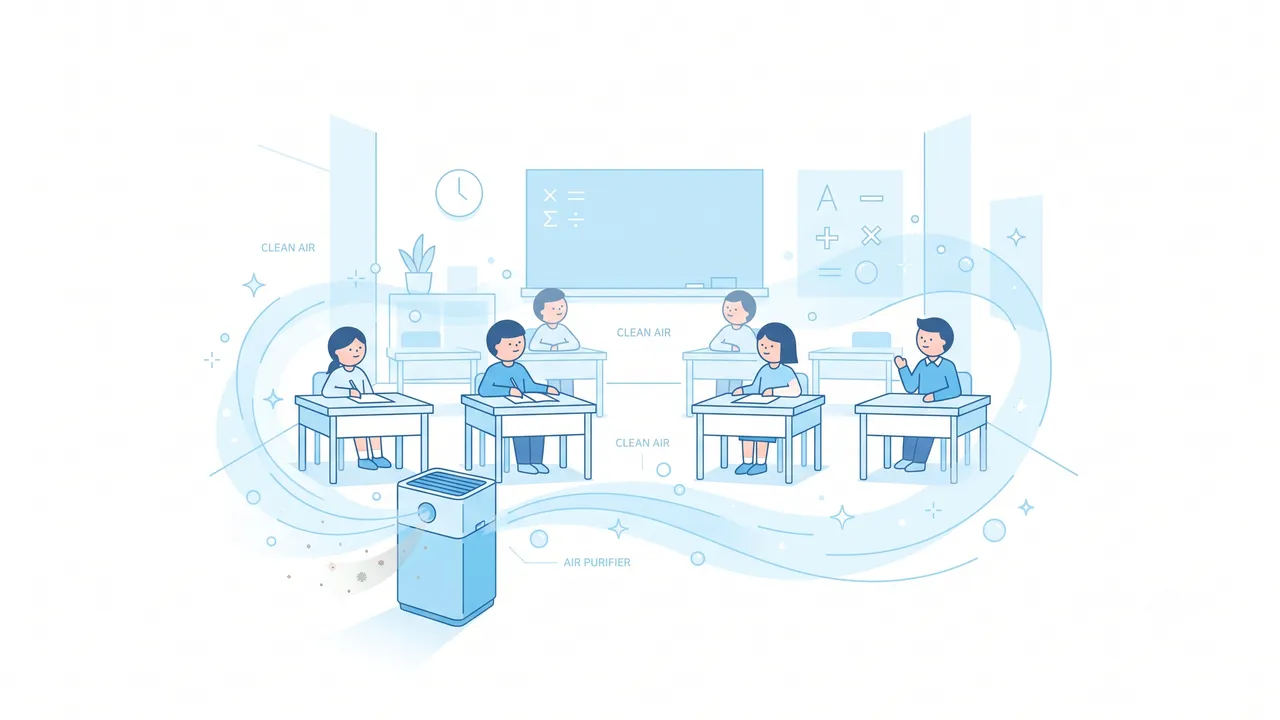
The mechanism behind these findings is straightforward. HEPA filters capture the respiratory aerosol particles, typically 1 to 5 microns in diameter, that carry viruses, bacteria, and allergens between room occupants. In a room where 25 to 30 students sit together for hours, this interception meaningfully reduces the concentration of airborne pathogens. It doesn’t replace ventilation, but it significantly supplements it, especially in older buildings where opening windows isn’t practical year-round.
For more on how air purifiers compare to other indoor air quality strategies, see our guide on DIY Ways to Improve Indoor Air Quality.
Best Air Purifiers for Classrooms
Not every air purifier that works well in a bedroom will work in a classroom. Schools need units that are quiet enough not to disrupt instruction, large enough to clean the full room volume, durable enough for daily use across 180+ school days, and safe around children. The table below compares five units that meet these criteria.
| Product | Noise Level (Medium) | Room Coverage | Price | Cord Safety Features |
|---|---|---|---|---|
| Coway AP-1512HH | 40 dB | ~360 sq ft per unit (use 2-3 for standard classroom) | ~$189 | 6-ft cord, no exposed wiring, stable base |
| Winix 5500-2 | 38 dB | ~360 sq ft per unit | ~$159 | 6-ft cord, low-profile design, tip-resistant |
| Blueair 211i Max | 32 dB (medium) | ~550 sq ft per unit | ~$339 | Short cord with cord management, weighted base |
| Coway Airmega 400 | 43 dB | ~1,560 sq ft (single unit for large classroom) | ~$449 | 6-ft cord, lockable child-safety controls |
| Medify Air MA-112 | 45 dB | ~2,500 sq ft (oversized for most classrooms) | ~$499 | Integrated cord storage, casters with locks |
Coway AP-1512HH (Best Budget Multi-Unit Setup): At ~$189 each, three units placed along the perimeter of a 900 sq ft classroom deliver effective coverage at a combined noise level that stays below typical classroom ambient noise (~40-45 dB). This is the most common real-world configuration in schools that have adopted purifiers. The filters last 12 months under normal use, and replacement filters cost ~$55 each. Total first-year cost for three units: approximately $730.
Winix 5500-2 (Best Value): Slightly quieter than the Coway on medium and ~$30 cheaper per unit. The washable carbon pre-filter extends HEPA filter life, reducing ongoing costs. A strong choice for schools deploying across many classrooms.
Blueair 211i Max (Best for Single-Unit Coverage): If you can only place one unit in a standard classroom, the Blueair 211i Max on medium covers more ground quietly than any competitor. At 32 dB on medium, it’s virtually inaudible during instruction. The tradeoff is higher filter replacement cost (~$70 every 6 months).
Coway Airmega 400 (Best for Large or Open Classrooms): With 396 Dust CADR, a single Airmega 400 can handle a large classroom or open-plan learning space. Lockable controls prevent student tampering.
Medify Air MA-112 (Best for High-Risk Settings): Medical-grade H14 HEPA filtration makes this appropriate for school nurse’s offices, special education classrooms with medically vulnerable students, or settings where immunocompromised staff are present. The 700+ CADR is overkill for a standard classroom but provides exceptional air changes per hour.
For help calculating exactly how much filtration your room needs, see our Air Purifier CADR and ACH Guide.
Classroom Sizing Guide
Sizing an air purifier for a classroom requires more careful calculation than sizing for a bedroom. The standard recommendation for classrooms is 4 to 6 air changes per hour (ACH), which the CDC and ASHRAE both reference for occupied educational spaces. Here’s how to calculate what you need:
Step 1: Calculate room volume. Multiply the room’s square footage by its ceiling height. A typical elementary classroom is 900 sq ft × 10 ft ceilings = 9,000 cubic feet.
Step 2: Determine target CFM. At 4 ACH, you need (9,000 × 4) ÷ 60 = 600 CFM of clean air delivery. At 6 ACH, you need 900 CFM.
Step 3: Match CADR to CFM. An air purifier’s CADR (Clean Air Delivery Rate) roughly approximates its CFM for the particle size listed. So a unit with a Smoke CADR of 200 delivers approximately 200 CFM of clean air for smoke-sized particles (which include most respiratory aerosols).
Step 4: Account for real-world conditions. Manufacturers test CADR at maximum fan speed, which is typically too loud for a classroom. Divide the published CADR by 0.6 to 0.7 to estimate the effective CADR at a tolerable noise level. A unit with a published CADR of 350 might deliver ~210-245 CFM at classroom-appropriate volume.
Step 5: Decide on one large unit or multiple small units. For a 900 sq ft classroom needing 600 CFM, you can deploy either:
- One large unit (600+ CADR at medium speed, expensive, loud), or
- Three smaller units (~200 CADR each at medium, cheaper, quieter, better air distribution)
In practice, multiple smaller units almost always win. They provide more even air mixing, lower per-unit noise, and redundancy if one unit fails. For more on these calculations, see our Air Purifier Statistics and Facts guide.
Here’s a quick reference table:
| Classroom Size | Room Volume (10-ft ceiling) | CFM Needed (4 ACH) | Recommended Setup |
|---|---|---|---|
| 600 sq ft (small) | 6,000 cu ft | 400 CFM | 2× Coway AP-1512HH |
| 800 sq ft (standard) | 8,000 cu ft | 533 CFM | 2-3× Coway AP-1512HH or 1× Coway Airmega 400 |
| 900 sq ft (standard) | 9,000 cu ft | 600 CFM | 3× Coway AP-1512HH |
| 1,200 sq ft (large) | 12,000 cu ft | 800 CFM | 4× Coway AP-1512HH or 1× Medify MA-112 |
Cord Safety and Child-Proofing
Classrooms introduce safety considerations that don’t exist in adult bedrooms. Young children can pull on cords, trip over them, or tamper with controls. When deploying air purifiers in schools, follow these guidelines:
- Use cord covers or route cords along walls to prevent tripping hazards. Adhesive cord channels cost under $10 per unit.
- Secure units to the wall or place on stable, low surfaces. Top-heavy purifiers should be wall-anchored in classrooms with young children.
- Lock control panels. Several units (including the Coway Airmega 400) have child-lock features that prevent students from changing settings or turning the unit off.
- Place units out of reach when possible. On a counter, shelf, or elevated platform, never on the floor in a pre-K or kindergarten classroom.
- Ensure grounded three-prong plugs and avoid using extension cords. If an outlet is far from the ideal placement, have the school’s maintenance team install a dedicated outlet rather than running an extension cord across the room.
The Noise Problem, and How Schools Solve It
The single biggest barrier to air purifier adoption in schools isn’t cost, it’s noise. A purifier running at full power to clean a 900 sq ft classroom generates 50+ dB, which competes with teacher voice levels and interferes with instruction. Teachers will turn off a noisy unit, which defeats the entire purpose.
On low speed, most units are quiet (25-32 dB) but deliver only a fraction of their rated CADR, insufficient for the room volume. On auto mode, purifiers ramp up and down unpredictably based on sensor readings, which can startle students and disrupt focus.
Schools that have successfully adopted purifiers use one of two strategies:
-
Multiple quiet units on medium. Three Coway AP-1512HH units placed along the perimeter of a 900 sq ft classroom, all on medium, produce a combined noise level that blends into typical classroom ambient noise (~40-45 dB). This cleans the air effectively without anyone noticing the sound.
-
One high-quality quiet unit. For individual classrooms where a teacher or parent group is funding a single purchase, the Blueair 211i Max on medium (32 dB) provides the best single-unit coverage-to-noise ratio for a standard 800-900 sq ft classroom.
How to Advocate for Air Purifiers in Your School
If your school doesn’t have air purifiers yet, here’s how to make the case:
Start with data, not emotion. Print the Georgia schools study (linked above) and the CDC’s guidance on improving ventilation in schools. Administrators respond to peer-reviewed evidence and federal agency recommendations more than to general health concerns.
Calculate the cost per student. Three Coway AP-1512HH units for one classroom cost ~$570 upfront and ~$165/year in filters. For a class of 25 students, that’s $23 per student for the first year and $6.60 per student per year after that. Frame it in these terms, it’s cheaper than a single box of tissues per student.
Propose a pilot, not a school-wide rollout. Ask for purifiers in 2-3 classrooms for one semester. Track attendance data in those rooms versus control rooms. If absences drop, the data makes the case for expansion on its own.
Involve the school nurse. School nurses are powerful advocates because they see the absenteeism data firsthand. If your school nurse supports the initiative, ask them to present the health data to the principal or school board.
Address the noise concern upfront. Bring a decibel meter app and demonstrate that units on medium run below classroom ambient noise. The fear that purifiers will be loud is often the biggest objection, and it’s the easiest to disprove.
Connect to existing policy frameworks. Many school districts have indoor air quality policies or are required to address ventilation under state health codes. Frame air purifiers as a supplement to existing ventilation infrastructure, not a replacement for it.
Funding Options
Air purifiers for schools can be funded through several channels. Here’s what’s available:
EPA Clean Air in Schools Grants: The EPA periodically offers grants under the Clean Air Act for indoor air quality improvements in schools. These are competitive but cover equipment purchases including air purifiers. Check the EPA’s Indoor Air Quality website for current funding cycles.
ESSER (Elementary and Secondary School Emergency Relief) Funds: ESSER I, II, and III funds allocated during the pandemic can still be used for air quality improvements in many districts, as the obligation deadline extends through September 2024 (ESSER III). Some states have extended these deadlines. Contact your district’s ESSER coordinator to check remaining balances.
CARES Act Funding: While the original CARES Act is largely exhausted, some districts allocated CARES funds to long-term air quality improvements that are still being deployed. Ask your district whether any CARES-allocated air quality funds remain.
PTA/PTO Fundraising: Parent-teacher organizations frequently fund air purifiers through direct purchase or dedicated fundraising campaigns. A single classroom setup ($570 for three Coway units) is within reach of most PTA budgets. Some PTAs have organized “adopt a classroom” campaigns where individual families or local businesses sponsor a unit.
Local Health Department Grants: Many county and state health departments offer small grants for indoor air quality improvements, particularly in communities with high asthma rates. Contact your local health department’s environmental health division.
Manufacturer Education Programs: Some air purifier manufacturers offer discounted pricing for educational institutions. Blueair and IQAir both have education pricing programs. Contact the manufacturer’s sales team directly and mention that you’re purchasing for a school.
DonorsChoose.org: Teachers have successfully funded classroom air purifiers through DonorsChoose, a crowdfunding platform specifically for classroom projects. Create a project listing the specific purifier model, the number of units needed, and the research evidence supporting the purchase.
Budget and DIY Alternatives
For schools with extremely tight budgets, Corsi-Rosenthal boxes offer a legitimate, peer-reviewed air cleaning solution at roughly $75 in materials per unit. A Corsi-Rosenthal box is constructed from a standard box fan taped to four MERV-13 furnace filters arranged in a cube, with a fifth filter on top as a pre-filter. Multiple peer-reviewed studies have confirmed that these DIY units deliver CADR comparable to commercial purifiers in the $100-200 range.
They are louder (55-60 dB on high) and less attractive than commercial units, but for emergency air quality improvement, during a flu outbreak, wildfire smoke event, or when commercial units are backordered, they are a proven stopgap. Science teachers can also incorporate Corsi-Rosenthal box construction into STEM curriculum, turning air quality advocacy into a hands-on learning activity.
Commercial purifiers cost $500-1,200 per classroom upfront plus $150-300/year in filter replacements and energy. Over a five-year period, budget approximately $1,200-2,700 total per classroom.
Frequently Asked Questions
Do air purifiers really reduce student absences? Yes. Peer-reviewed studies from Georgia, Italy, and the UK have documented reductions ranging from 33% to 48% in respiratory illness-related absences when HEPA purifiers are deployed in classrooms. The evidence is strongest for respiratory viruses and asthma triggers.
Will an air purifier be too loud for my classroom? Not if you choose the right unit and speed setting. A single Blueair 211i Max on medium runs at 32 dB, quieter than a whispered conversation. Multiple Coway AP-1512HH units on medium produce a combined ~40 dB, which blends into normal classroom background noise. The key is avoiding units on high speed, which typically exceed 50 dB.
How many air purifiers does a standard classroom need? For a typical 900 sq ft elementary classroom with 10-foot ceilings, three mid-range units (like the Coway AP-1512HH) placed along the room’s perimeter provide optimal coverage. Two units can work for smaller rooms (600-700 sq ft). One large unit (Coway Airmega 400) can cover a full classroom but at higher noise levels.
Are air purifiers safe around children? Yes, HEPA air purifiers are safe. They do not produce ozone (unlike some ionizers or electrostatic precipitators). Choose units with no ionizer function or with an ionizer that can be turned off. Ensure cords are secured to prevent tripping, and place units where small children cannot tip them over.
Can we just open windows instead? Opening windows helps when outdoor air quality is good and weather permits. However, in many regions, during winter, wildfire season, or high-pollen days, opening windows introduces more pollutants than it removes. Air purifiers provide consistent filtration regardless of outdoor conditions. The best approach is both: ventilation when outdoor air is clean, and HEPA filtration when it isn’t.
Final Thoughts
The evidence is clear: HEPA air purifiers in classrooms reduce airborne pathogen levels and decrease student absences from respiratory illness. The practical barriers, noise, cost, sizing, are all solvable with the right approach. Multiple quiet units outperform one loud unit. PTA fundraising, EPA grants, and crowdfunding platforms can cover costs. And proper sizing ensures you’re getting enough air changes without excessive noise.
If you’re a parent, teacher, or administrator considering classroom air purification, start small: propose a pilot in two or three classrooms, track the attendance data, and let the results speak for themselves. The research shows it works, your school’s experience will confirm it.
See also: Air Purifier CADR and ACH Guide: How to Choose the Right Size, DIY Ways to Improve Indoor Air Quality, Air Purifier Statistics and Facts (2026 Data).
Disclosure: This article contains affiliate links. If you purchase a product through one of our links, we may earn a commission at no additional cost to you. We only recommend products we have independently evaluated and believe are genuinely useful for classroom air quality. All recommendations are based on published research and independent testing, not affiliate relationships.
You May Also Like
- Best Air Purifier for Elderly and Seniors: Respiratory Health in Later Life
- Best Air Purifier for COPD and Chronic Respiratory Conditions: What Pulmonologists Recommend
- Air Purifier and Sleep Quality: The Science Behind Cleaner Air and Better Rest
- Best Air Purifier for COPD 2026: Doctor-Approved Picks for Cleaner Breathing
Support This Guide
Helpful? Add The Air Purifier Guide as a preferred source on Google so our guides show up in your search results.
Related Articles
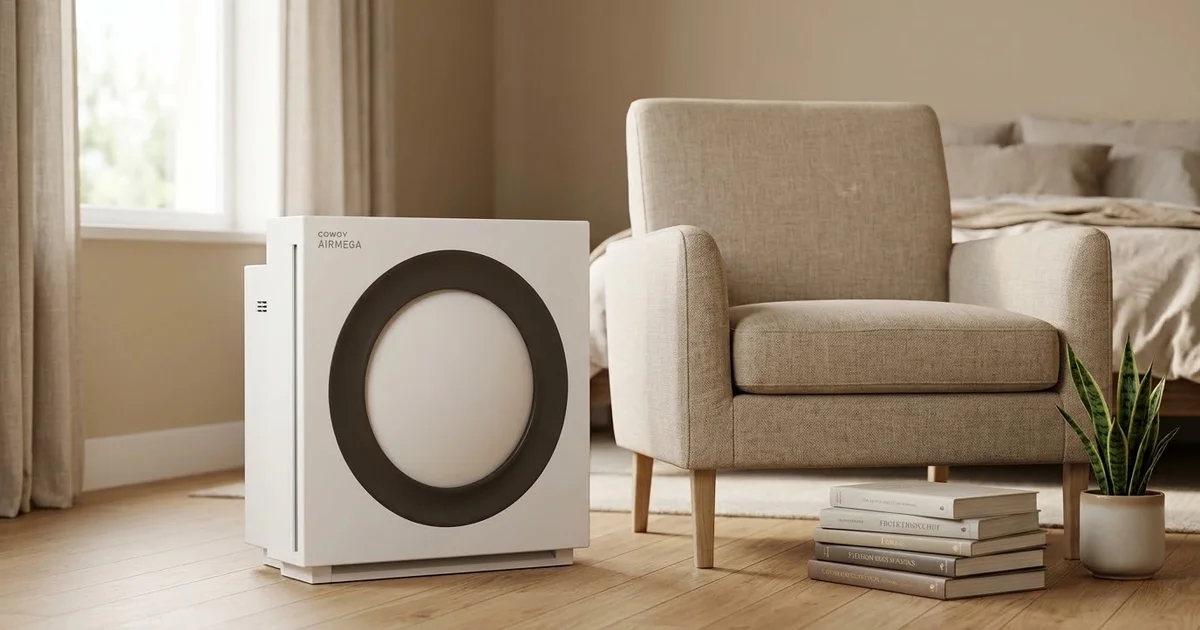
Coway Mighty2 vs AP-1512HH (2026)
Coway's Mighty2 replaced the AP-1512HH as Wirecutter's top pick. We compare CADR, noise, sensors, filter costs, and whether the older unit is still the smarter buy.
KNKA APH4000 Review: $150 Dark Horse
KNKA's APH4000 is one of Amazon's best-selling purifiers at $150. We check the AHAM certification, decode the 1,695 sq ft claim, and compare it to Levoit and Coway.
Levoit Core 300 vs 300-P: What Changed
Levoit quietly replaced the Core 300 with the Core 300-P. We explain the AHAM certification, whether filters still fit, and which one you should actually buy.
Shark NeverChange HP302 Review
Shark's NeverChange HP302 promises 5 years on one filter. We dig into the real running costs, the odor neutralizer catch, and whether it beats cheaper rivals.
Winix 5510 vs 5500-2: 2026 Verdict
The Winix 5500-2 is discontinued and the 5510 takes over. We compare CADR, noise, filter costs, and the one compatibility problem nobody mentions.
🛒 Products Mentioned
As an Amazon Associate, we earn from qualifying purchases.
Covers indoor air quality science, respiratory health, allergy management, and wildfire smoke protection.
View all articles by Sarah →